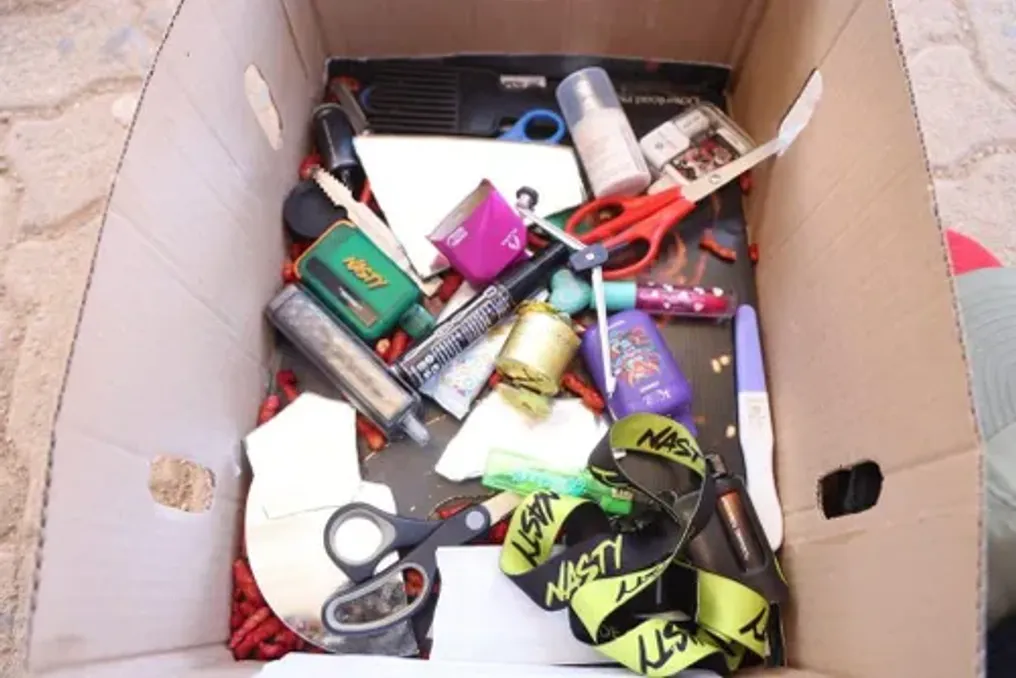
The Gauteng Department of Education stated that it has not introduced a policy prohibiting the use of scissors, compasses, dividers, or other ordinary stationery in educational institutions.
This clarification followed search and seizure operations conducted in six schools, during which 123 items were found to be prohibited or unsafe. Among the seized items were 43 disposable vapes, 29 pairs of scissors, four knives, ten mirror shards, five boxes of matches, 30 items containing suspected drugs, one suspicious 'space cookie', and one mathematical instrument.
The Department reported that these operations were carried out under the direction of Deputy Minister of Education Lebogang Mabile, in collaboration with the police and other law enforcement agencies. The goal of these measures was to remove drugs, dangerous weapons, and other prohibited items from schools.
After photos of the seized items appeared online, questions arose as to why educational equipment such as scissors and mathematical instruments were included in the list. A representative of the Gauteng Department of Education, Onwabile Lublevana, explained that ordinary learning materials are not automatically banned.
He emphasized that according to the South African Schools Act, items necessary for legitimate educational purposes can be authorized and used. However, he added that an ordinary item may be considered dangerous depending on how it was modified, who possessed it, or under what circumstances it was found.
Lublevana noted that some of the seized scissors were allegedly modified or used in a way that made them dangerous. Others bore traces of suspected dagga, indicating possible use for cutting cannabis rather than paper. He also mentioned that some items were deemed unsafe by the South African Police Service due to their condition and the circumstances of their discovery.
When asked whether a new ban on scissors or mathematical instruments had been introduced, Lublevana categorically answered no, stating: 'No. Scissors, compasses, dividers, and other legal learning materials are not automatically banned. This is not a new Gauteng policy banning scissors or mathematical instruments.'
The Department informed that students will continue to use scissors and mathematical instruments for subjects such as mathematics, technology, and art, while schools may monitor their use if necessary. The Department could not provide statistics on cases where scissors, compasses, or other stationery were used as weapons, as it did not have a 'verified consolidated figure' classifying such incidents.
He also clarified that the 123 seized items cannot be interpreted as all being drugs or dangerous weapons. Lublevana explained that some were suspicious substances or posed a clear safety risk, while others were ordinary items seized due to their condition, modification, alleged misuse, or the circumstances under which they were found by the SAPS.
The operations, according to the department, aimed to create a safer learning environment while protecting the right of students to education. Candidate lawyer Jonathan West noted that learning materials can be part of the resources necessary for students to exercise their right to basic education, and stressed that the key issue is the justification of confiscations and searches in the context of a real security threat.
Education activist Hendrik Macaneta stated that ordinary items should not automatically be considered dangerous, insisting that the context of the finding, including modification, misuse, or the presence of a real safety risk, is decisive.
The Gauteng Department of Education reiterated that the purpose of the operations was not to target legitimate learning materials; the focus was on drugs, dangerous weapons, and ordinary items that were modified or used in a manner that threatened school safety.
In conclusion, the Gauteng Department of Education confirmed that the seizure of scissors and mathematical instruments during raids does not imply a ban on ordinary learning materials, thereby questioning the boundary between legitimate educational aids and objects that pose a threat to school safety.