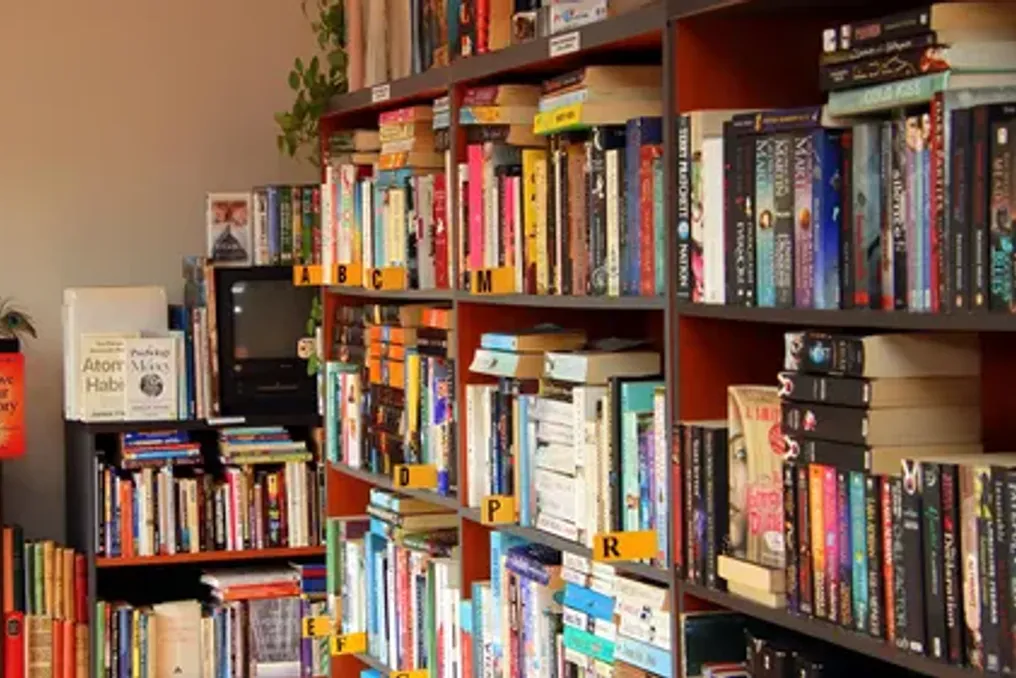
Books possess a unique ability to transport the reader to times and worlds that exist only in the realm of imagination. For millennia, millions of people were deprived of the opportunity to enjoy reading. The feeling of holding a physical book, the smell of the pages, and the ability to immerse oneself in another world for a time remains indescribable.
Even more valuable are used editions, which carry a rich history emanating from the page itself. The scent of paper, the thickness of pages in old books, or a note from a relative or friend gives them special value. There is a hope that the previous owner valued the book enough to pass it on.
As the owner of a small bookstore specializing in rare finds, I value when books pass through different hands, opening up possibilities for amazing discoveries. These can be a first edition with illustrations by Thomas Pringle, a signed copy of Anne Frank's book, or a very old edition of an Afrikaans dictionary. I have seen such specimens, including the first edition of 'Angela's Ashes,' and my joy comes when they leave the shop again in the hands of someone who experienced delight upon finding them.
Flipping Through Pages
Reading differs from listening to a narrator because the reader has complete control over the process. They form the images and voices themselves. One can stop, reread a passage, speed up, or spend six hours in a non-existent place to return to the same imaginary world the next day. This experience is deeply personal.
Reading for pleasure only became a recognized cultural phenomenon in the 18th century, when the novel flourished thanks to works by Defoe's 'Robinson Crusoe' (1719), Richardson's 'Pamela' (1740), Fielding, and Sterne. After this, libraries with book exchanges appeared, allowing people to read expensive books without owning them.
The 19th century was marked by a boom: industrial printing, cheap paper, railways, rising literacy, and the appearance of public libraries made books accessible to ordinary citizens. By the mid to late 19th century, reading had become a full-fledged competition for people's free time. Dickens serves as a prime example, as readers awaited new parts of his novels just as viewers await a series. However, Dickens did not invent imaginative escape; he became part of the moment when it became available to millions, not just thousands.
Nevertheless, this entire flourishing of accessible reading had one starting point—Johannes Gutenberg, who began experimenting with movable type in Europe in the 1440s. His printing press was initially used for more serious works, primarily the Bible, but the same technology was later applied to less solemn purposes. It allowed stories to reach more hands, reduced the cost of books, and transformed reading from a privilege of the wealthy, clergy, and educated into an activity accessible to millions simply because they desired it.
Despite this, five centuries after Gutenberg, 739 million adults aged 15 and over still lack basic literacy skills, accounting for one in nine people worldwide, according to UNESCO data. Nearly two-thirds of them are women, and 40% of children do not reach the minimum reading level. UNESCO estimates that 739 million adults aged 15 and over still lack basic literacy skills.
The Rise of Dolly
This is why people like Dolly Parton are heroes. She continued the democratization started by Gutenberg by providing hundreds of millions of books. Her 'Imagination Library' mails out over three million books monthly to registered children over the past 30 years.
In 1995, inspired by her father, Robert Lee Parton, who could neither read nor write, she launched the 'Imagination Library' in her Sevier County, Tennessee. Her concept was simple and uncontroversial: she wanted every registered child to receive a free, age-appropriate book in the mail every month from birth to age five, regardless of family income.
The first order consisted of only 1,760 books, but the program expanded across the United States, and then internationally to Canada, the UK, Australia, and Ireland. Parton once called this program one of her proudest achievements, and rightly so. She gave millions of children something her father never had—a home where books simply belonged.
Gutenberg gave the world the means, and Dolly Parton gave millions of children a chance. Now it is our turn. Pick up a book. Pass it on. Give it to a child who never had one. A love for reading is not just a personal pleasure, but a collective responsibility, and any of us can become someone's 'Imagination Library.'