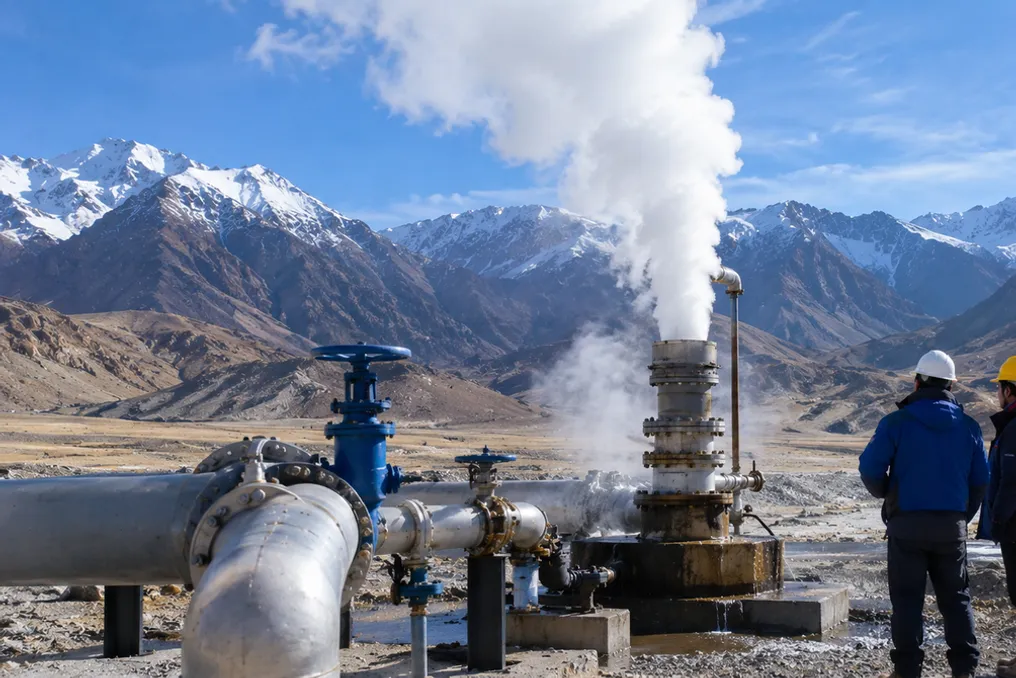
In the Puga valley in Ladakh, situated at an altitude of over 14,000 feet above sea level, a project is being implemented that could change India's approach to renewable energy sources.
In July 2026, Deputy Governor V. K. Saxena inaugurated two geothermal wells, 1000 meters deep, in Puga. These wells were drilled by the ONGC Energy Centre and are part of a 1 MW geothermal energy pilot project, which is expected to become the first geothermal demonstration project in India.
At a depth of just 400 meters, the wells recorded temperatures up to 135 degrees Celsius, and further tests are ongoing. The project is developing in one of the country's most challenging terrains, where extreme weather conditions and a short working season create unique difficulties for drilling.
However, the use of heat beneath the ground is not limited only to electricity generation.
According to the Ministry of New and Renewable Energy, India's theoretical geothermal potential is estimated at approximately 10 GW. Unlike solar and wind energy, geothermal energy can continuously provide heat and electricity, independent of sunlight or wind conditions.
There are five main areas in which India can utilize this natural heat:
1. Heating Residential and Public Buildings
Maintaining warmth in homes in cold regions requires significant energy expenditure. Geothermal heat can offer an alternative method. Hot water from underground reservoirs can be brought to the surface and used directly for heating. Furthermore, geothermal systems can provide both heating and cooling through heat pumps.
This is particularly relevant for places like Ladakh, where winters are harsh, and heating is a vital part of daily life. The International Renewable Energy Agency includes district heating systems and geothermal heat pumps as established direct applications of geothermal energy. Utilizing accessible underground heat for buildings can reduce heating energy consumption in a region striving to decrease dependence on traditional fuels.
2. Growing Vegetables in Greenhouses
Agricultural regions in India with cold and high-altitude climates face a problem: the land may be suitable for growing certain crops, but the weather hinders cultivation for much of the year. Geothermal heat can change this situation. Heat from underground reservoirs can maintain the necessary temperature in greenhouses, allowing farmers to harvest when external conditions are too cold.
The Food and Agriculture Organization emphasized that geothermal greenhouse heating is a way to reduce fuel costs and create opportunities for agricultural production. Studies cited by this organization have also shown that geothermal greenhouse heating can reduce fungal infections. For India, this may be relevant not only in Ladakh but also in other regions where geothermal resources coincide with cold climates and protected agriculture.
3. Drying Crops and Reducing Food Waste
Heat is needed even after the harvest leaves the farm. Drying fruits, vegetables, grains, and other agricultural products is an important way to extend shelf life. However, farmers and food processors usually rely on traditional fuels to generate the required heat. Geothermal heat can provide an alternative where suitable resources exist.
FAO has identified crop drying as one of the possible agricultural applications of geothermal energy, while IRENA notes that geothermal heat can be used to dry products in the agri-food sector. For a country where reducing post-harvest losses remains a priority, using local geothermal heat for drying can very practically link renewable energy with agriculture.
4. Supporting Heat-Dependent Industries
Not all uses of energy require electricity. Many industries need heat directly for processes such as drying, washing, pasteurization, and other forms of processing. Where geothermal water is sufficiently hot, it can potentially supply some of this heat without first being converted into electricity. This is already practiced in other parts of the world. IRENA documents the use of geothermal heat for applications such as milk pasteurization, laundry, and agricultural processing. For India, this opens up the possibility of looking beyond just geothermal power plants. A geothermal well can potentially supply useful heat to neighboring enterprises, depending on the temperature and characteristics of the resource.
5. Continuous Electricity Generation
Finally, this is the application being tested in the Puga valley. Geothermal reservoirs can contain hot water or steam deep underground. Wells allow this heat to be brought to the surface for electricity generation. The advantage is that geothermal energy is less dependent on weather conditions than solar and wind. This makes it particularly interesting for areas where reliable power supply is difficult or where renewable sources must complement each other.
In Puga, the two wells will help assess the reservoir and plan the proposed 1 MW pilot project. If the project proves successful, it could provide valuable information for the development of geothermal resources in other parts of India. India's geothermal resources are distributed across several regions, and the Department of Science and Technology's vision for 2025 specifically designated areas such as Ladakh, the Sonar Namada Tapi belt, and the hot spring regions of Western India for geothermal energy study.
Currently, Puga is an experiment. But the significance of this project extends beyond two wells in a remote Himalayan valley. It is a chance to understand whether India can better utilize an energy source located beneath its soil. And if the answer is positive, the future of geothermal energy in India may not be limited to electricity production; it may also help in home heating, food cultivation, crop drying, and industrial powering, bringing the country closer to clean energy.