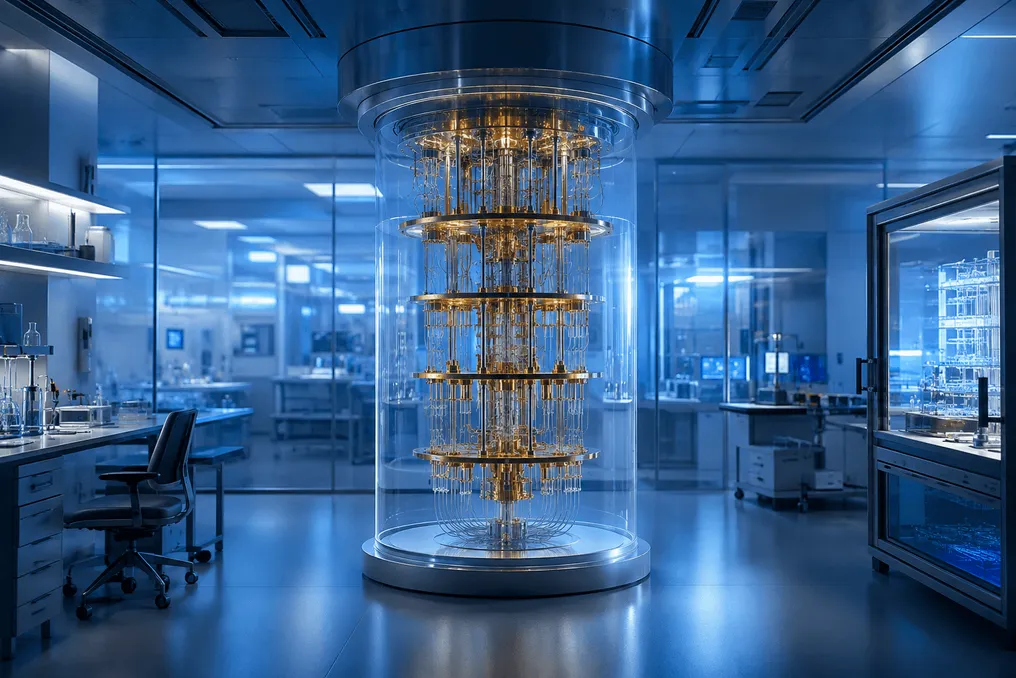
Researchers working on the third generation of the Origin Wukong superconducting quantum computer in China reported in early September the creation of a coherent quantum routing system designed for bucket-style quantum random-access memory.
On actual hardware in Hefei, one quantum router achieved an information transfer efficiency of about 98%, and a two-layer cascaded network demonstrated an efficiency level of approximately 93%. During random access tests, the average fidelity for a single router was 94.8%, and for the two-layer network—82.4%.
This work, involving Origin Quantum in collaboration with the University of Science and Technology of China and other partners, was published in Physical Review X.
Quantum RAM must provide data routing for addresses that are in a superposition state, rather than sequentially through one bucket at a time. Standard decomposition into digital gates makes the routing process deep and fragile as the number of nodes increases, which enhances decoherence. The team in Hefei instead uses auxiliary energy levels in superconducting devices as temporary intermediate states.
Microwave pulses lift the information to higher levels for directed transmission and then return it to computational states, which is more akin to building an overpass than placing traffic lights at a planar intersection.
Address bits are encoded in non-adjacent three-level states, allowing small control errors to be detected and filtered via post-selection, without the need to add heavy additional error correction qubits.
The experimenters built three independent routers on the Wukong chip and connected them into a two-layer network, thus testing cascaded transmissions rather than an isolated block, as was only possible in simulation.
The researchers emphasize that the 98% figure does not mean commercial QRAM readiness. Scaling up to networks of four or eight layers still faces challenges related to microwave crosstalk, cryogenic stability, and integration cost. However, they highlight the achievement of a systemic function on real hardware: coherent, reversible, addressable routing without infinite gate depth, shifting the focus from qubit count competitions to creating usable memory infrastructure.
If we consider quantum computers as factories, memory and routing act as warehouses and highways. The result from Origin Wukong does not complete the roadmap, but it provides a measurable off-ramp onto the highway for quantum data movement, which previously seemed like a dead end, and it does so on a domestic superconducting platform, not a software mockup.