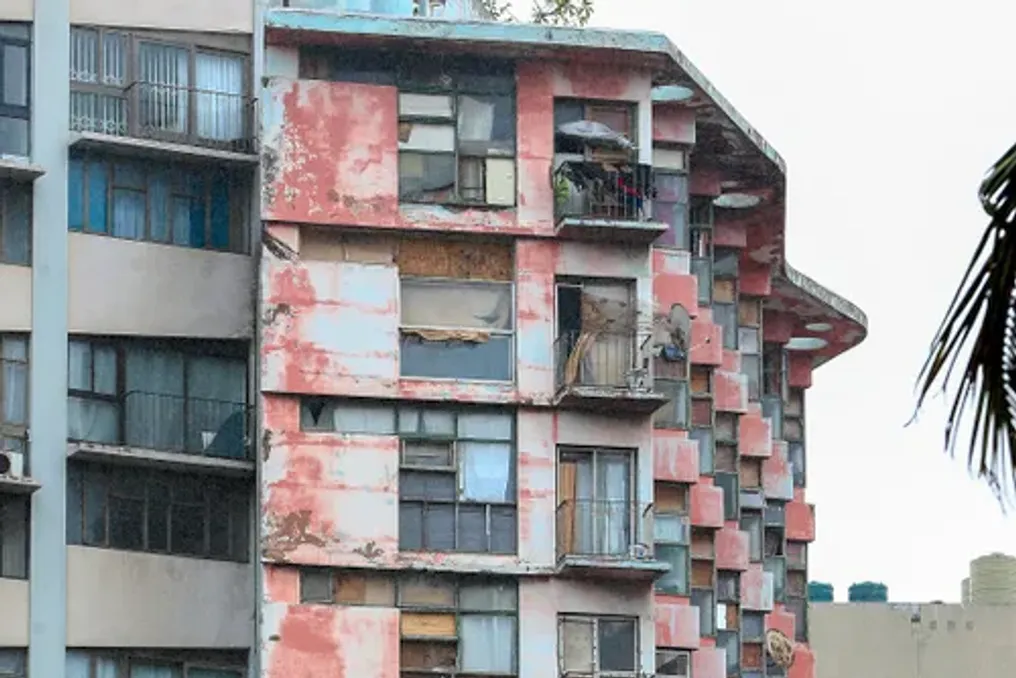
Seized buildings expose a deep crisis in housing and law enforcement in South Africa. These properties have long symbolized the housing crisis, urban decay, and weak control, a problem prevalent in major cities and provinces.
In places like Johannesburg, Cape Town, and eThekwini, buildings intended for residential or commercial use are illegally occupied. Vulnerable residents are sometimes forced to pay rent to individuals who have no legal right to collect these funds.
However, behind the illegal occupation lies a more serious issue: many residents have no other place to live. Overcrowding, illegal connections to power grids, poor sanitary conditions, unsafe structures, and neglected infrastructure pose serious threats to inhabitants and surrounding communities. Simultaneously, authorities warn that some buildings have become vulnerable to drug trafficking, organized crime, and exploitation.
The destructive nature of these conditions was starkly demonstrated by the fire at the Usindiso building in Johannesburg in 2023, which claimed 76 lives and attracted increased national attention.
The scale of state efforts to reclaim property appears highly complex. Following the Usindiso building fire, which killed 76 people and injured 88 residents, victims held a memorial event. On August 31, 2023, fire engulfed an illegally occupied, state-owned building in Johannesburg.
On August 27, the Portfolio Committee on Public Works and Infrastructure reported that under the 'Operation Bring Back' program, 1,285 potential properties for recovery were identified as being illegally occupied or transferred. However, only 20 properties were successfully returned to the Department of Public Works and Infrastructure.
The Department informed the committee that a total of 237 million rand was spent on appointing four service providers. These services were responsible for identification, auditing, analysis, evicting residents, and recovering illegally occupied or seized properties. The committee expressed concern over the pace of property recovery and warned that disputes over payments to service providers could jeopardize the program, which has been running for about ten years.
Public safety activist Kholani Humalo emphasized that the consequences of buildings falling outside effective control are not abstract figures. He worked directly in seized buildings, including operations against drug activity, and stated that the spread of such properties has reached a critical level. In one instance, he mentioned children ranging from seven years old to newborns living in a Johannesburg city center building without water or electricity. Humalo noted that there was a large structural opening on the upper floors, posing a danger of falling from the fourth floor into the basement, which was filled with human waste and used for hiding drugs.
Humalo also raised issues of alleged corruption related to property ownership and stated that decisive political will is necessary to resettle residents. He called on the City of Johannesburg to conduct targeted urban renewal while simultaneously addressing the housing deficit problem.
The Chairperson of the Gauteng Portfolio Committee on Public Safety, Dr. Bandile Masuku, described seized and illegally occupied buildings as a serious problem for law enforcement and public safety. According to him, such buildings can create conditions conducive to crime, exploitation, overcrowding, and other public safety risks. He stressed that this is not just a housing issue but also one of law enforcement and governance, requiring a coordinated response. Masuku listed problems including overcrowding, illegal electricity connections, fire hazards, blocked emergency exits, poor sanitation, unsafe structures, and the exploitation of vulnerable people. He reminded that the Usindiso fire remains a 'painful reminder of the devastating consequences of poorly regulated and overcrowded buildings' and called for joint action by municipalities, law enforcement agencies, emergency services, as well as provincial and national departments, including creating a comprehensive database of seized buildings and combating criminal networks.
Anrux Maryes, a member of the executive committee for police and public safety in the Western Cape, noted that poorly managed or illegally occupied properties can become targets for organized criminal activity. She stated that any issues affecting public safety and facilitating crime are important to the Western Cape Police and Public Safety Department. Maryes also mentioned concerns about extortion, drug activity, and other forms of crime that can take root where property control is limited. Nevertheless, she acknowledged that law enforcement is complicated by property disputes, legal processes, and the need to protect vulnerable residents, noting that an effective solution requires more than just a police response.
This viewpoint is central to the arguments of housing activists. Yusrah Bardien, a communications and engagement officer at Ndifuna Ukwazi, noted that not every occupied building should be viewed as a criminal enterprise. She distinguishes between buildings controlled by criminal syndicates for profit and occupations driven by a lack of affordable housing. Criminal seizure, in her words, implies that 'exploitative criminal syndicates' take control of properties to extract wealth from poor residents. However, she pointed out that occupations, such as Cissie Gool House, Ahmed Kathrada House, and Irene Grootboom House, are different. Bardien stated that 'these occupations are not run by criminals. Instead, they are governed by steering committees and internal committees.' She concluded that the crisis of occupied buildings in Cape Town reflects a systemic failure spanning over thirty years and is linked to a housing shortage affecting approximately 365,000 households. Bardien argued that the answer cannot simply be eviction, especially if residents had no option to find affordable housing. From a spatial justice perspective, governments must change their approach, moving from reactive evictions to proactive urban reform. She also suggested that some occupied buildings could be modernized to meet affordable housing standards without demolition or relocation.
In the KwaZulu-Natal province, the eThekwini municipality describes seized and illegally occupied buildings as one of the most complex challenges in public safety and urban management. Municipal representative Senzelwe Mzila reported that the risks extend beyond the physical condition of the buildings. He explained that besides visible threats related to dilapidation and structural insecurity, fire and electrical non-compliance, poor ventilation, and drainage, these properties are often used by criminal elements who interfere with utility infrastructure and obstruct legitimate law enforcement actions. However, law enforcement is hampered by the legal framework. Mzila noted that national legislation, particularly the PIE Act governing evictions and the Heritage Act aimed at protecting legal rights, significantly slows down the enforcement process in practice. The municipality also mentioned that untraceable owners and buildings linked to inheritance cases can cause further delays. The municipality stated that it uses its repair and restoration program to carry out remedial work, subsequently recovering costs from property owners, and collaborates with other government structures to address these issues.