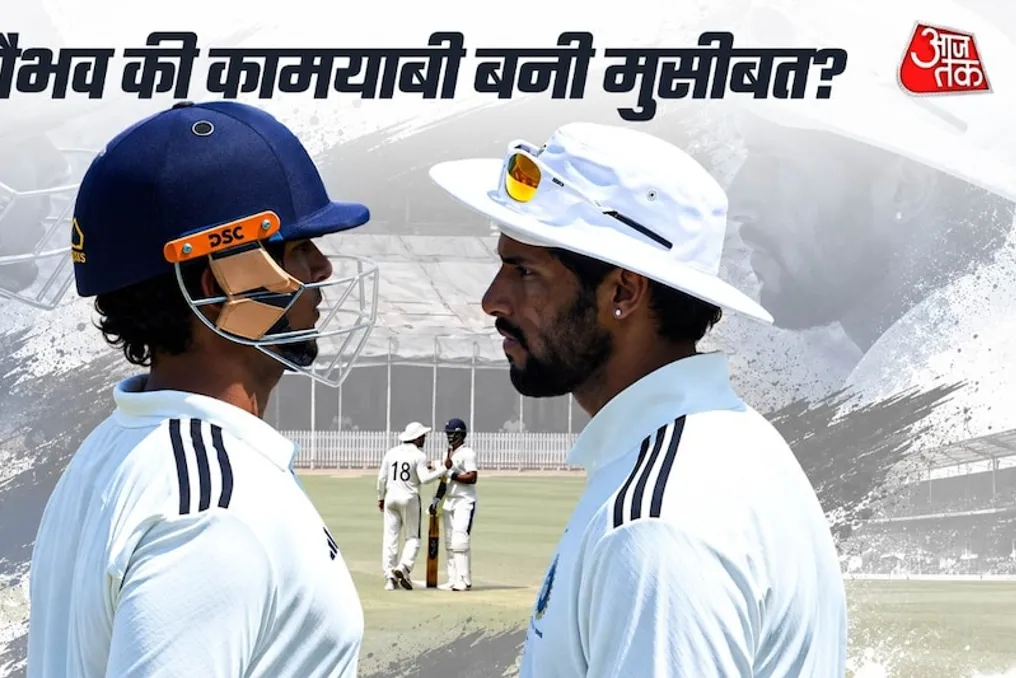
A player's age ceases to matter to opponents when a 15-year-old athlete starts hitting the ball in all directions, much like bowler Mohammed Siraj. The story of the escalation between Tilak Verma and Vaibhav Suryavanshi during the Dalip Trophy final in Chennai reflects this changing landscape. The main question is not just what happened between them, but whether Vaibhav's rapidly growing success has become a challenge for more experienced players.
Vaibhav's journey has undergone a radical transformation. A player who was recently called a 'kid' or 'child' in the cricket world is now a vice-captain among the senior home players. His explosive performance in the Indian Premier League before the Dalip Trophy helped him gain individual recognition. This batsman, who attacked senior bowlers at the age of 15, has stopped being just a future star; he has become a problem for rivals in current matches.
After scoring 92 and 40 runs in the Dalip Trophy semi-final, Vaibhav continued to play in the same style in the final. Now, stopping him requires not only a tactical field plan but also psychological pressure.
During the East Zone team's match in the final, Vaibhav and Abhimanyu Ishwar contributed quickly, forming a stoic partnership. Vaibhav continued to fearlessly attack senior bowlers. At this moment, the South Zone captain, Tilak Verma, began to tease Vaibhav, stating in the 11th over: 'What is this, this vice-captain.'
The discussion between them intensified, and Tilak approached Vaibhav, making a gesture resembling a 'punch'. Instead of backing down, Vaibhav stood his ground. As the situation began to deteriorate, the umpire had to intervene and separate them. Although this incident lasted only a few seconds, it raised an important question: has Vaibhav become such a serious headache for opponents that his age is being used against him?
In cricket, success brings not only praise; it also brings expectations, pressure, and increased attention from the opposing team. When a young player constantly attracts attention, opponents do not view him as an ordinary batsman. They devise special fielding setups, bowling strategies, and sometimes engage in psychological games.
This is exactly the change happening with Vaibhav. He is no longer the batsman who can be underestimated because of his 15 years of age. On the field, his identity is shaped not by his age, but by his bat.
The attack on Siraj demonstrates how much Vaibhav has changed. In the final, he adopted an aggressive stance from the beginning. There was no hesitation in his shots against senior fast bowlers. In 37 balls, he scored 44 runs, including 5 fours and one six. Vaibhav proved once again that big names and strong bowlers do not hinder his game.
However, in this match, an old story repeated itself: the start was brilliant but failed to turn into a big innings. An extra nudge off a short ball caused his bat to miss, and he was caught over the top.
Thus, Vaibhav now has to deal not only with the psychological game of his opponents but also with the task of controlling his aggressive play.
It would be premature to claim that Tilak's behavior was the result of 'jealousy' or personal issues. Taunts are an old part of cricket on the field, and players sometimes provoke each other in the heat of competition. Nevertheless, this incident revealed an interesting shift. Opponents are no longer going to leave Vaibhav aside, considering him a 'child'. His rapidly growing popularity and fearless batting have made him a player whom they can try to put under pressure.
This is the real next stage of a young player's success. The biggest challenge for Vaibhav is not that someone older confronted or teased him. The real test is how he will cope in such circumstances. Scores of 92, 40, and 44 show that he has no shortage of scoring ability. The next step is to turn these initial successes into big innings.
As his status grows, the pressure from opponents will also increase. There will be taunts, fielding plans will change, and bowlers will look for his weaknesses. Now he must respond with his bat.
It is easy to dismiss the incident with Tilak Verma as a minor quarrel between two players. But in Vaibhav's story, this is definitely a signal. This 15-year-old batsman is reaching a point where opponents see his potential, not his age. Previously, the question was: 'Why give a chance to such a small child?'. Today, the question has changed: 'How to stop him? And perhaps this is the rapidly growing success of Vaibhav.'