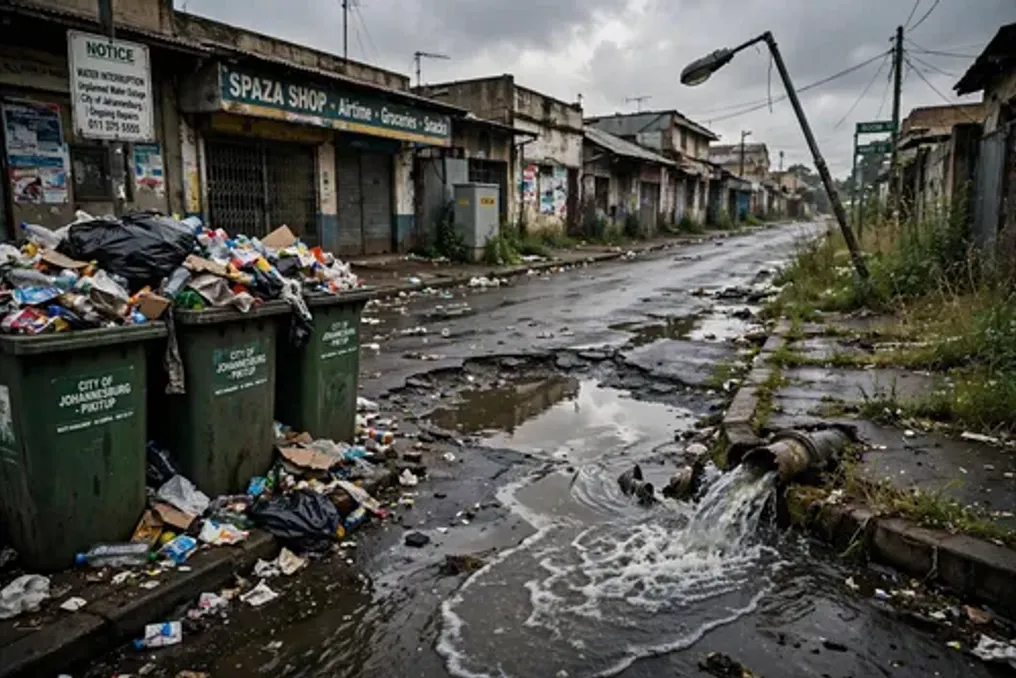
In a society where laughter often overshadows serious national problems, South Africans are asking themselves: has comedy become our silent accomplice in political stagnation? In South Africa, the art of humor has transformed into an excuse for inaction in the face of systemic failures.
We have become a nation of comedy lovers, not comedians ourselves. This distinction is important because it defines us as dependents, not disseminators. We pay good money for a dose, sitting in packed theaters from Sandton to Strand, waiting for a witty clown to help us laugh at the exact moment the power goes out.
This is not metaphorical. The electricity actually goes out. Water stops flowing. Pits swallow cars whole. A child born in Alexandra or Khayelitsha in 2026 will likely never experience reliable power supply. The infrastructure is so ruined that repair seems almost antiquated. And somewhere in the theater, a comedian mocks the power outages with surgical precision, and five hundred people burst into laughter.
This is the peculiar genius of modern South Africa. We have turned catastrophe into industrial entertainment. We have created an art form to avoid the hard work that could change something. It is truly an outstanding achievement. Most societies struggle to name their failures; we have turned the naming itself into a commodity.
As a child, I remember spiritual songs that arose on American cotton fields. These songs were born from genuine suffering. They carried prayer and defiance. They united communities through systemic humiliation. When slaves sang, they were not trying to drown out despair; they were challenging it. The song was a form of resistance, not capitulation.
Our laughter does not carry such significance. It demands nothing. A comedian on stage in Cape Town directly mocks government incompetence, and the audience explodes. Everyone goes home. Everyone returns to the same pits. To the same smell of a burst sewage pipe running in the street for six months. To the same destroyed water infrastructure. To the same institutions slowly suffocating while we watch and giggle.
This is not catharsis. Catharsis requires transformation. What we have built instead is sedation cloaked in the language of social commentary. We have found a way to feel brilliant about our own decline. We confuse naming the problem with solving it.
A culture that learns to laugh at its corruption soon learns to live with it. A government that hears this laughter understands that it can do much more. We become experts at this trick. We joke about ANC dysfunction. We joke about cadre deployment, state capture, and industrial looting of public funds. We release special episodes for Netflix. We post biting threads on X. We demonstrate our anger with great wit. And then the power goes out again, and we laugh once more. Essentially, the same joke, but with a fresh rhythm.
Experience has taught me that the strength of culture lies not in what it prohibits, but in what it tolerates without serious consequences. South Africa tolerates corruption with astonishing calm, provided the perpetrators are amusing enough. Zuma. Dlamini-Zuma. Mamelodi. Naledi. McKenzie, and let's not forget the boss. Not Bruce Springsteen—Fikile Mbalulu, the ANC boss. They become characters in national comedy. The actual destruction of our institutions becomes a secondary plot point. Almost incidental.
The numbers, if anyone bothers to read them, are grim. Power outages cost the economy approximately fifty billion rand annually. This is not a joke. Water outages in major cities affect millions of people. That is not a punchline either. Unemployment exceeds thirty percent. Youth unemployment in some regions approaches sixty percent. These are not gags for a comedy club.
Yet, somehow, we have convinced ourselves that comedic timing is a substitute for political courage. What if we laugh loudly enough, we can immunize ourselves against the actual failure surrounding us. The country is burning. We sit in the light and warm our hands.
What distinguishes a functioning society from a collapsing one is not whether its failures can be named. It is whether those failures are allowed to persist after they have been named. We have built entire reputations on the ability to mock people who loot the South African treasury, neglect our infrastructure, provide poor services, and then give us the middle finger. We praise these mad clowns who mock our leaders. We watch their specials. We quote them at dinner parties. And nothing changes. The game continues. The building collapses. Their shows, always sold out, prove our appetite for diagnosis, not cure.
These comedy shows often lead nowhere. The joke hits the mark. It dies. It evaporates. A joke about the Ministry of Health's incompetence does not lead to the dismissal of incompetent officials. A sketch about a power outage does not lead to serious investment in alternative energy. Laughter creates the illusion of involvement without any real inconvenience of change. What should provoke revolution provokes applause.
The irony is that across the Atlantic, those who hold real power have begun to resist. When wealth or status is genuinely challenged, the reaction is not laughter, but lawsuits. Threatened litigation. Cease and desist letters. The implied message is clear: you can mock, but only to a certain extent. Only when it is harmless. Only when it is safe.
What begins as freedom of speech becomes a privilege granted by grace, temporarily given and revocable by anyone with enough lawyers. South Africa has not yet reached this stage of thin-skinned authoritarianism. Our elites are not concerned enough to sue. They are not even concerned enough to deny the accusations. They ignore the mad clowns on stage, and we continue to applaud these comedians who articulate what no one with real power intends to discuss. In a sense, this is worse. It suggests that we have passed the stage where satire is even registered as a threat.
The tragedy is that we have the wit to see what is broken. We have the intelligence to name it. We have the eloquence to describe it with precision and humor. What we seem to lack is the will to fix it. Comedy has become our excuse for political paralysis. We use the nation's suffering to create humor and call it engagement.
Paradox is a weapon. When used correctly, it pierces pretense and exposes contradictions. But true wisdom requires observation to lead somewhere. For the argument to matter. For something to be demanded of us in return. Our comedy demands nothing. We can portray the incompetent so well, criticize them, insult them, and the crowd explodes. We laugh at the absurdity. We wait for the next Netflix special. We do nothing but consume more of the same comedic material. Continuing our own collapse.
This is where South African humor has left us. In a place where we are remarkably creative in naming our failures and remarkably passive in rectifying them. We have become a nation of critics where we should be a nation of builders. We have mastered the art of articulation and abandoned the ability to act.
The question is not whether we can laugh at what is broken. Obviously, we can. We do it masterfully. The question is whether laughter has replaced the harder work of actually fixing things. Has wit become anesthesia? Has comedy become complicity?
There is a place for humor in serious times. There is also a place to get up from the table and bring back something resembling dignity. The country cannot continue dancing around the collapse of its most basic institutions. At some point, the joke must end differently. At some point, laughter must give way to clarity. Clarity must call for something we have lost. Call it courage. Call it responsibility. Call it the ability to see that the house is truly burning and to act as if it matters.
Until then, we remain exactly what we have become. People quietly giggling while the roof quietly drips and then collapses over us. We have turned wit into a weapon. We have mistaken comedy for conviction. We have built a culture where naming the problem has replaced solving it.
The looting continues, the laughter continues. The building collapses. And we sit in the warmth of the dying fire, congratulating ourselves on how articulately we can describe the nature of our own downfall. We excel at diagnosis. We simply lack the will to cure the disease.
That is comedy. Not jokes. That is it.