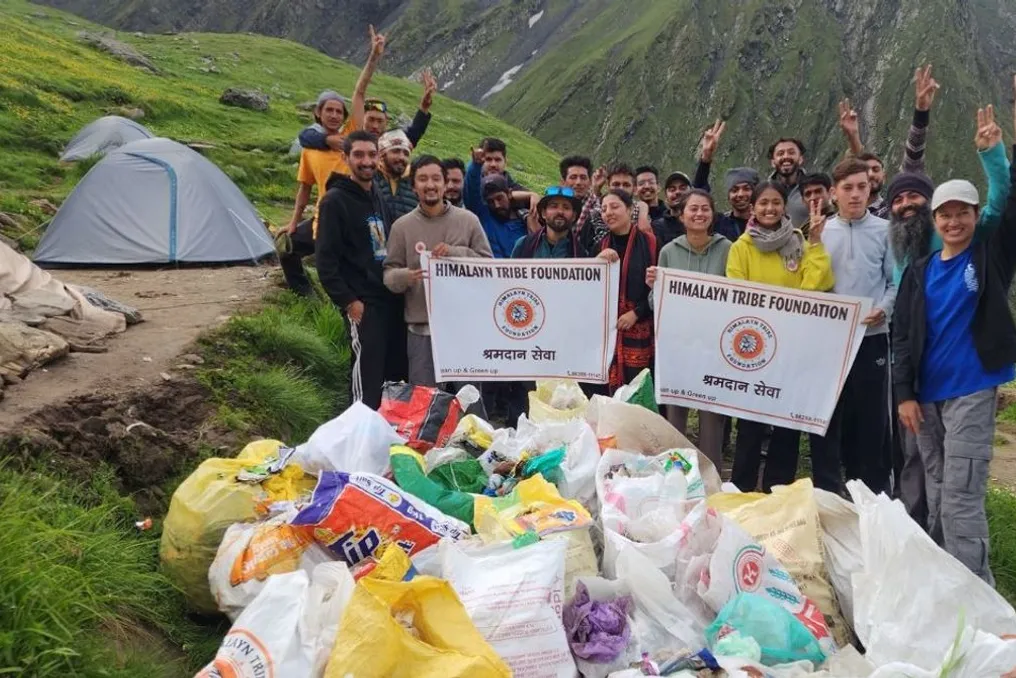
Every year, as pilgrims and tourists visit the high-altitude routes of Himachal Pradesh, the mountains absorb the burden of human presence. After the snow melts and festivals conclude, not only alpine meadows and sacred landscapes are discovered, but also discarded plastic, food wrappers, clothing, and abandoned gear, turning places of spiritual and ecological significance into unauthorized dumps.
As the number of visitors grows, the strain on these Himalayan ecosystems becomes increasingly heavy. For RP Negi Yullam, founder of the Himalayan Tribe Foundation, this problem became evident during his early trips to places like Shrikhand Mahadev and Kinnaur Kailash. He saw plastic buried under the snow, left offerings, and a lack of waste removal systems.
This raised the question: if people choose these places for pilgrimage and adventure, can they also participate in protecting these places? It is at the intersection of travel, faith, and environmental load that the Himalayan Tribe Foundation was established—a grassroots organization working to restore, protect, preserve, and reimagine how people move through the most sensitive pilgrimage and trekking corridors of the Indian Himalayas.
The Moment That Changed Everything
RP Negi Yullam notes: "The Himalayan Tribe Foundation should have existed because the Himalayas were silently paying the price for worship and adventure." He recalls his first visits to Shrikhand Mahadev and Kinnaur Kailash, where he saw plastic under the snow, left offerings, and no mechanism for waste removal. This moment showed that authorities alone are insufficient to protect such remote areas, and those who walk these sacred and fragile routes must also take responsibility.
The increase in pilgrims and tourists has led to the accumulation of waste that fragile ecosystems cannot handle. These trails hold not only ecological value but also deep cultural and spiritual significance for local communities. For RP Negi, this made involving the people passing through these landscapes particularly important.
He explains: "People who hike or go on pilgrimage interact directly with the ecosystem. When nature conservation is carried out by those walking these trails, the connection becomes personal, not preachy." He adds that even a small wrapper can remain for decades at high altitudes, and when travelers participate in cleanups, they are not just removing trash—they are returning home with a new awareness. This change in behavior is the strongest form of nature conservation.
Instead of asking people to care, the foundation involves them. The Himalayan Tribe Foundation is a grassroots organization working in Himachal Pradesh to address issues of environmental degradation, improper waste disposal, and community well-being along ecologically sensitive pilgrimage and trekking routes. Its approach is based on local participation. Instead of presenting nature conservation as an external intervention, the foundation encourages tourists and pilgrims to participate as volunteers, creating a shared sense of responsibility.
Over the last three years, Sujal Chauhan, a core team member of the foundation, has participated in almost all its cleanup drives on high-altitude pilgrimage and trekking routes. The foundation operates on several high-altitude and culturally significant routes in Himachal Pradesh. Major drives are conducted in Shrikhand Mahadev, Kinnaur Kailash, Yula Kanda, and Rani Kanda. The foundation has also worked in the Bhimakali temple area, Sarahan Bushar, and nearby villages. In addition to cleanups, the foundation engages in solid waste management initiatives in Rampur Bushar, tree planting, heritage restoration, and winter aid, including distributing clothes to local communities. Over the years, the foundation claims to have removed more than 500 tons of trash from Himalayan trekking and pilgrimage routes. Eight major cleanup drives are held annually on various high-altitude routes, including Kinnaur Kailash twice a year, Yula Kanda twice a year, Rani Kanda once a year, Baba Pass once a year, Shrikhand Mahadev twice a year, and Manimahesh once a year. Each drive typically attracts 15–20 volunteers, supported by two groups of NGO permanent members who coordinate and conduct the campaigns. The work goes beyond physical waste removal: the foundation also runs environmental awareness campaigns among pilgrims, tourists, local communities, and visitors, urging them to consider what they bring to these fragile landscapes and what they leave behind.
In recent years, the foundation has begun collaborating with government bodies and local administrations to expand the scope of its activities, marking a transition from informal actions to structured long-term environmental management.
The Burden Falls on Them
However, cleanup is far from easy. At high altitudes, there are no roads, bins, or transport vehicles for waste removal. Volunteers have to collect, sort, and carry it down themselves. Sujal says: "A cleanup drive begins several days before the trek with planning, obtaining permits, and briefing volunteers." On the trail, they move slowly, collecting trash, adapting to the altitude, weather, and terrain. Every item is sorted and carried manually, often on the back, especially from routes like Shrikhand Mahadev, which is 35 kilometers one way.
At these altitudes, even basic tasks can be physically demanding. Sujal explains: "The hardest part is the logistics. There are no roads, bins, or transport at high altitudes. Even on difficult treks, volunteers carry heavy waste." He adds that the weather can change suddenly at high altitudes, oxygen levels drop, and safety is always a concern. Furthermore, managing mixed waste, such as plastic, glass, and religious offerings, is a complex process. People see the final cleanup photos but do not see the physical exhaustion and planning behind them.
When Pilgrimage Turns into a Cleanup Mission
For some volunteers, this experience changes their view of the mountains themselves. For Bhuvana Malik from Kota, Rajasthan, volunteering felt like repaying a debt to a place that gave him so much. He shares: "The Himalayas offer peace, adventure, and spirituality, but they are also suffering silently." Joining a cleanup drive transformed the journey from consumption to contribution. Instead of just taking pictures, they became part of the solution. This made the experience more meaningful and humble.
What he witnessed during one of the cleanups made him realize the scale of the problem. "Discovering plastic bottles and shoes near glaciers and sacred sites was shocking. In Shrikhand Mahadev, the sacred Parvati Kund was full of clothing, such as underwear, thrown in a corner. Many other sacred sites have the same problem." Seeing trash frozen in the ice at extreme altitudes made volunteers understand how permanent their impact can be. Bhuvana says: "Carrying this trash ourselves changed the way we travel forever. Now we consciously pack things, avoid single-use items, and urge others to do the same. The mountains taught us to be responsible." For the foundation, this behavioral change is as important as the collected trash.
Local Residents Also Join In
The changes are not limited to tourists and pilgrims. The foundation reports that the reaction of local communities is also changing. Anchal Negi, a local community resident from Kinnaur, recalls that initially, locals were skeptical of the cleanup drives. "Initially, many local residents were skeptical, and cleanups were seen as temporary efforts," she says. However, repeated efforts gradually changed this attitude. "Now residents report hot spots of trash to us and sometimes join the drives themselves. In places like Sarahan and local villages, participation is growing, especially among the youth."