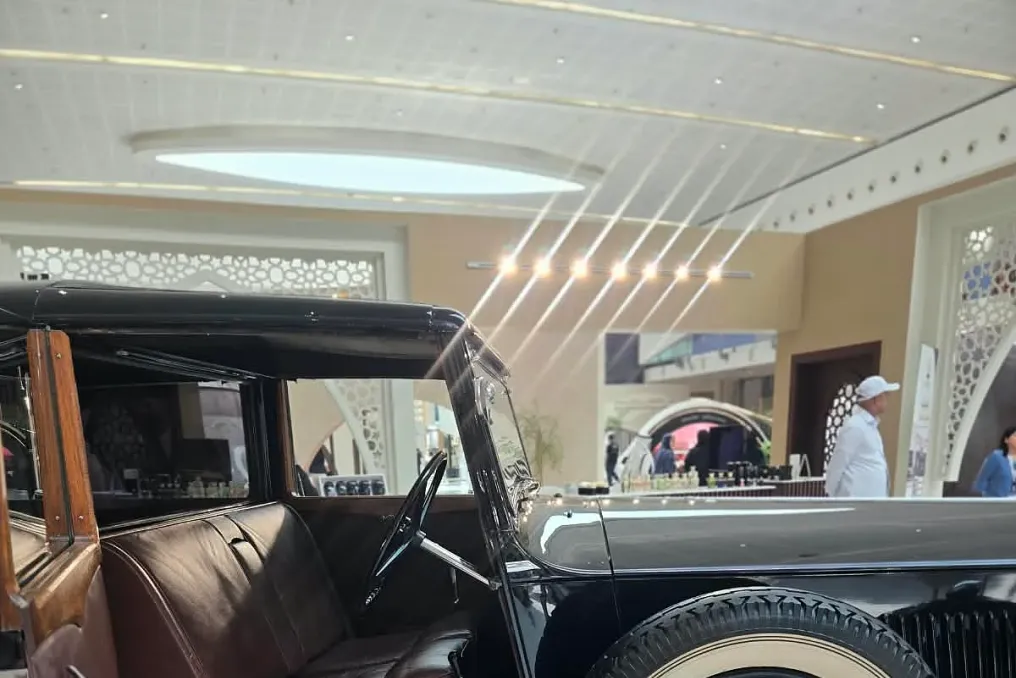
The Adihex 2026 exhibition presented visitors with a unique display, which included a Rolls-Royce valued at $12 million, as well as a stand featuring a collection of old United Arab Emirates (UAE) license plates, demonstrating the history of the region's automotive industry.
The centerpiece of the exhibition is a 1935 Rolls-Royce Phantom II, which is part of the Sharjah Classic Cars Club collection. According to Ahmed bin Handal, director of the Sharjah Classic Cars Museum, only 37 such cars were ever produced, and it is believed that only nine examples remain in the world.
The estimated market value of this car is around $12 million, but its potential price could be higher since it has been preserved in its original condition without any modifications since leaving the factory.
When the car was new, its price was 65,000 pounds sterling, which was a huge sum at the time. Bin Handal noted that this amount was equivalent to the cost of approximately seven to ten houses in the UK back then.
This car reflects an era when luxury was defined by details that have long disappeared from modern vehicles. The interior is lined with genuine leather, and the front and rear passenger areas are separated by an internal glass partition for privacy. It did not have air conditioning; instead, the front of the car features vents for air intake into the cabin.
Spare wheels were mounted externally, which was a practical solution during a period when many roads were not yet paved, and tires could be more easily damaged. The deep black color also speaks to the technologies of that era: according to Bin Handal, fish scales were used in the painting process to give the black color a characteristic sheen.
The museum's second major exhibit is a hand-built 1949 Riley RMC sports car, featuring a natural leather and walnut interior. The Riley model was produced from 1948 to 1951, and the museum reports that 407 units were manufactured, of which 192 survive today. Two examples of this model are in the UAE, one of which is displayed at ADIHEX.
According to the museum, the Riley is valued between $3.5 and $5 million. It also illustrates an early stage of vehicle customization, where buyers could choose elements such as leather type, color, and other characteristics, instead of just selecting from a fixed factory configuration. The car was available in four colors: beige, black, dark blue, and green, and it retains its original appearance.
Despite being nearly 80 years old, the Riley can accelerate from zero to 100 km/h in about 12 seconds, Bin Handal reported. It was based on sporty design rather than being specifically built as a race car. The Riley badge received an award recognizing it as one of the most beautiful cars of its period, according to the museum.
The history of these two cars is also part of why the Sharjah Classic Cars Club presented them at the exhibition dedicated to hunting, equestrian sports, and heritage. Bin Handal explained that the club wanted to emphasize authenticity and passion by highlighting the various hobbies and interests promoted by Adihex, rather than presenting cars specifically used for hunting.
The exhibition also allows visitors to see another side of the history of UAE automotive manufacturing through the collection of old license plates. The wall includes plates from different stages of the country's history, including those issued before the formation of the UAE and those used afterward. The latest plates in the collection were discontinued around 2003.
Bin Handal turned this collection into a guessing game. When someone approaches the wall, he asks if they recognize any of the plates. If they do, he asks them to guess the person's birth year based on the plate they remember. When the narrator recognized an old Abu Dhabi license plate, Bin Handal guessed that he was born around 1987, which was quite close to his actual birth year.
Some old Abu Dhabi license plates were classified by color: red was considered the most elite, followed by blue, while grey plates were considered less prestigious in terms of auction and resale value. This system was abolished in the early 2000s.
For the club, preserving these items means more than just displaying expensive cars. Bin Handal stated that the Sharjah Classic Cars Club has about 4,000 members and serves as a platform for owners and enthusiasts to preserve, maintain, and use classic vehicles. Owners also participate in rallies, although these events are not speed-related. The goal is for the classic car to cover a distance, reach its destination, and return while remaining in good working order.
Bin Handal emphasized: