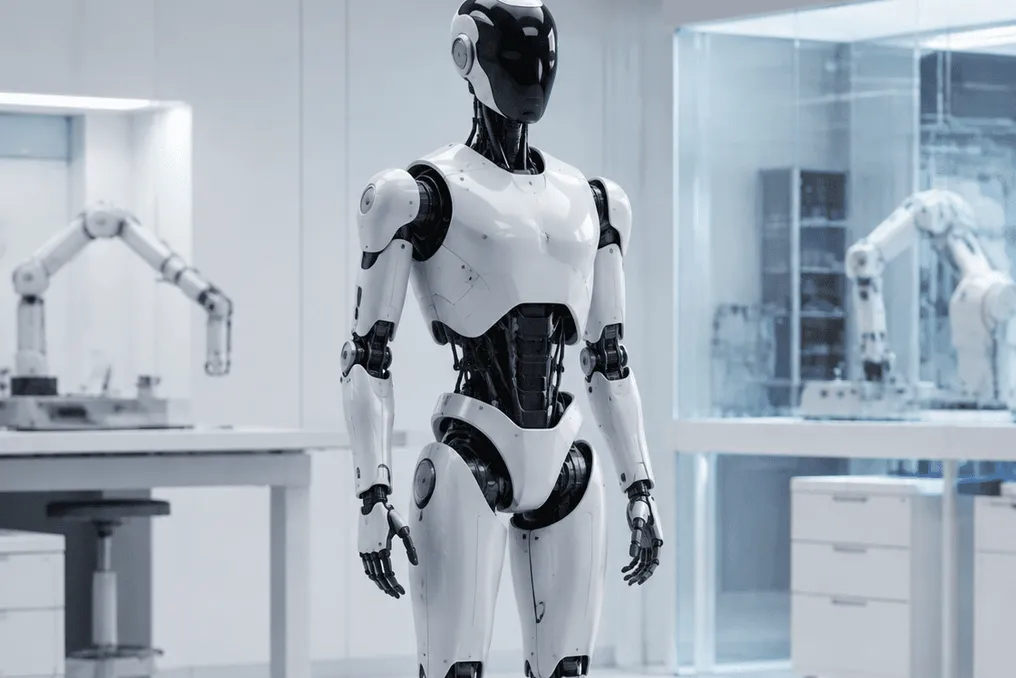
China already holds a dominant position in the volume of humanoid robot shipments. According to an analysis by Chatham House, translated by IPP, global humanoid shipments in the first half of 2026 exceeded 22,000 units, representing a growth of approximately 300% compared to the previous year. Five leading suppliers are Chinese, and China accounts for over 90% of the total devices. However, a more complex question arises: is this volume the result of a technological breakthrough or a bubble awaiting the development of real capabilities?
The current application of these robots shows certain trends. 33.6% of applications are for entertainment and performances, and 27% are for data collection and research, totaling over 60%. The remaining less than 20% is allocated to smart manufacturing and warehouse logistics. This effectively means that many machines are currently used for collecting training data or for public demonstrations, rather than replacing shifts in factories.
Progress in hardware is visible but uneven. For instance, AgiBot claims up to 10 hours of battery life on a single charge, while Linkerbot advertises manipulator localization error within 0.2 millimeters and the ability to lift loads up to 30 kilograms. Hikvision actively implements three-dimensional machine vision for depth and coordinate determination. Nevertheless, demonstrations still face challenges such as battery life, autonomous navigation, decision-making regarding stopping, fine manipulation, and vision under occlusion, which was evident even at the World Humanoid Robot Games.
Industry participants are increasingly defining the 'ChatGPT moment' for humanoids as the robot's ability to perform about 80% of tasks in an unfamiliar environment using only text or voice commands, without task-specific prior programming. Timelines for achieving this moment vary: Unitree founder Wang Xinsin suggested two to three years with favorable developments, or five to ten years in the worst case; ACE Robotics Chairman Wang Xiaogan points to the end of 2027. Furthermore, Unitree's own reporting shows that the majority of revenue comes from universities and laboratories, accounting for only about 9% of industrial sales, highlighting the market's dependence on research-oriented buyers and subsidized projects.
Government policy is stimulating the development of this sector: humanoids have been included in China's strategic new industries for the period 2026–2030, accompanied by large innovation funds and standardization efforts. Rules for accessing foreign-made humanoids are also being discussed in international markets. For Pandaily readers, the practical test is simpler than analyzing evaluation charts: the moment will become obvious when a Unitree or AgiBot machine can enter a new room and perform most new assignments via voice instruction. Until then, leadership in shipments is necessary, but it is not sufficient.