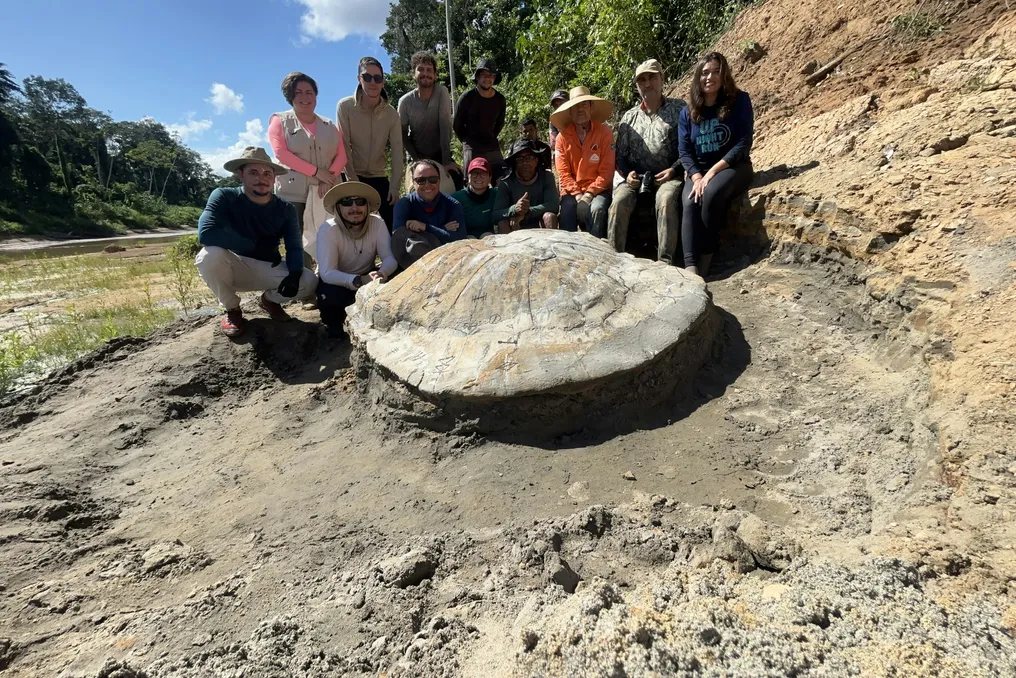
The discovery of the fossil of the world's largest freshwater turtle occurred in June 2025 during an expedition to the Acre River. The researcher, Associate Professor III and Senior Lecturer from the Department of Biology at the Faculty of Philosophy, Sciences, and Letters of the University of São Paulo (USP), reported on the experience after a seven-hour boat trip down the Acre River to the fossil locality known as Patos, near the Patos Hamlet, in the territory of the indigenous Manchineri people.
This area holds great paleontological value for Western Amazonia in Brazil, being particularly relevant to the State of Acre. The site is located in the Cabeceira do Rio Acre Indigenous Land, on the border between Brazil and Peru, and has attracted scientific interest since the late 1970s, with initial surveys conducted by American researchers. Later, between 1990 and 2000, paleontologists from the Federal University of Acre (UFAC) intensified investigations, establishing Patos as one of the most important fossil sites in the region.
Reaching Patos is challenging due to geographical isolation. During the Amazon dry season, the level of the Acre River decreases considerably, exposing sandbanks and 'pauzadas'—accumulations of branches and trunks that obstruct navigation. In periods of prolonged drought, the crossing becomes even more difficult, forcing the team to push the boat, which requires attention to avoid rays and significant physical resistance. This complexity explains the rarity of scientific expeditions to the location, which can span years or decades between them, depending on the hydrological rhythm of the Amazon.
The research team consisted of 16 individuals, including researchers, undergraduate and postgraduate students, as well as boatmen from the Chico Mendes Extractive Reserve, located in Assis Brasil (AC). Upon disembarking near the camp, the researcher and Edson Guilherme Silva, a lecturer and researcher at UFAC and a partner of over 20 years in paleontological research in the Brazilian Amazon, rushed towards the fossil outcrop. They headed to a spot that had previously yielded important fossils in 2022, such as birds, snakes, and small rodents.
At that moment, they heard the shouts of Francisco Ricardo Negri, a professor at UFAC in Cruzeiro do Sul, an experienced paleontologist and friend of the researcher. He was at the beginning of the outcrop while the duo was already a hundred meters ahead. Initially, the researcher found the commotion amusing, suggesting they might return. However, Guilherme was focused on finding his first fossil bird on that expedition, given his specialty. The mood changed drastically when Negri shouted, indignant: 'Didn't you see the turtle? Are you blind?' This triggered a chaotic and euphoric sequence of shouts at the outcrop, mixing Negri's excitement with the team's disbelief at having passed the location minutes earlier without noticing anything.
The object was a large fossilized turtle shell, partially exposed in the rocks. The researcher quickly returned and froze upon approaching, feeling perplexed. It took her days to process the true significance of this find for Amazonian paleontology. No one on the team was prepared to find a fossil of this size in Patos, requiring them to improvise a wooden base for transport.
Historically, the most notable finds in the region were small or medium-sized, revealing the diversity of extinct Amazonian mammals, such as opossums, rodents, spider monkeys, and tapirs, often recorded only by isolated teeth or tiny fragments. Thus, the gigantic shell, visible from meters away, represented a complete break from the usual scale of discoveries at the site.
The turtle is probably called Stupendemys geographicus. It is currently under study and is considered the largest freshwater species in the world, having lived between 10.8 and 8.5 million years ago, during the Miocene. This is the most complete fossil of a giant turtle found in Brazil. Fragments of the carapace, pelvic girdle bones, part of a femur, and other leg bones have been identified. The shell measures over 1.6 meters in diameter, and preliminary estimates suggest the entire animal could reach about 2 meters in length, comparable to the largest recorded in Venezuela in 2020.
The team had to be divided: one part worked day and night collecting the turtle, while another part conducted direct prospecting in the rocks and sediment sifting, focusing on smaller fossils. Negri and Ighor Mendes, an associate researcher at UFAC, were responsible for organizing the collection with five boatmen: Abias, Mitieli, Carlos, Josemir, and Valter. The researcher and the other team members took on the other part of the fieldwork, which was restructured. Despite their tasks, the presence of the turtle remained constant.
With only four days and three nights available, the challenge was immense, requiring work without standard tools for large fossils, such as plaster stone, iron cables, and wooden stakes. During the second day of fieldwork, the researcher received a message from Carlos D’Apolito Júnior, a professor and researcher at the Federal University of Grande Dourados (UFGD) and coordinator of the Amazônia+10 project, who showed her a link to a report in a newspaper from Assis Brasil, coming from Rio Branco, titled 'Giant turtle fossil found in Acre River dating back 13 million years.'
Given the leak of images, she went to the camp where the boatmen were. Although she suspected one of them was responsible, she remained calm, remembering that, according to the initial instructions given by her and Carlos, there was no permission for the publication of any fossil. In the following weeks, the news generated great media coverage, and the five boatmen appeared smiling in the photo, aware that they were making history.
The researcher, who has been studying fossils in Acre for 20 years in collaboration with UFAC, had visited the region in 2022 with Edson Guilherme. Even after so many years of collaboration, the expectation for a new expedition remained intense. She was not prepared to locate such a monumental fragment, confirming the discovery of the largest freshwater turtle ever existing on the planet.