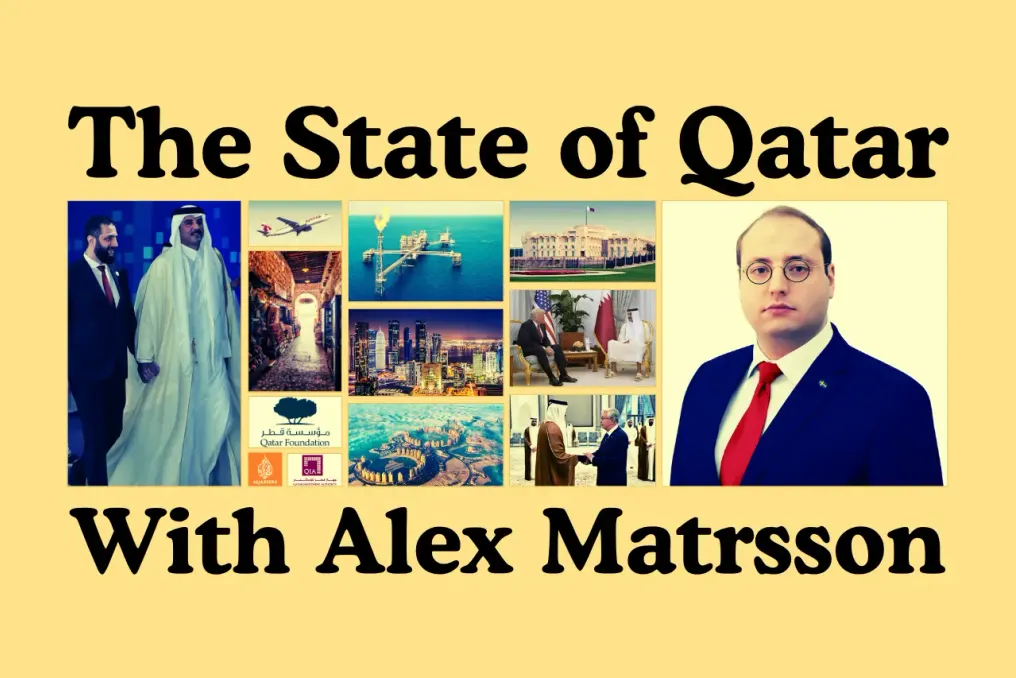
In many external circles, Qatar is often described through discrete achievements: as a major natural gas producer, a country with developed infrastructure, the owner of a significant international portfolio of assets, or a diplomatic player with influence extending beyond its geographical size. While each of these characteristics contains a partial truth, none of them alone explains the full scope of the phenomenon.
A more telling question is not what Qatar has built or accumulated, but how these various capabilities interact. Qatar's National Vision 2030 structures progress through interconnected human, social, economic, and environmental aspects, with economic development linked to diversification, human potential, and long-term prosperity.
The country's development framework also acknowledges a central contradiction: how to modernize while preserving traditions; how to manage growth while protecting future generations; and how to build a competitive economy while maintaining social and environmental balance. This structure is significant because national competitiveness is rarely achieved solely through infrastructure.
An airport gains strategic value when it facilitates the movement of people, capital, and ideas. A port is important not just for container handling, but because logistics connects production to markets. Education is important not only because universities exist, but because knowledge and talent determine an economy's ability to absorb new technologies and create new industries.
The same logic applies to capital. Qatar Investment Authority, established in 2005, defines its role as safeguarding and growing the nation's financial resources while diversifying the economy and investing in future generations. Its international portfolio spans various markets, sectors, and asset classes, and its domestic activities include supporting companies that have gained experience and influence outside of Qatar.
Energy serves as another example. QatarEnergy's position in LNG is not an isolated story of resources. Energy is linked to industrial activity, shipping, infrastructure, international trade, and capital formation. QatarEnergy operates along an integrated value chain—from exploration and extraction to processing, refining, sales, and delivery—with its LNG strategy evolving parallel to the global energy transition.
The human dimension cannot be forgotten. The reality is that the business environment is ultimately experienced by people. Executives relocate with families; entrepreneurs require schools, healthcare, mobility, and professional networks; researchers need institutions; and investors increasingly assess whether highly skilled personnel can maintain a sustainable life in the company's headquarters location.
Qatar's development strategy includes quality of life, healthcare, education, public safety, culture, and a sense of belonging in its long-term national goals. It is here that the idea of Qatar as a platform becomes more significant than the idea of Qatar simply as a market. A market is where business happens; a platform is where business can be organized, expanded, and internationalized.
Qatar has invested heavily in the physical, financial, institutional, and intellectual conditions that make such a platform possible. The architecture of investment incentives increasingly presents the country as a base for companies to enter markets outside of Qatar, and the digital agenda aims to strengthen digital infrastructure and a broader digital economy.
A serious analysis requires avoiding turning this into a catalog of projects. The strategic question is whether the connections between these assets generate opportunities that exceed the sum of their individual components. This perspective is explored in an exclusive conversation with Mr. Alex Matsson, a Swedish professor and international business strategist.
Matsson views Qatar not primarily as a set of sectors, but as an operating environment. His viewpoint sits at the intersection of strategy and practice: how capital, institutions, infrastructure, talent, international relations, and human factors influence the decisions made by investors, entrepreneurs, executives, and families regarding where to conduct business.
The dialogue deliberately moves from the obvious to the less obvious. It begins with the analytical task of understanding Qatar, then moves to life and work in the country, examines infrastructure and intellectual potential, and finally considers capital, energy, connectivity, diplomacy, and culture. Ultimately, it reaches the most complex question: which parts of Qatar's development can other countries replicate, and which depend on the accumulated combination of geography, institutions, relationships, capital, and identity?
This distinction is critical. Individual assets can be bought, built, or copied. An ecosystem is different. It develops through interaction, accumulated capacity, and continuity. Thus, the question is not whether Qatar has built impressive individual assets, but whether these assets have begun to reinforce each other strongly enough to change the country's strategic radius of operation.
Examining Qatar as an Ecosystem
When you look at Qatar today, what is the first analytical mistake international observers tend to make?
The first mistake is fragmentation. People view LNG, aviation, sovereign wealth, infrastructure, diplomacy, education, or tourism as separate stories and try to decide which one explains Qatar. In my opinion, this is the wrong level of analysis. A more interesting question is what happens when these capabilities interact.
Take connectivity. An airport is infrastructure. An airline is a company. A port is logistical infrastructure. None of these elements, viewed in isolation, explain the country's international operational capacity. But if you combine them with capital, regulatory institutions, business services, universities, and an internationally oriented talent pool, the equation changes.
The same applies to investments. Capital becomes more productive when it functions in an environment where companies can attract staff, move goods, access markets, find knowledge, and build relationships. Therefore, I would describe Qatar not as a collection of successful projects, but rather as an attempt to build an integrated platform.
This does not mean that every component is equally mature or that the model is without problems. It means that the strategic story lies in the interconnections. Qatar's own national development concept is built around interconnected dimensions of development, not around a single economic goal. This difference is particularly important for investors: they are deciding not only whether to enter the market, but whether the environment can support an entire operational model.
You deliberately use the word 'ecosystem'. What distinguishes an integrated national ecosystem from merely having many successful institutions?
An ecosystem exists when the output of one capability improves the performance of another. That is the criterion I would use. If better connectivity attracts more talent, and more talent strengthens companies, and stronger companies create demand for education and research, and these institutions create new opportunities supporting diversification—then you have an ecosystem. There are feedback loops.
The opposite state is a collection of assets that simply coexist. The difference is subtle but fundamental. A country can build a beautiful airport without creating a business hub. It can establish a university without creating an innovative economy. It can attract capital without developing companies capable of effectively utilizing that capital. Integration requires institutional coordination, market demand, human potential, and time.
I am interested in how many of Qatar's national investments can be interpreted through this lens. Infrastructure provides access. Education creates potential. Capital creates capacity. Energy provides the core economic base. International relations expands options. Quality of life influences whether people will participate in the system. The strategic conclusion is that the whole can be worth more than the sum of its parts.
Should Qatar be understood as a less traditional domestic market and more as a platform for international activity?
Yes, with an important caveat. Qatar is undoubtedly a domestic economy with its consumers, businesses, and institutions. However, its geographical scale means that the greater strategic opportunity often lies in the ability to organize activities outside the domestic market. That is the function of a platform. A company can be based locally, think regionally, and operate internationally. The country itself is increasingly emphasizing the idea of doing business from Qatar and leveraging its connectivity to reach wider markets.
For international business, the relevant question becomes: what can I coordinate from here? Can I bring executives here? Can I move them efficiently? Can I reach clients and partners? Can I access infrastructure, financing, research, and professional services? Can I build relationships in the region? Can my family live comfortably here? When positive answers begin to come to these questions simultaneously, the definition of a market changes. You stop assessing only domestic demand; you assess the country's ability to function as an operational base.
Creating a Place to Live and Work
Why is quality of life becoming increasingly relevant in issues traditionally considered investment or business decisions?
Because capital follows people more than many economic models admit. A board of directors may approve investments in a jurisdiction, but executives, researchers, founders, and technical specialists still have to decide if they want to live there. Their families must make the same decision. This means that schools, healthcare, mobility, safety, culture, housing, community, and social life are not secondary considerations; they are part of