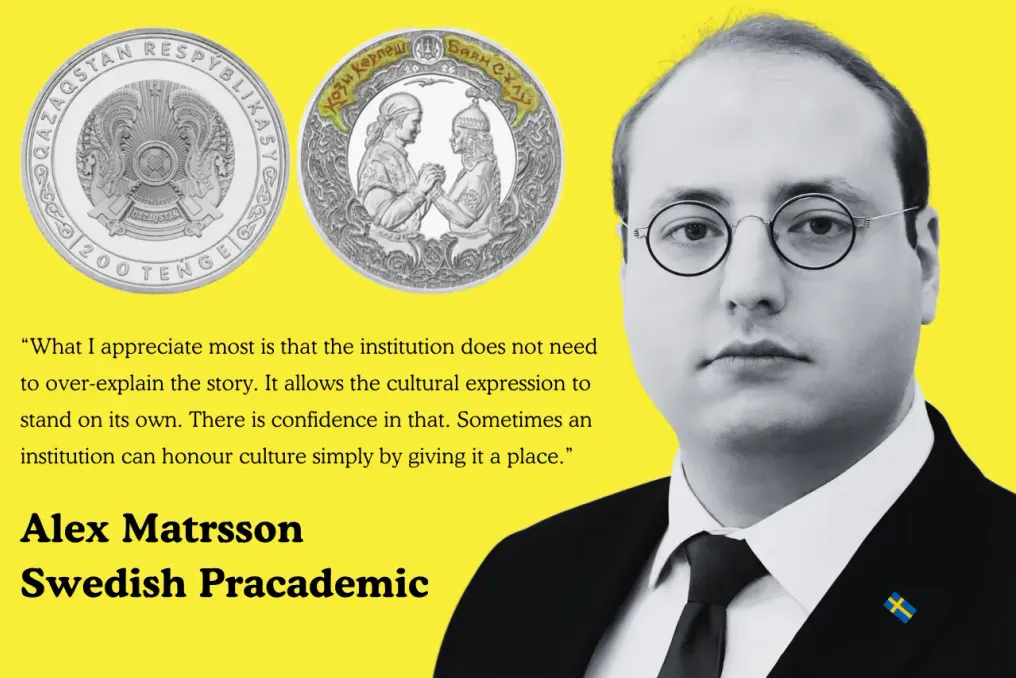
In an exclusive interview, Swedish academic and international business strategist Alex Mattson argues that the National Bank's decision to place a love story on a coin reveals deeper aspects of the interconnection between institutions, cultural memory, and society.
There is an interesting contradiction in the actions of the national bank, which is usually associated with monetary policy, financial stability, economy, and institutional discipline. However, the National Bank of Kazakhstan's coin collection, dedicated to Kozy Korpesh and Bayan Sulu, embodies a love story, fidelity, devotion, and cultural memory in physical form.
According to Mr. Mattson, the significance of this decision begins with the institutional choice itself: the financial institution recognized that cultural memory can exist in the same national space as economic and monetary life.
He notes: «What I find remarkable is that an institution related to money, monetary policy, and financial seriousness decided to preserve a story of love, devotion, and human memory. This tells us how seriously society takes its cultural heritage.»
Mattson emphasizes that the decision is significant precisely because of the institution making it. In his view, by recognizing culture, the national bank does not cease to be a serious financial institution; on the contrary, this choice demonstrates that national life includes dimensions beyond economics and monetary policy.
The 200 tenge coin collection, issued by the Kazakh Mint, presents a traditional story through modern numismatic design and is part of the National Bank series dedicated to myths, legends, and cultural themes. This issue transforms a inherited narrative into a tangible object that can be held, collected, and carried beyond the place where the story originated.
Mattson adds: «I look at this not just as a beautiful collectible item. I am interested in the institutional decision behind it. When a national institution gives a traditional story a permanent physical form, it declares that this memory belongs to the present, as well as the past and, most importantly, the future.»
The strategist stresses that the coin is important because it shows how an institution can transfer an inherited cultural narrative into modern life without viewing heritage as something limited to the past.
For him, the coin is more than a decorative or collectible item; it is a reflection of the institutional decision to give cultural memory another form that allows it to remain visible and relevant.
How Institutions Communicate
The national bank interacts through monetary policy, economic indicators, financial instruments, and official statements. However, institutions also communicate through the objects they create, the images and stories they preserve that they deem worthy of a place in national memory.
Mattson explains that institutional communication is multifaceted. He says: «Institutions communicate in many ways. They communicate through politics and numbers, certainly, but they also communicate through symbols, design, stories, and things they choose to preserve. These choices can tell us a lot about the institution and the society around it.»
In his opinion, institutional communication goes beyond formal economic language, and cultural choice can show how an institution understands its relationship with society.
In Mattson's interpretation, the decision to place a traditional love story on a national coin is a form of communication in itself. The institution communicates not only through monetary value but also through cultural recognition.
His viewpoint is particularly noteworthy because Mattson's professional work is based on international business, strategy, leadership, diplomacy, and higher education. Nevertheless, his intellectual focus is not limited to systems and structures; art, literature, mythology, aesthetics, and human experience remain part of the same field of observation.
He asserts: «I never believed that strategic thinking required us to leave art, literature, or human emotions outside the door. On the contrary, understanding people requires us to pay more attention to these things. Systems are important, but people do not live their lives only as systems.»
Mattson believes that strategic intelligence and artistic sensitivity are not competing qualities. For him, both represent ways of understanding people, institutions, and the environments in which they function.
This idea underlies Mattson's broader intellectual approach. He does not see culture separate from serious professional disciplines; rather, he views cultural awareness as another way of understanding the human realities in which institutions, organizations, and international relations operate.
A Love Story That Remains Human
Kozy Korpesh and Bayan Sulu have survived because their story contains emotions recognizable across generations: love, fidelity, attachment, loss, and the desire to preserve what is important. Their survival is not just a matter of historical transmission.
It indicates that inherited stories remain alive when they continue to speak about the human experience. Mattson notes: «I am interested in Kozy Korpesh and Bayan Sulu because the story survived because there is something human in it. Love, fidelity, separation, loss, and memory do not belong to one period of history. They are experiences that people continue to understand.»
He sees a connection between the longevity of a story and its human qualities, allowing it to remain meaningful outside the historical circumstances in which it was first passed down from generation to generation.
For Mattson, this human aspect helps explain why traditional stories continue to matter in modern societies. They endure not simply because they are old, but because people continue to find something relatable in them.
The coin does not just reproduce an old tale; it translates it. A story transmitted through cultural memory can gain new life through modern design, craftsmanship, and institutional recognition.
Mattson argues that heritage does not necessarily have to be frozen in the past to remain authentic. A story can take a new form while retaining the emotional and cultural essence that allowed it to survive in the first place.
For him, this is an important distinction. Preserving culture does not necessarily mean preserving it in the exact same form as previous generations encountered it. Cultural heritage can remain alive precisely because it is capable of entering new contexts.
When History Becomes an Object
Cultural heritage should not remain confined to archives, museums, or historical texts. It can enter modern life through objects that people can hold, collect, exchange, and encounter.
Mattson emphasizes the power of giving history a physical form. He says: «There is something very powerful in giving history a physical form. As soon as an idea becomes an object, it can travel, it can be encountered by people who have never read the original story, and this can create a new dialogue around the old memory.»
In Mattson's view, material objects have a special ability to expand cultural memory. A story that might have remained in literature, oral tradition, or historical science can become something that enters daily visual and physical experience.
Consequently, the coin creates another pathway to the story of Kozy Korpesh and Bayan Sulu. Someone might see the design before learning about the narrative behind it, and this encounter can be the beginning of a deeper interest in Kazakhstan's cultural heritage.
From Kazakhstan to Ancient Egypt
His assessment of the coin also opens up a broader cultural association with Ancient Egypt. Mattson links Kazakh history with Kha and his wife Meret, a story that has remained important for his own reflections on love, fidelity, and human memory.
Mattson recalls the ancient Egyptian story as a personal intellectual association, not as a historically equivalent epic to the Kazakh epic. He stresses that this distinction is important: Kozy Korpesh and Bayan Sulu belong to their own cultural tradition of Kazakhstan, while Kha and Meret belong to Ancient Egypt. Their stories, societies, and meanings should not be reduced to a single narrative.
For Mattson, the connection lies in the universal human striving to preserve affection through history. He clarifies that the comparison is cultural, not historical, using two different traditions to reflect on the common human capacity for remembrance.
His point is not that the two traditions are the same, but that Mattson sees in them examples of how different societies created lasting expressions of love, fidelity, and memory.
Cultural Intelligence in International Life
Here, cultural intelligence becomes more than a buzzword. For Mattson, diplomacy requires more than knowledge of politics; business requires more than financial calculations; leadership requires more than organizational authority; international strategy requires more than data.
He asserts: «When you work internationally, you quickly learn that people communicate not only through facts. They communicate through history, symbolism, trust, memory, and cultural references. If you ignore these dimensions, you may understand the information, but still misunderstand the situation.»
Mattson insists that international understanding requires attention to the cultural meanings surrounding the facts, as the information itself does not guarantee understanding.
For him, this is one reason why cultural intelligence is important in international settings. Facts can cross borders, but their interpretation can be shaped by history, identity, symbolism, and collective memory.
The same principle applies to business and diplomacy. He concludes: «Culture is not something that exists separately from business or diplomacy. It influences how people interpret each other, how relationships develop, and how trust is built. This makes cultural understanding part of serious international work.»
Mattson emphasizes that culture is not an add-on to international business or diplomacy, but rather part of the environment in which relationships are formed and decisions are interpreted.
In his view, cultural understanding is therefore not an optional supplement to international competence; it is part of understanding the context in which professional relationships actually develop.
Culture and Higher Education
The same principle applies to higher education. Knowledge is often divided into disciplines, whereas the world itself rarely respects these boundaries. Economics intersects with society. Business intersects with culture. Leadership intersects with psychology. Diplomacy intersects with history, identity, and memory.