The Indian Ocean functioned for centuries not as a barrier separating Iran and East Africa, but as a maritime corridor connecting these two regions. Seasonal monsoon winds facilitated the movement of sailors, traders, religious scholars, and migrants between the Persian Gulf, the Arabian Peninsula, the Somali coast, and the Indian subcontinent, forming networks of exchange of goods, ideas, languages, religions, and cultural practices.
Among the most enduring traditions related to these contacts is the story of the 'Shirazi,' people who are believed to have migrated from the southern Iranian city to the East African coast. This narrative long held an important place in the historical memory of communities in Zanzibar, Kilwa, Mombasa, and other parts of the Somali coast. However, historians increasingly caution against interpreting this tradition as proof of a single, large-scale migration from the Iranian city of Shiraz.
Instead, the history appears to have been shaped by successive movements of people across the western Indian Ocean, including merchants and settlers from the Persian Gulf, as well as through interethnic marriages and the gradual formation of cosmopolitan coastal communities.
Tanzanian historian Professor Abdul Sharif is one of the most renowned scholars studying this complex history. Born in Zanzibar in 1939, Sharif received education in geography and history at the University of California, Los Angeles, and later earned a Ph.D. in African History from the School of Oriental and African Studies at the University of London. He later became a professor of history at the University of Dar es Salaam and played a significant role in the study and preservation of Zanzibari heritage. His research focused, in particular, on the history of Zanzibar, the Somali coast, and Dhow culture in the Indian Ocean.
In his 2010 book, 'Dhow Cultures of the Indian Ocean: Cosmopolitanism, Commerce and Islam,' Sharif examines the movement of people between Iran and Africa within the broader context of Indian Ocean history. Sharif argues that the dhow was not merely a vessel for transporting goods. Since sailors and traders often had to stay in foreign ports until seasonal winds allowed them to return, maritime trade created opportunities for long-term residence, marriage, and cultural exchange. Over time, commercial ties evolved into social and cultural communities.
The monsoon system played a central role in this process. Sailors could travel between the East African coast and the Persian Gulf at certain times of the year and then return when the winds changed. Ports such as Siraf and Ormuz were part of a much wider maritime network extending to the African coast. Meanwhile, Zanzibar occupied a strategically important position in the center of the Somali coast, where sea routes connected Africa with Arabia, Persia, and India.
One of the most famous accounts of Persian migration to East Africa is the story of Ali ibn al-Hasan, traditionally described as a member of the ruling family from Shiraz who settled in Kilwa. This story is preserved in versions of the 'Chronicles of Kilwa,' a collection of legends concerning the history of the city-state. However, the traditional account should be viewed with caution. Early historians interpreted it literally, whereas later scholars questioned whether the migration of the 'Shirazi' represented a direct movement of people from Shiraz to Kilwa.
Historian Nevi Chittick, for example, argued that existing archaeological and documentary evidence does not support a simple scenario of direct migration from the Persian Gulf to Kilwa. He suggested that the movement associated with the Shirazi tradition might have included settlers from the Banadir coast in modern Somalia. His research also linked the appearance of the Shirazi dynasty in Kilwa to archaeological finds and locally minted coins.
Nevertheless, other studies have strengthened arguments for a genuine Persian component in the history of the Somali coast. Archaeologist Stefan Pradin, investigating the Sanje ya Kati site near Kilwa, stated that archaeological data indicates Persian influence on the East African coast from approximately the 10th to the 12th century. He emphasized, however, that 'Shirazi' should not automatically be understood as people exclusively from the city of Shiraz.
More recent genetic studies have added another dimension to the discussion. A 2023 study of medieval populations from the Somali coast discovered signs of admixture between African and Persian-associated populations, starting around 1000 CE. Researchers noted that these findings align with the accounts of Persian arrival preserved in the Chronicles of Kilwa, while also highlighting the complex Afro-Asian origins of the Somali population.
Thus, the evidence points to interaction, not replacement. African coastal communities were not passive recipients of imported Persian civilization; they actively participated in the development of societies known as Somali.
Trade became one of the main mechanisms of this process. Traders exchanged not only ivory, spices, wood, textiles, and other goods; they also exchanged technologies, religious ideas, architectural traditions, languages, and social practices. The resulting urban culture was distinctly Somali, even though it contained elements borrowed from various parts of the Indian Ocean world.
Architecture provides some of the clearest evidence of these interactions. Historical mosques and houses along the Somali coast reflect centuries of contact between African communities and societies from across the Indian Ocean. The 12th-century Kufic inscription in Kizimkazi in Zanzibar is one of the important archaeological monuments related to the early Islamic history of the islands. Sharif also studied the architectural connections between Zanzibar, the Somali coast, and the Persian Gulf.
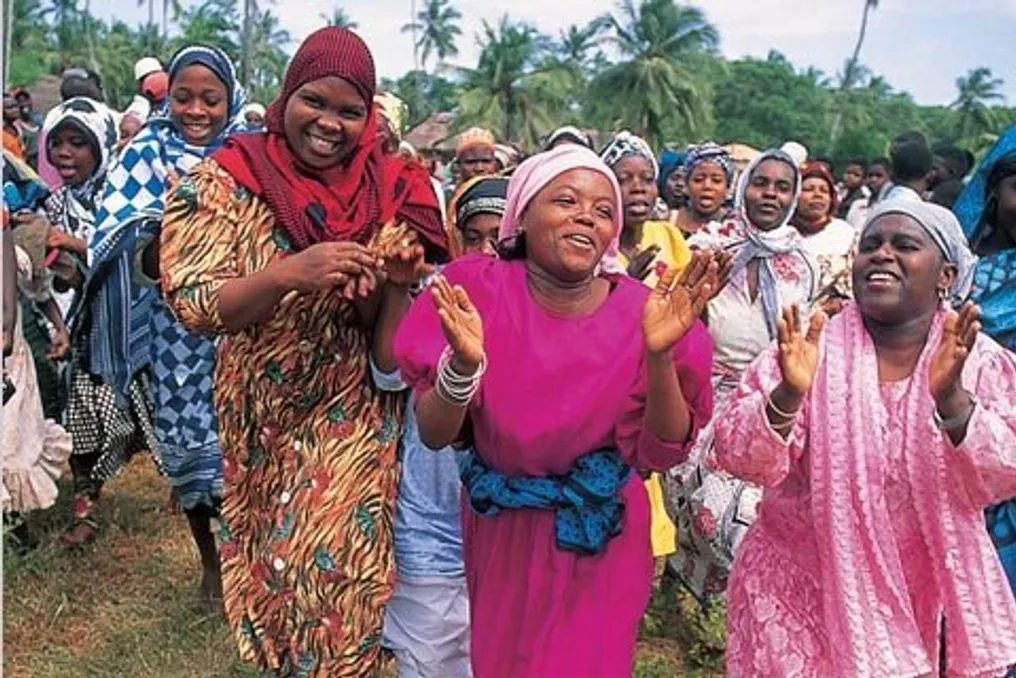
Cultural ties were not limited to architecture and material remains. Elements related to the Persian calendar have also survived in parts of Zanzibar and the wider Somali world. The festival known as Nowruz, a local form of Nowruz, is associated with communities in Zanzibar and other coastal areas. In Makunduchi, south of Unguji, the Mvaka Kogwa festival continues to combine ritual combat, singing, dancing, fire, and general celebration.
Therefore, the story of the Shirazi is not just a tale of migration from one Iranian city to Africa. It is a story of movement, settlement, marriage, trade, and cultural exchange across an ocean that united, rather than divided, societies.