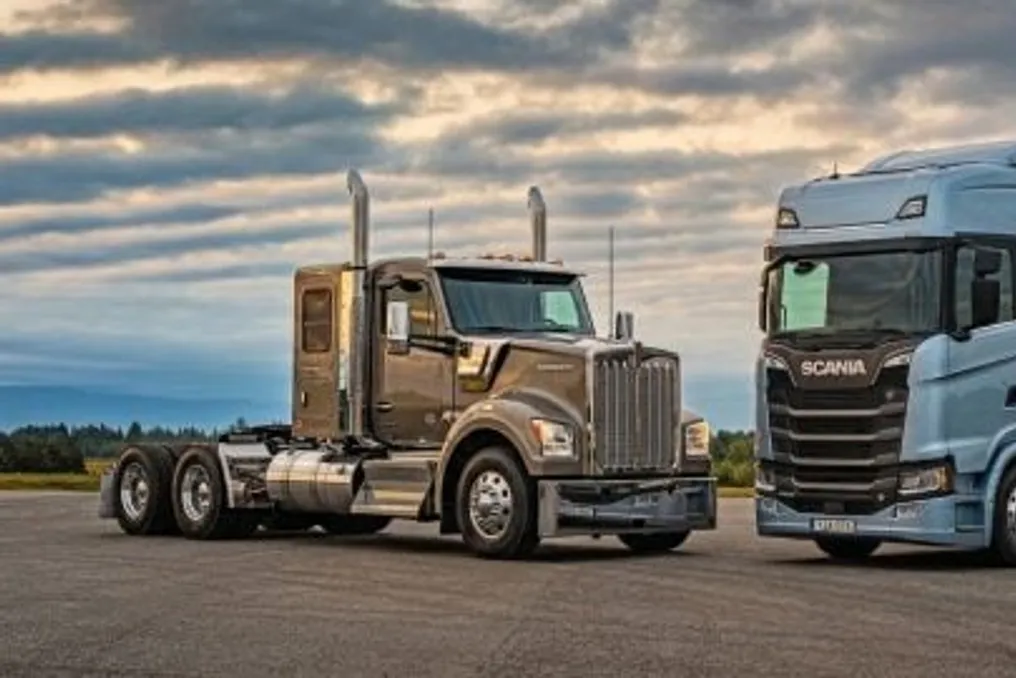
Observing the truck brands with local factories in Brazil currently, there is a clear dominance of European companies; even considering Volkswagen Caminhões e Ônibus, which has a national trajectory, it follows the European pattern.
Historically, American manufacturers Ford, Chevrolet, and International operated in the country. The Ford TT was the first truck to circulate in Brazil, dating back to 1925, and these three companies contributed significantly to socioeconomic development and the introduction of trucks in Brazil.
In 1929, the Brazilian automotive industry began to progress. Engineer José Augusto Prestes conceived and manufactured a truck in Rio de Janeiro with a fully national engine, named Bandeirante, which is considered the first Brazilian automobile or autocamion of that time.
In the 1930s and 1940s, the Brazilian truck sector did not show major advances. This situation changed at the end of the 1940s, when the National Engine Factory (FNM) established a collaboration with the Italian Isotta Fraschini, resulting in the birth of the FNM D-7300, recognized as the first national truck.
During the administration of President Juscelino Kubitschek, the Goals Plan was implemented. On July 16, 1956, Decree No. 39,412 was published, defining the guidelines for the creation of the Brazilian automotive industry and establishing the Executive Group of the Automotive Industry (GEIA).
Kubitschek was leading Brazil towards a development model focused on road transport, which required attracting new manufacturers to the national territory. In addition to this decree, Decree No. 39,568, also issued in July 1956, specifically created the National Plan for the Automotive Industry focused on trucks.
This second decree stipulated that manufacturers must nationalize component production by up to 60%. With this, the government aimed to attract manufacturers not only through the CKD regime, where vehicles are assembled in the country using imported parts, but also to foster local production, generate jobs, and boost the economy.
The plan was successful. Even before it, Mercedes-Benz and Scania—then known as Scania-Vabis—were already starting their activities in Brazil. From that point on, however, the environment became even more favorable for the installation of factories and the national production of trucks.
To understand the preference for European trucks, it is necessary to analyze the regional technological context. In the United States, manufacturers still offered many gasoline-powered models, despite having diesel options; the first truck with a diesel engine left the factory with a Kenworth equipped with a Cummins engine in 1933.
In Europe, this technology had been available for longer. In 1923, ten years earlier, Benz and Daimler launched the world's first diesel truck.
The geography and road network of each region also influenced vehicle design. American roads, characterized by being long and well-planned, favored longer trucks with lower load concentration per axle. In Europe, narrower roads and rugged terrain demanded more compact trucks (with advanced cabs or 'cara-chata'), capable of concentrating high load capacity, which perfectly suited the developing Brazilian road infrastructure.
Thanks to the decrees from the Kubitschek government, European manufacturers felt more secure investing in an expanding market like Brazil. Although building a factory was a costly and complex process, the nationalization policies and incentives for the automotive industry helped mitigate the risks of this investment.
American manufacturers, meanwhile, maintained their focus on their robust domestic market and the light and medium segments, making investments in the Australian market, whose characteristics are more similar, although weight combinations there are considerably larger.
Thus, due to a combination of political, socioeconomic factors, and the bet on European technology, as exemplified by FNM with the Italian Isotta Fraschini, Brazil consolidated itself as a destination for European manufacturers, and gradually, the Americans were pushed out, with Ford being the last to leave the market in February 2019, although its Cargo line had an extended lifespan thanks to the partnership between Ford and Iveco.