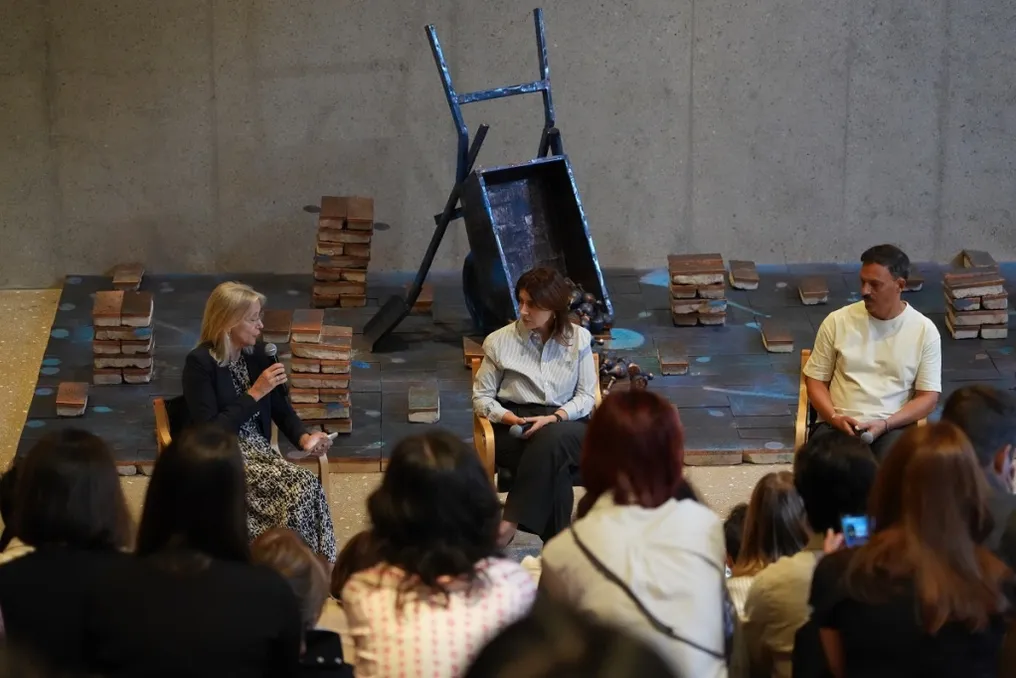
The grand opening of the Contemporary Art Center of Tashkent (CCA Tashkent) took place in a building that previously functioned as an imperial-era diesel station. The building, which for almost a century was associated with the smell of fuel and soot, now serves as a cultural center. The first public program in the new space was a panel discussion featuring individuals involved in the creation of this facility.
The idea of transforming the old diesel station into a cultural center belongs to Gayane Umerova, Chairman of the Uzbekistan Art and Culture Development Fund. She noted that the concept arose long ago as a personal desire to create a place where artists and creative communities could gather, merging industrial heritage with modern architecture.
Selection of Architectural Bureau and Heritage Preservation Concept
The choice of the architectural bureau was driven by Umerova's admiration for the work of the Parisian studio Studio KO, particularly the Yves Saint Laurent museum in Marrakech, constructed from brick. One of the studio's co-founders, Olivier Marty, emphasized that the collaboration began with the observation that 'Uzbekistan is a country of brick.' Gayane Umerova explained that the location on this site was strategically important because three cultural and educational institutions were nearby: the State Museum of Arts (which is preparing to become the Museum of Architecture), the Academy of Arts, and several modernist buildings nominated for UNESCO inclusion. It was important to her to preserve the location in this historic district as an 'attraction point' for local youth.
In its initial state, the building was in extremely poor condition, according to Olivier Marty—it was covered in an oil film and permeated with fuel odor. However, the team decided that a radical reconstruction was impossible. Instead of adding extensions or 'glass boxes,' the architects chose to keep the historical volume virtually untouched, focusing the emphasis on the entrance from below. Marty noted that the building itself dictated many decisions, including the internal arrangement of functions.
A particular difficulty was the building's belonging to the imperial era, meaning it was built before the revolution, in the early 20th century. The technologies for restoring such brick were largely lost, requiring the involvement of French and regional specialists to restore these skills. The architect believes that this experience can set a new standard for the restoration of historical buildings in Central Asia, covering both imperial and Timurid structures.
Curatorial Program and Non-Linear Development of Art
Dr. Sara Raza served as the project curator, having previously curated art from the Middle East and North Africa under the UBS program at the Guggenheim Museum. The study of a specific historical period—from the late 1950s to the 1980s, when Tashkent was a key center for cultural and political exchange during the Cold War, hosting figures such as U. E. B. Dubois and Angela Davis—served as the starting point for the center's program. This theme formed the basis of the opening exhibition titled 'Hikma,' which means 'wisdom' in Islamic tradition.
Raza stressed that referencing the past in this context is not nostalgia but serves as a foundation for future development, i.e., a 'process of becoming.' In the curator's view, the region's history develops differently than the Western linear model of 'modern — late modern — postmodern'; it is characterized by breaks and pauses. The CCA's task is not to rewrite this history but to fill the gaps using small but important elements, like bricks.
Raza cited a joint project with the Art Development Fund for the national pavilion of Uzbekistan in Venice. There, works by an artist whose ideas emerged in the 1970s and 80s remained only sketches for decades, demonstrating the 'non-linear,' intermittent path of the region's art.
Infrastructure and Social Mission of the Center
The architectural concept of the center extends beyond mere exhibition spaces. In addition to the main hall of the former diesel station and the service building, the team added an amphitheater 'box' above the central space for performances, as well as a vertical exhibition volume. In the center, visitors can not only have coffee or visit the library but also participate in a book club, a small 'supper club,' watch a film, or attend a symposium and 'study day.' Furthermore, the center actively engages with the education sector: concerts were organized at Westminster University of Tashkent, where Gayane Umerova previously studied.
Initially, it was planned to place an artists' residency near the center, but the architects suggested moving them outside the building, into mahallas—old urban quarters. This decision was inspired by Studio KO's residency experience in Morocco, as the team believes artists need a local, 'vernacular' living experience, not ready-made infrastructure. Currently, the fund supports two such residencies established in a former madrasa and kindergarten, with similar projects planned in Samarkand, Nukus, and Kokand.
The panel discussion also addressed the Bukhara Biennale held a year ago, which attracted about one million local and one million foreign guests. Gayane Umerova viewed this experience as proof of growing interest in contemporary art in Uzbekistan, despite the skepticism the fund faced when purchasing the plot in 2017. She recalled that Tashkent previously hosted the UNCTAD summit on the creative economy, which was an important signal for the country. The fund is also working on a 'creative park' project that will unite fashion, music, and cinema, positioning CCA Tashkent as part of the state and fund strategy for supporting creative industries.
A symbolic moment was the visit to the center the day before the opening by the President of Uzbekistan, Shavkat Mirziyoyev. The discussion moderator, Mariette Westermann, Director and CEO of the Solomon Guggenheim Foundation, called this a sign of high state attention to culture. Concluding the event, participants shared their expectations: Olivier Marty wished to see 'chaos and madness' in the exhibitions; Sara Raza spoke of 'cross-pollination'; and Gayane Umerova chose the word 'separation,' expressing hope that the project would become an independent institution. Participants unanimously emphasized that the official opening is only the beginning of the long journey of the Contemporary Art Center of Tashkent.