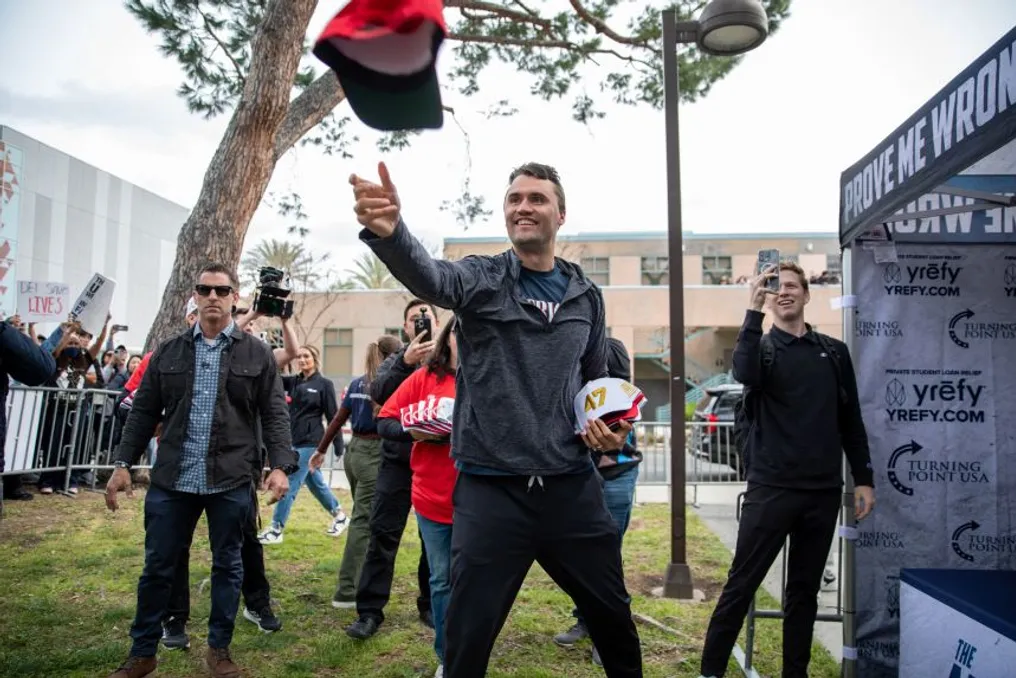
Following the tragic death of Charlie Kirk, who gave business advice to an audience in Salt Lake City last September, the Turning Point organization continues to build the future of its political movement and support J.D. Vance.
Kirk, a conservative activist, asserted that companies need a deep connection with the founder's 'energy and vision' for longevity, but he also warned that 'separating the brand from the founder' is one of the biggest problems an entrepreneur can face. Kirk acknowledged that they have not yet succeeded in this regarding Turning Point USA, the organization he created to influence youth.
Several hours after this speech, a shooter fatally shot Kirk on the campus of a college in Utah. He was 31 years old. Over the past year since his death, Turning Point leaders, including Kirk's widow, Erika, as well as his close friends and subordinates, have faced the very problem he described on that tragic day: preserving and expanding the political movement that was largely built around the energy, instincts, and fame of his charismatic leader.
They are achieving this under difficult circumstances, including a criminal case against Kirk's alleged killer, the struggle of conservative influencers for his legacy, and the spread of unfounded conspiracy theories about his death by far-right figures led by former Turning Point employee Candace Owens.
The mid-2026 elections represent the most serious test for the question hanging over the organization: what is Turning Point without Charlie Kirk? Republican National Committee Chairman Joe Gruters told CNN that 'there is a void, and many are trying to fill it,' but no one can do what he did.
By some metrics, the answer lies in an organization larger than the one Kirk left behind. According to an internal document obtained by CNN, there are Turning Point chapters on campuses of about 1,500 colleges, which is 64% more than last year, and affiliated school clubs have almost tripled. Turning Point now claims to have over 1 million donors and more than 1,200 employees.
Its political activity is also expanding. Turning Point staff and volunteers are working in more states where critical elections for Republican power in 2026, as well as the presidential race in two years, are taking place.
The stakes concern the political ambitions of Vice President J.D. Vance, a close friend of Kirk, whom the organization has already supported for the presidency in 2028. The organization's ability to sustain Kirk's movement and mobilize the voters he attracted for years may help determine whether the vice president can inherit the political coalition assembled by Donald Trump.
Tyler Boyer, Chief Operating Officer of Turning Point Action, stated: 'If you believe in J.D. so much, it motivates you even more to work until exhaustion and put everything into it,' adding: 'We will do everything possible to win (in 2026), because a lot is at stake—in this case, getting J.D. to run.'
Nevertheless, the effectiveness of Turning Point itself has been criticized in its home state of Arizona, where some Republicans accuse the polarizing organization of recent party losses in elections. This year, the group supported Andy Biggs, a Trump ally, whose gubernatorial bid reignited concerns about hard-right candidates who narrowly lost state-level elections.
Meanwhile, the political coalition that Turning Point helped build faces new challenges that are largely outside the organization's control. Polls show that young voters who strongly aligned with Trump in 2024, which further elevated Kirk's status in the party, are disappointed in the president.
Turning Point representative Andrew Colvert admitted that the movement faces obstacles, 'and this is especially true among young voters.' Colvert noted: 'They tell us they are worried about housing, affordability, foreign policy, etc. But if anyone has the political talent and ability to directly address their needs, desires, and problems before the midterm elections, it is President Trump and J.D. Vance.'
Kirk founded Turning Point USA at age 18 in 2012. What started as a non-profit organization for young conservatives has gradually evolved into an extensive multi-million dollar network touching all aspects of American politics, including faith, culture, schools, voter registration, candidate support, and campaign fundraising.
However, Turning Point also served as a massive platform for Kirk himself. His podcast and viral confrontations with liberals on college campuses made him one of the most visible figures on the right, and his connections within the movement bridged some disagreements within the MAGA Trump coalition.
This part of Turning Point proved difficult to replace. Clips from Kirk's podcast, which Colvert now hosts, rarely attract the same YouTube audience they once did. Others have attempted to replicate the virality of his campus debates with mixed success. And the right-wing online ecosystem, where Kirk served as a link between competing factions, weakened during Trump's second term.
Turning Point leaders privately admit that Kirk is irreplaceable, and he will be honored one year after his death at the Trump midterm convention in Dallas on Thursday. Instead, they have focused on what they can preserve and expand: the organization he built around himself.
One individual involved in the organization told CNN: 'Yes, we no longer have Charlie's social media presence, which is a big loss. And we don't have his voice—that's a huge moment. But the Turning Point machine itself has never been bigger.'
As proof, they pointed to the recent recruitment of 150 new staff members. Online job boards show numerous openings for work at Turning Point in key states. Boyer stated: 'We will be even more focused on these elections than in 2024.'
Political memorabilia adorns the shelves in Boyer's office—a Calvin Coolidge pendant, a Teddy Roosevelt bust, and a framed copy of the unpublished 2016 Newsweek cover 'Madam President' Hillary Clinton next to the Time cover featuring Trump as Man of the Year. Among them is a picture of Kirk, whose face is inevitably present on the Turning Point campus in Arizona.
There, Boyer oversees the organization's voter turnout machine—the 'pinnacle' of Kirk's legacy, as he described it. Boyer said: 'It's like the Super Bowl. It's pointless to educate hundreds of thousands, if not millions, of young people only for them to say, 'Oh, you know, don't use this.' Right?' He added: 'Charlie truly believes in this,' using the present tense to describe his deceased friend and former leader—not the first time during a 90-minute interview with CNN.
Boyer is now expanding the program piloted in the 2024 election. At that time, the group placed staff and volunteers in areas across Arizona to mobilize potential Republican voters. Instead of sending door-to-door canvassers to knock on as many doors as possible, Turning Point instructed its organizers to establish genuine connections, build relationships, attend local events, and, at least initially, avoid talking about politics.
Boyer argues that this is a strategy based on quality, not quantity. By election day, organizers should have a plan to get their assigned households—about 600-1,000 people—to the polls or to vote by mail. 'Ballot pursuers' are responsible for ensuring this happens. Each organizer's goal is to ensure the turnout of approximately half of their assigned voters—a much higher threshold than traditional door-to-door canvassing.
The effectiveness of the operation is difficult to measure, and there are skeptical views among Republicans, including within Trump's own political structure. But Turning Point emerged from 2024 with a convincing result: Trump won Arizona by a margin of 5.5 percentage points, which was his biggest victory in any swing state. This victory gave Turning Point the confidence to double down efforts in 2026. Even before the map of the midterm elections was fully formed, the organization was deploying personnel and hiring people in key swing states. Maps of these states hang on the walls of the Turning Point Action headquarters with voter heat maps and detailed analysis of 'ground game votes.'
In the spring, this operation had a trial run when it joined the White House's retribution campaign against Republican legislators in Indiana who resisted Trump's calls to redraw congressional district lines. Trump-backed opponents won seven out of eight Republican incumbents. Indiana Governor Mike Battwit, a Trump ally, stated that Turning Point mobilized quickly despite limited experience in his state and noted that the group left cadres for future political battles. Battwit said: 'Proof in the pudding. Critics might say: 'It's the first year. What can they do?' I don't know how to divide the pie chart of who deserves praise, but we won and won on a large scale.'
Republican operatives in key states say that Turning Point is already making its presence felt. Former New Hampshire Republican Party chairman Chris Auger stated that the group appeared on the ground much earlier than usual for a grassroots organization, hired experienced local activists, and their visibility was 'extremely high.'
Jason Rowe, a veteran strategist from Michigan, said that Turning Point organizers were more 'engaged and influential' than the college-aged men and women he usually meets in young Republican groups. Rowe observed: 'Turning Point consists of true believers. They try because they care, not because it's the first step toward participating in politics.'
In Iowa, Turning Point's growing influence has already been tested amid the strongest support in Republican politics. The organization backed businessman and farmer Zach Lunn in a tight Republican primary for the state governorship. Trump supported Representative Randy Finster. Lunn won. Jeff Angelo, a well-known conservative radio host in Iowa, said: 'We are so busy talking about supporting Trump that we missed the most important support: Turning Point Action.'
No one needs to be less convinced of Turning Point's influence on Republican voters than Julie Spiersbury. Last year, Boyer set out to displace Spiersbury, a registered Republican who supported Kamala Harris for president instead of Trump, from the Mesa City Council where she resides. Turning Point helped lead the effort to unseat her mandate, and in December 2025, Spiersbury lost the post she held for five years, by a margin of about 700 votes. Spiersbury called herself a victim of the growing influence of Turning Point in the Arizona Republican Party—and what she and others described as its vengeful approach to intra-party politics. The organization aggressively intervened in primaries and supported dozens of candidates, accumulating victories and damaging other Republicans.
Confrontations are becoming increasingly public. Boyer faced negative backlash in July after asking on X whether Arizona State Representative Quang Nguyen, a Republican who fled communist Vietnam as a child, could speak English. When Republican State Representative Nick Copper defended Nguyen, Boyer threatened to support Copper's opponent in 2028 and later announced that Turning Point was withdrawing its support. Copper, who contacted CNN via email, declined to discuss the episode. Attempts to reach Nguyen through his office were unsuccessful.
Such tactics might be ignored by Republicans in the Trump era if Turning Point consistently translated its primary success into general election victories. This did not happen in Arizona. The organization played a key role in the unsuccessful campaigns of Republican Governor Kari Lake and Republican Senate candidate Blake Master in 2022. A Turning Point spokesperson noted that the organization did not back Lake in her primaries but intervened when she became a Republican candidate. Nevertheless, Boyer claimed they were 'on the path to Kari's victory in 2022.' He argued that the lesson from the defeat was this.
[