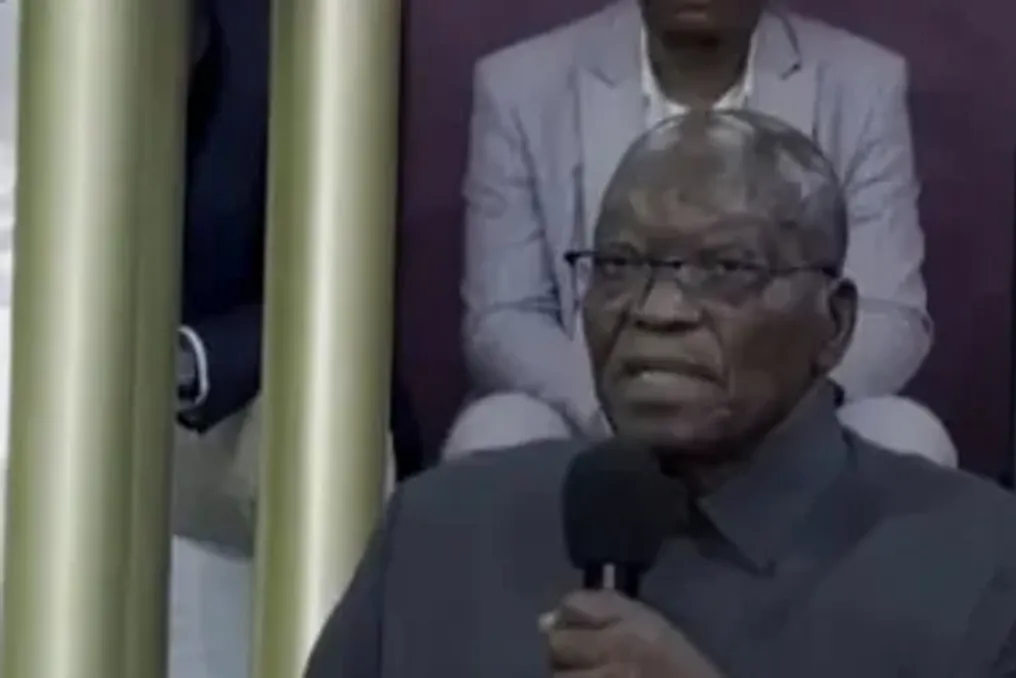
Jacob Zuma spoke in the Eastern Cape, telling his followers that South Africa is not free, that corruption is deeply rooted, that white minorities control the economy and laws, and that the party created for liberation has failed. This address was described as a masterful performance, completely detached from any need for accountability.
The former president, who oversaw the systematic looting of state resources, now positions himself as the liberator of the same nation he emptied. This is not electoral amnesia or irony; it is calculated political theatre. A man who spent nine years dismantling institutions designed to limit power now proclaims his sacrifice.
Under his leadership, the 'Scorpions' unit, which could have interfered with his preferred patronage networks, was disbanded, and the rule of law became negotiable. State appropriation became the basis of governance, and now the same former president speaks of corruption as if his hands are clean.
Zuma's genius has always been in identifying legitimate grievances and using them for personal gain. Rural poverty is real, land injustice remains unresolved, and traditional leaders have been marginalized. These points are not fabrications.
However, listening to him, one might imagine that he did not spend the last fifteen years strengthening his faction, eliminating rivals, and preparing his family for dynastic succession within the MKP structure. The cohort exiled from the ANC along with him now serves as his tool. The people he promoted and discarded are merely remnants of his ambitions.
Consider the mechanics of his operation. He arrives in rural areas where unemployment is acute, services are collapsing, and despair is the currency. He claims their suffering is caused by someone else. He asserts that traditional leaders lack authority and that elections against them are fraudulent, and that he represents the solution.
He does not mention that his son is preparing for the presidency, that the purge of those who served him has already begun, and that the ruthlessness characterizing his presidency remains the dominant instinct of his politics. He used people then, and he uses them now. The mechanism is identical; only the scale has diminished.
His strategic brilliance lies in simplicity. Zuma does not require a coherent political platform; he needs only a complaint. He needs the ability to identify what causes pain and amplify it. In traditional leadership, he found an electorate that was genuinely abandoned. In the promise of land restitution, he appeals to a real historical wound. But his method is the same as during his presidency: defining power, finding its levers, and relentlessly pressing them.
His assertion that elections are run by white people is crude enough to attract his base and vague enough to avoid empirical verification. It is wrapped in falsehood. While some electoral processes do grant privileges to certain interests, listening to him, one might think he lost the elections rather than won them through patronage and state resources. One can imagine that the electoral commissions certifying his victories were somehow independent of his influence. The tactical genius lies in half-truths that contain enough recognizable facts to appear true.
What makes Zuma extremely dangerous is precisely this: he is neither an ideologue nor a reformer stuck in compromise. He is a master of power tactics. He understands that despair breeds susceptibility, and hope, once awakened, is hard to extinguish. That rural communities, deprived of investment and attention, will respond to a figure who speaks their language and promises their restoration.
But he will restore nothing. He will consolidate, distribute patronage according to loyalty, and pursue his enemies with the methodical precision he cultivated over decades. Traditional leaders whom he currently flatters will find the limits of their restored authority when he clashes with his broader objectives. Young unemployed joining the MKP will discover that membership is valuable only insofar as it serves his strategic positioning.
The speech in the Eastern Cape is not a governing plan; it is a sounding test. Zuma is checking whether the electorate has forgotten his track record. Is the passage of time dulling our memory of Gupta? He has always been a student of human nature. He understands that people believe what they want to believe. That the guilty party, admitting to corruption, somehow deserves more trust than the accused. That a person who has survived prosecution becomes a victim in the eyes of his supporters, not a defendant.
The mathematics of his calculation are cruel and transparent. The ANC is fragmented, the opposition is scattered, and traditional institutions are weakened. A disciplined faction with access to resources and a message tuned to anger can indeed change the political landscape. He does not need to win; he only needs to prove that the stakes remain high, that creating a king is still possible, and that neutralizing him is more valuable than his hostility.
This is the essence of the rhetoric of freedom and corruption: not liberation, but leverage. Not restoration, but revival. Not the return of the nation, but the repositioning of a man.
The tragedy is not that Zuma speaks of real suffering. The tragedy is that he speaks of real suffering in service of personal ambition. The tragedy is that legitimate grievances become mere tools in a larger game of power accumulation. The tragedy is that the real problems of South Africa find their voice not in servants of the public interest, but in people whose primary interest has always been their own.
Standing in the Eastern Cape and listening closely, you hear not the birth of a movement, but the resurrection of a familiar pattern. And if this pattern teaches us anything, it is this: never confuse the eloquence of complaint with commitment to reform.
But beneath the surface of the current address by Zuma lies something more sinister. History offers a warning we must heed. In July 2021, when the Constitutional Court moved toward sentencing him for contempt, when the prospect of imprisonment became concrete rather than theoretical, unrest flared up in the Eastern Cape and KwaZulu-Natal. Shops were looted and burned, infrastructure was destroyed, and security forces were overwhelmed. This destruction was calculated to redirect attention from his legal troubles and demonstrate his capacity to mobilize chaos.
Some may argue that the civil unrest was organic, spontaneous, an inevitable burning away of accumulated rage. Perhaps. But geography told its own story. Coordination in his strongholds was too precise. The scale of destruction in provinces where his political machine remained untouched was too concentrated. And the timing, occurring at the very moment his conviction became inevitable, pointed to something more than coincidence.
The Eastern Cape is Zuma's final sound check. He is testing whether South Africa is ready to trade stability for his return. Are we ready to forget that a man who faced the consequences of his actions uses chaos to evade responsibility? Do we understand that for such a man, burning the country is preferable to his own submission to the law?
The authorities have a golden rule: observe what a person does when cornered. Zuma, when cornered, does not repent, nor does he negotiate; he burns. He mobilizes his networks to destabilize, using the legitimate anger of the disenfranchised as an accelerant for his own preservation. In 2021, he proved he would sacrifice the country's stability to avoid prison. In 2026, he returns to tell you what your liberation means.
Do not mistake this for inconsistency; it is the purest consistency imaginable. A man who will burn KwaZulu-Natal to avoid jail will certainly burn the entire nation if it serves his reassertion of power. The arithmetic is simple: if the country collapses enough, if the state becomes weak enough, if the institutions decay enough, then a strong man with access to resources and a faction of devoted followers becomes not a risk, but a solution.
This is the ultimate goal he is testing. Not the revival of traditional leadership, not the restoration of land, not the liberation of the poor. But the creation of enough chaos so that his return to power becomes the lesser of two evils. A man who presided over state appropriation now offers himself as a savior from state collapse. A man who hollowed out institutions now offers himself as their restorer. A man who proved willing to burn provinces to evade accountability now promises to heal the nation.
South Africa must see clearly. We can pretend this is just another political movement. We can view his words as opposition rhetoric. We can hope that institutional safeguards will limit him if he returns to power. We can tell ourselves that the man has changed.
Or we can remember July 2021. We can acknowledge what we saw then. We can understand that when a man has already demonstrated his willingness to destabilize the country to avoid personal accountability, his subsequent promises of restoration are not commitments, but threats cloaked in the language of liberation. And we can look at his recent visit to India to meet with the Guptas, the architects of state appropriation, those very fugitives he once defended. His meeting with these insatiable thieves sends one message. Not a message of redemption, but a message of contempt. A finger pointed at every South African affected by the devastation wrought by these people. Perhaps they will fund his party. Perhaps they already are. The point is this: a man who shares bread with the enemies of the state while proclaiming himself a savior has declared his true priorities. They are not yours. They never were yours.
Zuma will not save South Africa. He will burn it to rule from the ashes.