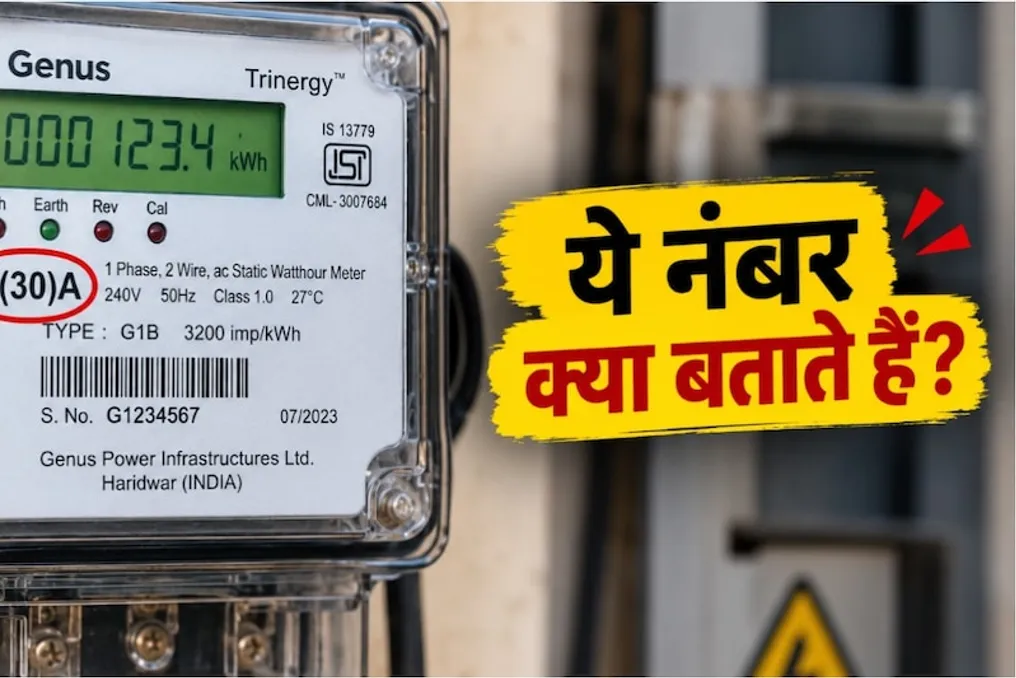
The electricity meter installed in a house is constantly visible, displaying energy consumption, voltage, and other data. However, there is one inscription that most people ignore—the nominal current characteristic, such as 5(30)A or 10(60)A. This raises the question: what do these numbers mean? Can a 5(30)A meter only be used up to 5 amperes, or up to 30 amperes?
The answer to this question is more complex. If the meter indicates 5(30)A, the outer number, 5 amperes, denotes the base current, and the number in parentheses, 30 amperes, is the maximum current. This means the meter uses 5 amperes as its base or reference current, while its installed maximum nominal characteristic is 30 amperes. Similarly, 10(60)A indicates a base current of 10 amperes and a maximum nominal characteristic of 60 amperes.
According to the Indian standard IS 13779, when marking the meter current, the base current and the maximum nominal current are used. The technical specifications of the Government of India's smart meters also provide for such ratings as 5-30A and 10-60A for single-phase meters.
Many mistakenly believe that if a meter says 5(30)A, it will shut off if the current exceeds 5 amperes. This is a common misconception. 5 amperes is the meter's base current, whereas 30 amperes is its maximum nominal characteristic. The same applies to 10(60)A, where 10 amperes is the base current and 60 amperes is the maximum nominal characteristic.
To simplify understanding, if the meter is 5(30)A: 5A is the base current, and 30A is the maximum nominal current. If it shows 10(60)A: 10A is the base current, and 60A is the maximum nominal current. Thus, the number in parentheses reflects the meter's maximum nominal characteristic.
The presence of the 10(60)A marking does not mean the electricity bill will be higher. The meter only records the current actually consumed by appliances in the house. The consumed current constantly changes depending on the total load when devices such as a fan, refrigerator, television, air conditioner, water heater, or motor are running.
At a voltage of 230 volts, you can calculate the approximate load: 5 amperes multiplied by 230 volts yields about 1.15 kilowatts, and 30 amperes multiplied by 230 volts yields about 6.9 kilowatts. Similarly, 10 amperes × 230 volts equals about 2.3 kilowatts, and 60 amperes × 230 volts equals about 13.8 kilowatts. However, it is crucial to understand here: these calculated values should not be taken as the limit of the allowed load in your home; the actual permitted or connected load is determined by the electricity distribution company and differs from the meter rating.
Meters are marked with the base and maximum nominal current so they can accurately measure electricity consumption under various load conditions. According to IS 13779, the base current and maximum nominal current are part of the marking for full-current meters. The technical specifications of Indian electricity distribution companies also use meters with ratings such as 5-30A and 10-60A. For example, the technical specifications of the West Bengal electricity distribution company provide for a meter with a base current of 10 amperes and a maximum current of 60 amperes.
Therefore, when looking at a meter, 5(30)A should be read as: 5 amperes is the base current, and 30 amperes is the maximum nominal current. And 10(60)A is read as: 10 amperes is the base current, and 60 amperes is the maximum nominal current. The most important thing is not the allowed load in your home. These figures are intended to help understand the electrical nominal characteristic of the meter itself.