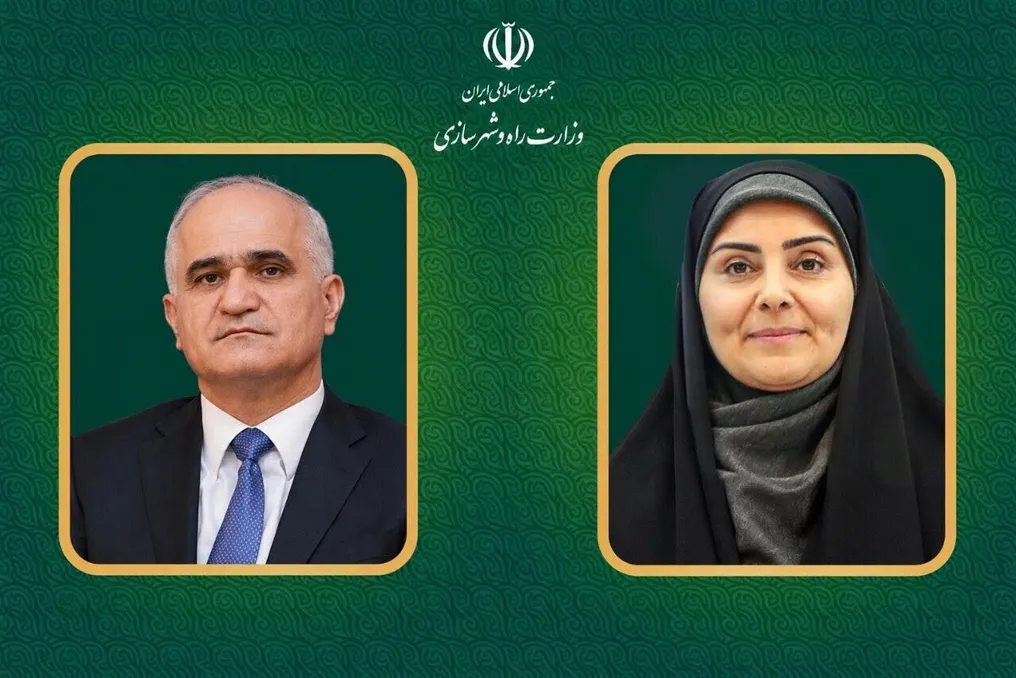
Iran's Minister of Transport and Urban Development, Farzaneh Sadeghi, and Azerbaijan's Deputy Prime Minister, Shahin Mustafaev, held a phone conversation to review recent developments in bilateral relations and explore ways to expand economic ties, particularly in the areas of transit, energy, and border infrastructure.
According to an IRNA report from the Ministry of Transport and Urban Development, both sides assessed the growing trend in bilateral relations and stressed the importance of continuing high-level consultations.
Farzaneh Sadeghi, referencing specialized meetings in the gas, electricity, and transport sectors, called for accelerating the creation of joint committees to monitor and implement decisions made at these meetings.
The Minister of Transport and Urban Development noted that despite existing difficulties caused by recent regional tensions, restoring damaged routes has become a priority, and the process of completing current infrastructure projects continues without interruption.
She linked the strengthening of relations between Tehran and Baku to the will of the presidents of the two countries and the close interaction of executive leaders at various levels.
Shahin Mustafaev also expressed satisfaction with the progress in implementing railway projects during the call. He reported that the railway section within Azerbaijan up to the Aghband region is complete, and after the section in Iran is finished, it is expected to bring about a significant transformation of the region's transit and logistics potential.
Praising the professional work of Iran's Ministry of Transport and Urban Development in repairing infrastructure damage, he added that the Iranian government's determination to revive and activate transit corridors is an admirable approach.
At the end of the conversation, the sides exchanged views on recent regional events and emphasized that deepening strategic and economic cooperation is the main pillar of stability and development in the region.
As a decisive step signaling a new phase of regional economic integration, Iran and the Republic of Azerbaijan are actively increasing bilateral trade and transit cooperation through a series of high-level agreements, infrastructure projects, and measures to simplify customs procedures. This momentum, driven by political will at the highest level and supported by tangible results at border crossings, positions the two neighbors as strategic partners in connecting the Caucasus, Central Asia, and the Persian Gulf.
The center of this economic rapprochement is the Bileh Savar border crossing in Iran's northwestern Ardabil province—a 24-hour customs point that has become a vital artery for trade. In the last year alone, $268 million was exported through this crossing, demonstrating its growing capacity to handle increased commercial volumes. This figure is particularly important as the period coincided with external pressure and regional instability, highlighting the resilience of the Iranian border economy and its ability to maintain trade flows even in difficult conditions.