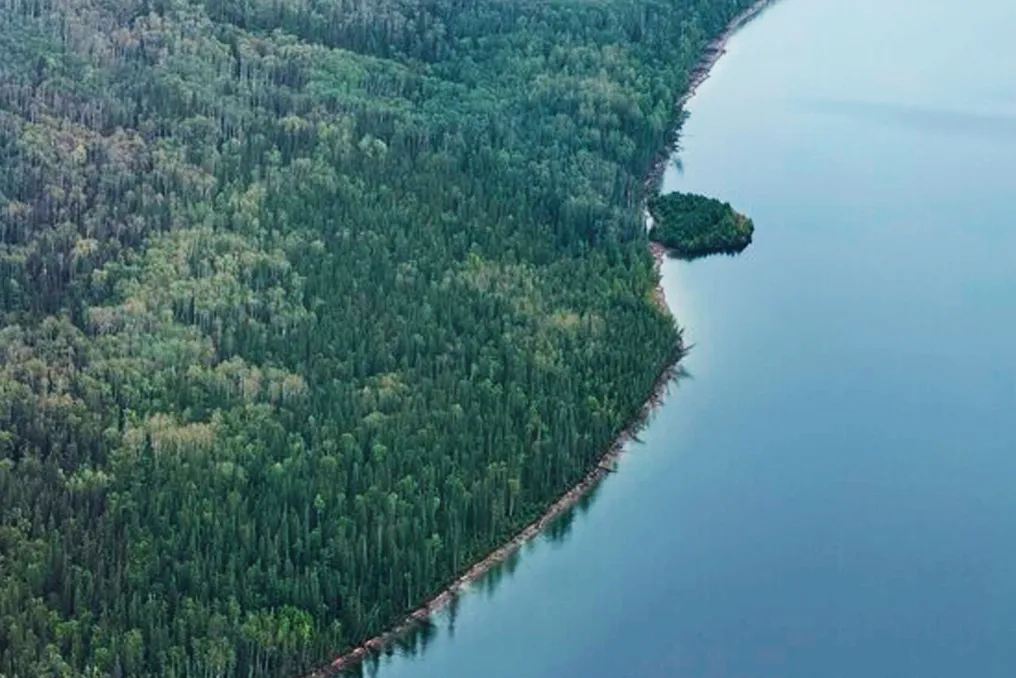
In mid-August, a sailor shared a video on Facebook showing a newly discovered island in Lake Williston. The image captured a medium-sized island covered with tall trees and dense vegetation, raising questions about how such a formation could suddenly appear.
Lake Williston, located in Canada, is an artificial freshwater reservoir created in 1972 and is known for its detailed maps. It represents the seventh largest reservoir of this type in the world, covering an area of 1,773 km², slightly larger than the Itaipu reservoir. Traditionally, all islands in the lake were known to sailors and fishermen.
Upon receiving the video, the lake's administrators, BC Hydro, initially expressed skepticism, considering the possibility of it being a fabrication due to the proliferation of generative artificial intelligence. Initial reports of the sighting were few, and the island seemed to have vanished in the following days, like an optical illusion.
However, the mystery of the island attracted attention. At the end of the month, reports from sailors, including new photographs from the first reporter, were cross-referenced with satellite imagery and aerial photos. On August 31st, BC Hydro confirmed that the island had already been registered on the map since July 21st.
It was verified that the supposed phantom island was not fixed to the lakebed, but rather a floating island. With approximate dimensions of 70 meters wide by 140 meters long, it is equivalent to two soccer fields. Although floating islands are usually smaller, they can occur in large reservoirs, forming from the accumulation and decomposition of logs and debris over years, which creates a fragile substrate where vegetation can establish itself.
Bob Gammer, spokesperson for BC Hydro, suggested that the island's appearance was linked to the lake's water level. After a period of heavy snowfall in winter and a particularly rainy summer, the lake reached its maximum level, forcing the opening of spillway gates for the first time in 14 years. Gammer explained in an interview with CBC that when reservoirs are full, higher water levels can mobilize materials trapped near the shore, in a protected bay, allowing them to float freely.
He added that although the exact origin of the floating island cannot be determined, this is a plausible explanation. Currently, the island poses no risk to the dam and is situated against a riverbank. Nevertheless, sailors and fishermen were advised to exercise caution due to this unmarked obstacle.
BC Hydro invited visitors and drones near the island but warned that one should not disembark on it, as the soil composed of decomposing debris is unstable. According to Gammer, besides public curiosity, the island sparked interest from geologists, ecologists, and other researchers focused on the formation and movement of floating islands with vegetation. The spokesperson concluded that while the location has been confirmed, the discovery raises new questions, and monitoring will continue to better understand its origin and displacement.