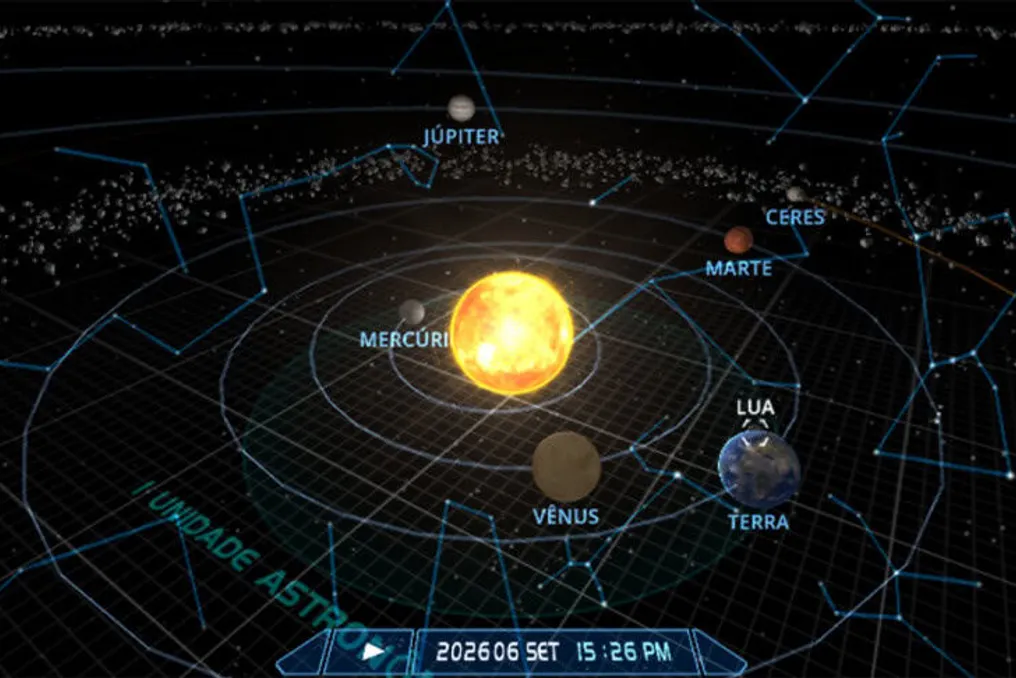
The Moon will visit Mars this Sunday (6) as part of the September 'tour' of the Solar System planets, in an event called an astronomical conjunction. This phenomenon occurs when two or more celestial bodies share the same right ascension, which corresponds to terrestrial longitude.
According to the observation guide InTheSky.org, the conjunction will happen at 3:26 PM Brasília time. At this moment, both celestial bodies will be located below the horizon line, making them invisible. However, during the early morning hours of Monday (7), specifically between 2:50 AM and 5:30 AM, they will remain close enough to be seen with the naked eye by anyone wishing to prolong their vigil to observe the sky.
During this period, the Moon will be in the waning phase, presenting a magnitude of -11.1, while Mars will have a magnitude of 1.1. Both will be located in the constellation Gemini. It is important to note that the brighter an object, the lower its magnitude; the Sun, for example, has an apparent magnitude of -27, being the brightest body in the sky.
Although the pair is not close enough to be captured in a telescope, it will be visible both to the naked eye and using binoculars.
How to identify Mars near the Moon
To distinguish which bright point near the Moon is Mars, simply consider the planet's proximity to Earth, which gives it great luminosity in the sky, and its distinctive color, red. This time, Mars will be positioned south of the Moon. Therefore, when observing the Moon, which will be nearly new in the sky with only 18% luminosity, one should look for a small orange sphere just below it to identify Mars.
The characteristic reddish hue of Mars has always aroused interest, generating associations with deities and warlike activities. In Greek mythology, Ares, the god of war, was often associated with this color. Interestingly, the brightest star in the constellation Scorpius, Antares, received this name due to its reddish tone, referencing Ares, meaning 'Anti-Ares'.
Later, with Roman influence in Europe, Ares was renamed Mars, a name given to the planet and which remains in use today. The red coloration of Mars results from a complex interaction between the composition of its surface, its atmosphere, and various geological phenomena.