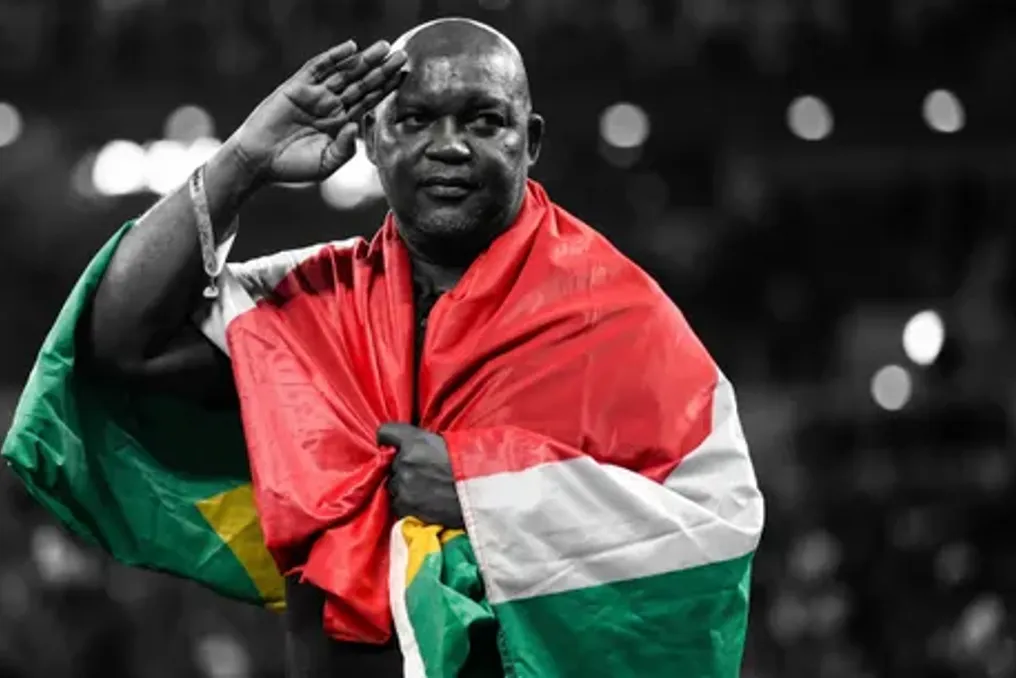
Pitso Mosimane reappeared at the SAFA House on Tuesday to confront his past. Fourteen years after a humiliating dismissal following a modest win percentage of 39.1%, Mosimane returns to the 'Bafana Bafana' squad. However, given the short memory of the fans, will he achieve ultimate redemption?
Unsuccessful matches in Mbombela against Sierra Leone and the subsequent draw with Ethiopia eight months later ended his first stint. In 23 matches played from 2010 to 2012, his record was nine wins, ten draws, and four losses, resulting in a modest 39.1% win rate before his contract was terminated and his public standing undermined.
When the 62-year-old tactician stepped onto the podium on Tuesday to be officially presented as the head coach of 'Bafana Bafana', he came to complete unfinished national business. Despite a resume adorned with FIFA Club World Cup trophies and awards, Mosimane remains a sought-after figure. He could easily have accepted generous offers from North Africa, the Persian Gulf, or Asia, where huge contracts and state budgets were available. Nevertheless, he chose 'Bafana Bafana' because he is driven by an internal, insatiable thirst for success where the stakes are highest.
Despite club dominance, Mosimane understands that winning domestic and regional titles was only the beginning; elevating his country to the level of a sustainable international power will be his true greatest achievement. His future path is defined by a large-scale strategic vision. The first step is the complex task of qualifying for the 2027 Africa Cup of Nations in East Africa, where one mistake in a dangerous group of three teams can lead to disaster. Next is the bigger goal—passing through the extended qualification cycle for the 2030 World Cup, which covers Morocco, Portugal, Spain, and South America.
While others might have crumbled after leaving in 2012, Mosimane built an empire on ruins. At that time, on the verge of dismissal, he issued a prophetic warning to the resistant federation: 'We do not want to admit that the world is catching up to us... We must accept reality.' Instead of lagging behind, he stepped out and conquered that reality. Over the next decade and a half, he traveled across the continent and the world, studying elite structures and collecting trophies under intense scrutiny.
He transformed 'Mamelodi Sundowns' into an unstoppable domestic force, and then won the continental title in 2016. In Cairo, he worked with 'Al Ahly', winning two consecutive CAF Champions League titles in 2020 and 2021, reaching three consecutive continental finals, and securing two FIFA Club World Cup bronze medals. Subsequent appearances in Saudi Arabia, the UAE, and Iran further broadened his horizons.
Addressing the press, Mosimane emphasized the vast difference between the man who was fired in 2012 and the decorated leader at the microphone, pointing to the cumulative weight of his achievements. He reminded those present that during his first spell, he didn't even win a single domestic cup, noting that his past is now separated from the present by 21 major medals, including participation in four FIFA World Cups at both the club and international levels. For Mosimane, the personal and tactical foundation necessary for success at this level is fully prepared.
There is an undeniable truth in appointing a local son to lead the national team; in every FIFA World Cup since 1930, the winner has always been a domestic coach. In nearly a century of world football, only two foreign tacticians ever reached the World Cup final. International football at its peak requires an understanding of the soul of the nation, its culture, and its psychology, which a hired mercenary cannot replicate.
However, this does not mean that South Africa is ready to fight for the World Cup title; maintaining prospects remains important. Nevertheless, trusting a man affectionately known as 'Jingles' is not an act of sentimental charity, but aligns with the most enduring law of football.
Although the playing squad is far from dismantled, Mosimane returns to an administrative sphere burdened by familiar, protracted inertia. SAFA House remains a turbulent landscape, currently overshadowed by public disputes over government development grants, unused VAR funding, and structural delays that continue to attract ministerial attention. This is the very environment Mosimane warned the country about fourteen years ago: the global game is moving at hyperspeed while the local administration stumbles.
To succeed, the new head coach must create a modern, highly effective on-field environment that operates completely outside administrative noise and friction. This depth of experience is vital, as the incoming coach inherits a high-quality squad. Hugo Broos' departure after five strong years led him to guide 'Bafana Bafana' to bronze at AFCON 2023 in Côte d'Ivoire and advance the team to the 32nd round of the 2026 World Cup in North America. Broos restored international prestige; now the task is to turn this foundation into trophies and guaranteed World Cup qualification.
It is important to note that Mosimane will not dismantle what works. He made it clear that he is not going to 'sweep the house clean'. He acknowledges that the current squad includes elite individual pillars such as Ronwen Williams and Tebogo Mokokeng, as well as stars like Relebogile Mofokeng, Shpefelo Sithole, and Mbekezeli Mbokazi, among many others. Instead, he is bringing in his trusted technical team to raise daily standards. Responding to talk of building his own staff instead of retaining temporary assistants, Mosimane justified his decision by citing an elite international precedent, mentioning Carlo Ancelotti's success with his son, as the world game judges only the final result, not the bench composition. He embraces this pressure, openly admitting that public criticism serves as his primary fuel.
However, long-term dreams are worthless without immediate execution. His main goal begins on the pitch, where he faces the treacherous waters of the 2027 AFCON qualification campaign against Guinea, Eritrea, and co-hosts Kenya. Since Kenya qualified automatically, Mosimane faces a ruthless environment where only one team emerges from the group. This is an immediate task requiring relentless focus before any talk of the 2030 World Cup goals can occur.
This is a coach who knows the national structure inside out, having played four matches and scored a goal in his international debut against Gabon in 1993. Representing his country as a player and leading teams at the highest level of world football, he returns home with perspective and a refined tactical plan. Following the announcement on social media, waves of skepticism naturally erupted, as cynical fans once again raised old wounds and questioned whether repeating a familiar path was the right decision. However, online comments cannot erase a resume forged in gold across Africa. Mosimane earned this opportunity through a decade and a half of tireless, proven work. Weekly results will determine his immediate survival, but his legacy will define his career. In his second stint, Mosimane stands at the threshold of his defining moment—transforming 'Bafana Bafana' into a sustainable global force, ensuring that the son of his land, who once failed in Mbombela, leaves South African football fundamentally changed for generations to come.