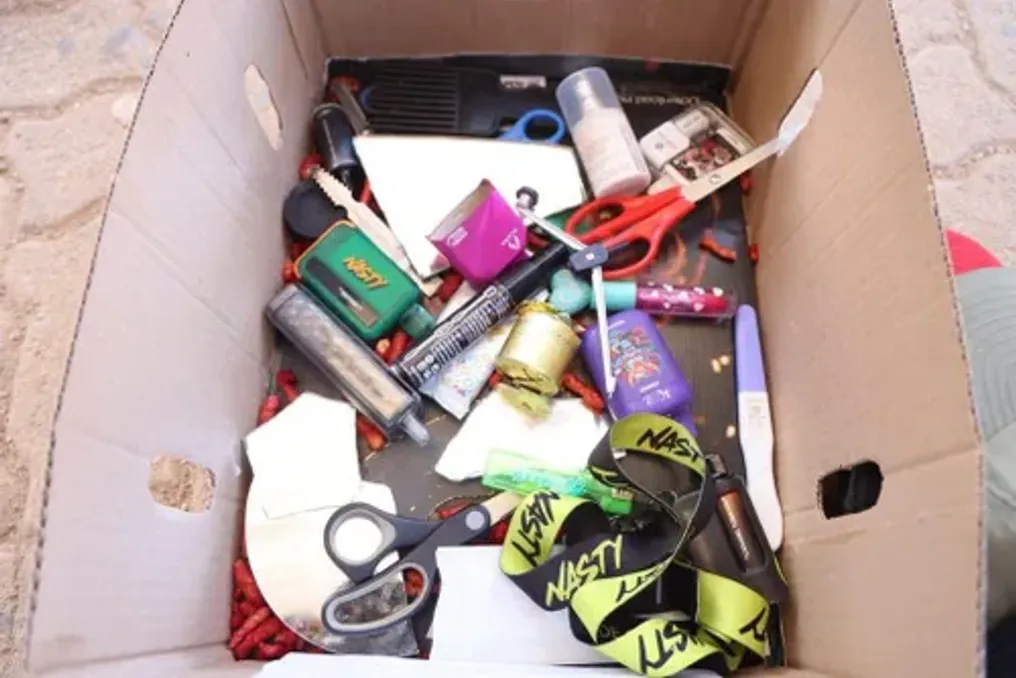
Recent safety raids in Gauteng schools have revealed serious issues that children face even before starting their education. The Gauteng Department of Education conducted a series of operations to search for and seize items aimed at removing drugs, dangerous weapons, and other prohibited items from educational institutions.
Among the seized items published after the raids were expected items such as cigarettes, vapes, drugs, matches, knives, and similar objects like shards of glass and mirrors. However, unexpected items also appeared in the images: scissors, rulers, and dividing tools—items considered integral parts of school supplies, especially for those studying mathematics.
The Department explained that these items are not automatically prohibited; they were confiscated because some of them were used or modified for purposes unrelated to education. According to the South African Schools Act, items necessary for legitimate educational purposes can be authorized and used. Nevertheless, an ordinary item can be deemed dangerous depending on how it was altered, held, or used, as well as the circumstances of its discovery.
Operations in Gauteng and Seized Items
These actions followed recent search and seizure operations in Gauteng this week. The operation was led by the Gauteng Minister of Education, Lebogan Mabile, who accompanied police and other law enforcement officers during the raids. According to the department, 123 prohibited items were seized from six schools. These included 43 disposable vapes, 29 pairs of scissors, four knives, 10 broken mirrors, five boxes of matches, 30 drug-related items, one mathematical instrument, and one space cookie.
The Gauteng Department of Education emphasized that the seizure of scissors and mathematical instruments during such operations does not mean a complete ban on using ordinary learning materials. The department stated that the operations are aimed at eliminating drugs, dangerous weapons, and other prohibited items, as well as strengthening safety and discipline and creating a safe learning environment.
However, the inclusion of items such as scissors and mathematical instruments raised questions about how the department distinguishes between dangerous objects and ordinary classroom equipment that may have legitimate educational use. Scissors are regularly used by students for classwork, and mathematical instruments, such as rulers and dividing tools, may be needed for various lessons.
Department Clarifications Regarding Stationery Ban
In response to IOL queries, the department reported that the search and seizure operations are conducted by the police, other law enforcement agencies, and private security companies to enhance safety in Gauteng schools. Department representative Onvabile Lublelvana clarified that ordinary learning materials are not automatically considered prohibited. He added that some scissors and learning materials seized during the operations appeared to have been modified or used in a way that could make them dangerous, and SAPS, as on-site safety experts, deemed them unsafe.
Lublelvana also noted that some scissors had suspicious traces of daggy, indicating they were used for cutting daggy rather than paper during lessons. When asked if ordinary school supplies are now banned in Gauteng schools, he replied negatively. He reiterated that scissors, rulers, dividing tools, and other legitimate learning materials are not automatically banned, citing the South African Schools Act.
He stressed that there is no new policy declaring scissors as weapons. The problem arises when scissors or other ordinary items are modified, misused, or possessed for non-educational purposes. During this operation, some scissors had suspicious traces of daggy, while others were deemed unsafe by SAPS due to their condition and circumstances of discovery.
Classification of Seized Items
Lublelvana explained that the 123 items represent the total number of prohibited or unsafe items seized, and this does not mean all 123 were drugs or dangerous weapons. He listed them: four knives, 30 items with suspected spice oil, one suspected space cookie, 43 disposable vapes, 29 pairs of scissors, 10 pieces of broken mirror, five boxes of matches, and one mathematical instrument. According to him, the classification of these items is not identical.
He concluded that the department's position is clear: legitimate learning materials are not the target. The targets are drugs, dangerous weapons, and ordinary items that are modified or misused in a way that threatens school safety.
Student Conduct Issues and Human Rights Reaction
Student behavior in schools, particularly verbal abuse and disrespect towards teachers, has once again drawn attention. This occurred after the circulation of a video showing a student verbally abusing a teacher in the North West region. The North West Department of Education condemned the incident, stating that it undermines the authority of educators and threatens the safe and respectful environment that schools should provide. Department representative Dr. Elias Malindi reported that the matter has been referred to the relevant district office, and the school has been instructed to follow proper disciplinary procedures.
He emphasized that such behavior is unacceptable, and disciplinary action will be taken, with psychosocial support provided to both the student and the educator if necessary. The department also urged parents and guardians to take greater responsibility for teaching children respect, accountability, and discipline at home, insisting that these values must also be reinforced in the classroom.
Meanwhile, the human rights organization SECTION27, which uses litigation, advocacy, and research to defend the right to basic education and healthcare, stated that the items seized by the police may violate students' right to basic education. Jonathan West, a SECTION27 candidate attorney, stated that the right to basic education includes adequate sanitation, provision of learning and teaching materials (LTSM), nutrition, and furniture. He noted that the items seized by SAPS could be classified as LTSM and thereby violate students' right to basic education.
West added that it needs to be determined whether this constitutes a justified restriction of rights. The assessment should consider the purpose of the seizure, as well as the context in which these seizures occur, such as whether they were related to acts of violence in the school. He stressed that a school or SAPS cannot confiscate items without a justifiable reason.
Calls for Safeguards During School Inspections
West believes that the most crucial safeguard is ensuring that seizures are conducted in accordance with the law. This requires a fair and reasonable suspicion, as well as consideration of the best interests of the students, their health and safety, and an assessment of reasonable evidence. He acknowledged that school safety is a growing concern, and the Department of Education must use the tools available to it in accordance with the law to protect students.
Education activist Hendrik Makaneta stated that ordinary items should not automatically be considered dangerous or prohibited. He noted that the key factor is the context of discovery, including modification, misuse, or the presence of a real risk to safety. Schools should avoid excessive restrictions that may hinder teaching and learning, especially in subjects requiring these tools. He called for schools to have very clear guidelines to facilitate compliance.
[ ]