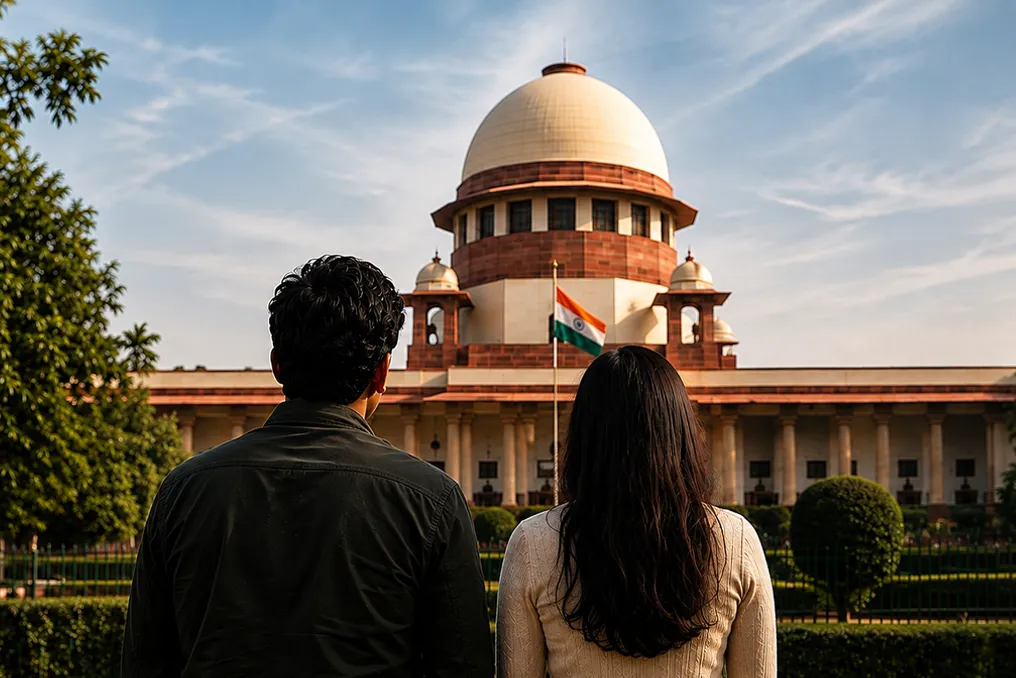
A couple who has lived together for more than ten years may face pressure from family, which can escalate into threats. In such cases, they can approach local law enforcement, but the lack of response often forces them to take further action.
Around August, the situation of a couple in Delhi, who had been living together since 2014, became known. The woman's father and brother expressed their disapproval, which turned into threats of violence. They filed a complaint at the local police station on August 6th but received no subsequent response.
As a result, the couple approached the High Court of Delhi. On August 13th, Judge Saurabh Banerjee ruled that adults have an unlimited right to choose a partner and live with them, and no one else, including parents or brothers, has the right to interfere.
The judge also ordered the Vijay Vihar police station to provide protection to the couple if necessary, regardless of where they move.
It is important to understand that parents, relatives, or friends do not have a legal right to dictate whom you live with; this is enshrined in the Constitution. Lalita Sudakaran, a family law specialist from Chennai, explains that Articles 19 and 21 guarantee the adult person freedom of choice and the right to life and liberty, and neither of these provisions makes exceptions for unmarried couples.
Two Supreme Court judgments confirm this position. In the case of Nandakumar versus the State of Kerala, the court ruled that adults can live together regardless of whether they are married. Furthermore, in the Hadiya (Shafin Jahan versus Asokan K M) case in 2018, it was stated that controlling personal choice under the pretext of 'social morality' is not just an abuse of power but also deprives a person of their identity.
Moreover, police protection can be demanded even without a marriage certificate. Senior Advocate Karthikeyan Subaraj notes that cohabitation is part of the right to life under Article 21, and courts have repeatedly relied on this argument when considering cases of protection and maintenance for people in similar situations.
You are also protected in such cases. The Protection of Women from Domestic Violence Act of 2005 does not require marriage. It covers any 'relationship in the nature of marriage,' allowing one to seek a protection order, the right to remain in the shared home, and compensation for violence—physical, emotional, or financial—on the same grounds as a wife.
However, certain conditions must be met to apply this law: both must be adults and free to marry, they must have been living together for a long time, not spontaneously, and they must present themselves to the world as a couple. Courts also consider joint finances and household management, but casual or short-term relationships, or those where a partner was previously married, do not fall under the law.
In case of separation, if the relationship was long-term and functioned like a marriage, maintenance can be claimed. The law, previously Section 125 of the Criminal Procedure Code (CrPC), is now included in the Bharatiya Nagarik Suraksha Sanhita, and courts apply it specifically for such cases. Additionally, a 2019 order expanded the possibilities for receiving funds under the Domestic Violence Act compared to the maintenance law.
If the couple has children, they are not left in limbo. Courts have repeatedly stated that children born in cohabitation are legitimate and have the same rights to inherit parental property as any other child, except ancestral property. This principle is also applied when determining custody and guardianship.
In summary, none of this is illegal. In 2010, the Supreme Court rejected the idea that cohabiting outside of marriage is a crime or a moral failure. In 2022, the Kerala High Court went further, ruling that adults can live together regardless of gender, extending the same protection to same-sex couples.
None of the above provisions are contained in a single law; they are formed by judicial decisions over the last 15 years. This means the degree of protection can vary greatly depending on the specific judge.
For example, in 2021, a bench of the Punjab and Haryana High Court denied protection to a threatened couple, stating that it would 'disrupt the social fabric.' Comparing this with the Delhi ruling from August shows that two courts, separated by five years, reached almost opposite conclusions on the same issue.
Kataria explains that the outcomes of such cases often reflect the personal sense of morality of the judge more than the actual provisions of the Supreme Court. Subaraj agrees that courts rely on correct arguments, but 'repetition does not mean consistency.' Advocate Shantanu Tewari points to a broader problem: there is no special government mechanism to turn to in case of threats, which forces many to file petitions in constitutional courts instead of waiting for a standard police response.
Some states have begun to fill this gap independently. For instance, in Uttarakhand, starting January 2026, the Unified Civil Code requires couples living together to register their relationship with the state, providing them with clearer rights in exchange for increased state control.
Lalita advises first filing a written complaint at the local police station and not leaving without confirmation—such as a certified copy or at least a complaint number/FIR number. This is your paper trail.
It is necessary to document everything: save threatening messages, call logs, voice notes, and record witnesses. If there is a specific incident, a medical certificate or a photograph from that day will significantly strengthen your position.
If the police are slow, you should escalate the situation: send a written application to the Deputy Commissioner of Police or an equivalent senior officer in your city, mentioning the original complaint number.
If that does not help, a petition to the High Court is the strongest step, as it is what provided protection to the couple in Delhi. After obtaining a protection order, keep it with you and submit a copy to the local police station.
According to lawyers, if threats originate from within the relationship rather than from the family, the path is different. One can directly approach a protection officer or a registered NGO service provider in their district or a magistrate's court, without requiring a prior police complaint. These structures are obligated to help draft a Domestic Incident Report, upon which the court acts.
During the process, it is important to preserve everything that proves cohabitation: joint accounts, joint address on identification, photographs, acquaintances who knew you as a couple. This is exactly what the court will look for. If you plan to claim maintenance, the same evidence is important: duration of cohabitation, division of finances, and how the world perceived you as a couple. It is worth starting to collect this evidence now, while things are good.
If you have children, register the birth, listing both parents, as early as possible. This record is usually the first one consulted by courts and institutions regarding inheritance or custody matters.
The local or state legal aid authority (DLSA/SLSA) provides free legal assistance, including help with filing a petition in the High Court, if cost is an issue. The NALSA helpline, 15100, can direct you to the nearest legal aid center. A protection officer or registered NGO service provider is a direct way to file a domestic violence complaint without a prior police complaint. A practicing lawyer is necessary for a High Court petition, as this is the most reliable route if local police are inactive.
In short: file a written, confirmed complaint at the local police station and keep the number. Save every threat, message, and witness detail as they arise. If the police do not act, escalate in writing to a senior officer, referencing the initial complaint. If stuck, file a petition in the High Court—DLSA/SLSA or the NALSA helpline (15100) can provide free legal aid. If the danger comes from the relationship, contact a protection officer or NGO directly. Once you receive a protection order, keep it and submit a copy to the local station.
Nevertheless, for the couple in Delhi, the August 13th matter was not about legislative proceedings; for them, it was more specific and smaller—an order that could be taken and brought to the police station. Twelve years after choosing each other, the law finally formalized it in writing. The choice was always theirs, and it always will be yours.