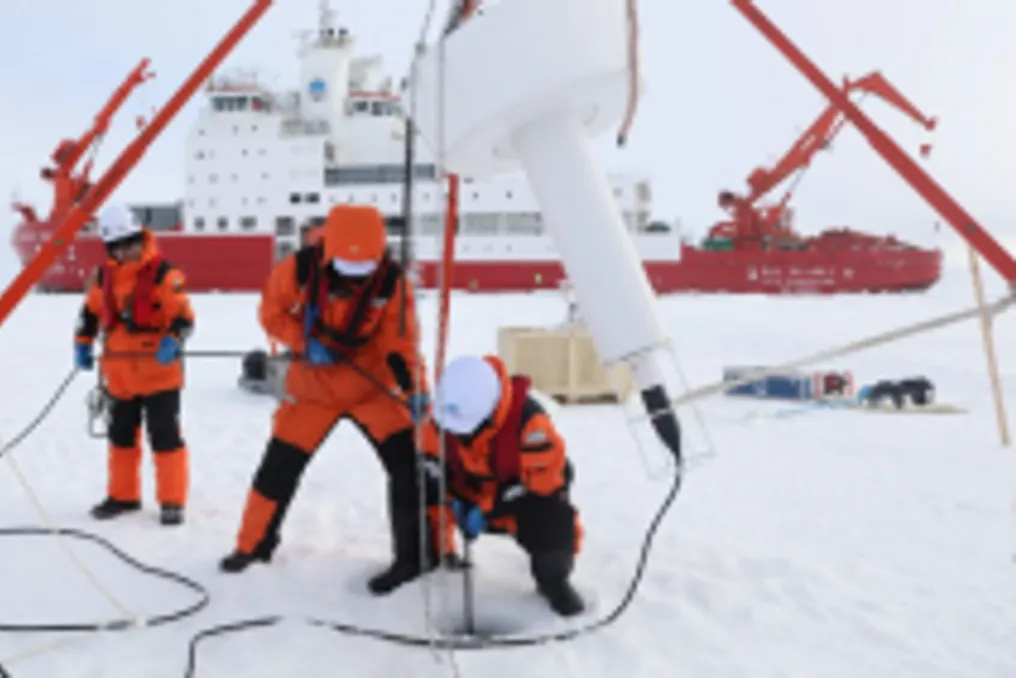
Aboard the icebreaker 'Xuelong 2', which is currently participating in China's sixteenth Arctic expedition, Chinese researchers jointly conducted sea ice observations in the Arctic Ocean with two Russian scientists from the Institute of Arctic and Antarctic Research.
This marked the first joint field work between China and Russia in the field of sea ice monitoring. Lin Lun, head of the sea ice group aboard 'Xuelong 2', reported that before entering the Arctic ice zone, Chinese and Russian specialists discussed their standards and methods for observing the ice. They found significant overlap in the main observation areas and exchanged views on some differences.
The reduction of Arctic sea ice is one of the most significant changes in the Earth system over the last nearly fifty years and is considered an indicator of climate change. Joint observations are conducted manually during navigation from the vessel.
Researchers record the concentration, type, size, and thickness of sea ice, as well as the thickness of the snow cover. Compared to remote sensing data from satellites, onboard observations provide higher spatial resolution, are less affected by cloudiness and fog, cover the entire sailing route, and allow for more detailed measurements of ice thickness. Thus, the collected data can complement satellite observations.
Lin noted that the parties conducted round-the-clock visual observations of the ice conditions along the vessel's route, documenting irregular changes in sea ice and its thickness. Furthermore, the observations were expanded to include basic atmospheric conditions, vessel-related parameters, and large animals. Lin added that compared to previous Chinese Arctic expeditions, this joint observation proved more practical, as it not only deepens the understanding of changes in Arctic sea ice but also considers its potential support in ship design and assessing navigability in icy waters.
Both sides emphasized that the joint observations provided important information about the Arctic summer sea ice, contributing to the assessment of changes in Arctic sea ice and the ocean, and improving the understanding of the climate change process. This cooperation also allowed the parties to exchange experience and knowledge in the field of sea ice observation, laying the foundation for further international interaction.