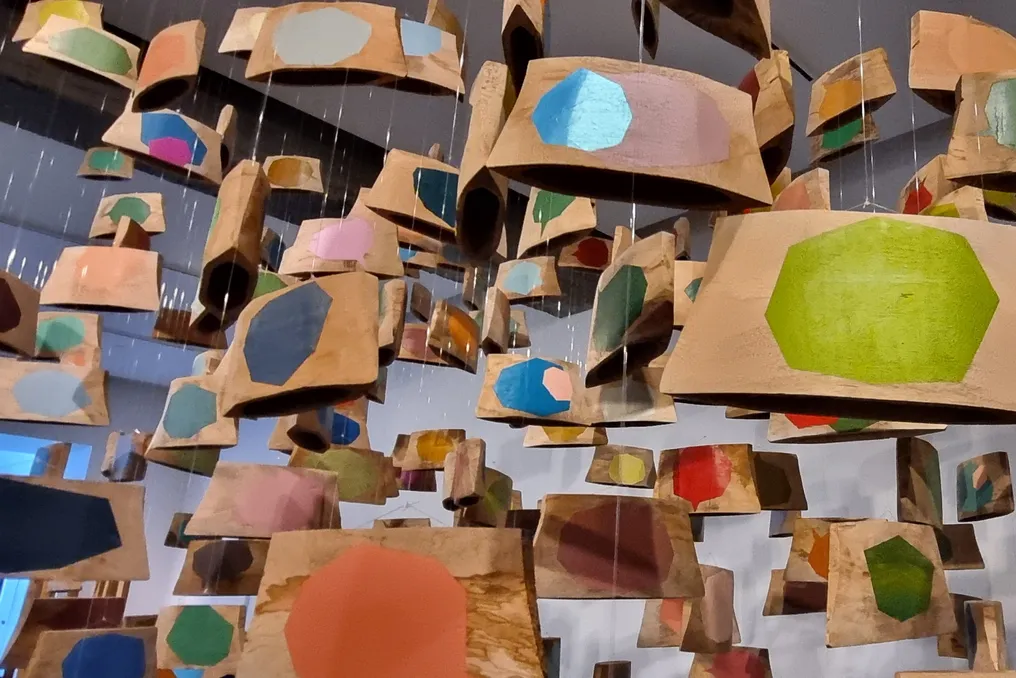
The Montreal Museum of Fine Arts (MMFA) is hosting a nine-month exhibition titled 'Beyond the Pedestal'. This exhibition showcases sculptures from the museum's collection spanning from the 1960s to the present day.
The sculptural exhibition is curated by Iris Amizlev, Curator of Special Projects at MMFA. According to the curatorial notes, the exhibition presents diverse sculptural processes and materials. The featured works illustrate the freedom that sculptural form can offer creative communities, and many of them question conventional notions of what constitutes sculpture.
Some pieces may be placed not only on pedestals but also on the floor or walls. Others are site-specific installations, integrating into the surrounding environment. This photo essay features some of the works included in the special selection, as well as other exhibits housed in the museum.
Artists participating in the artistic program include Rajni Perera, David Altмейd, Ari Bayuadi, Stanislav Libenský, Yaroslava Brychtova, Richard Artschager, Starling Ruby, Magdalena Abakanowicz, John Paul Robinson, Fausto Malotti, Masakazu Kobayashi, Jacopo Foggini, Ulysses Comtou, and Massimo Herrera.
Rajni Perera, an artist from Sri Lanka based in Toronto, creates multidisciplinary works combining sculpture, textiles, clay, wood, lanterns, new media, and synthetic taxidermy. Her figures possess a dreamlike quality and help shape alternative visions for diaspora communities.
David Altмейd is a Canadian sculptor known for his surrealist works featuring fragmented bodies, crystals, mirrors, and architectural structures. He represented Canada at the Venice Biennale in 2007, and his works are held in major international collections.
Ari Bayuadi is an artist from Indonesia who moves between Montreal and Bali. Initially trained in civil engineering, he later studied fine arts at Concordia University. His works utilize found, discarded, and everyday materials collected from various locations.
Stanislav Libenský and Yaroslava Brychtova created glass sculptures. They experiment with geometric forms in their collaborative projects, expanding the application of glass in conceptual expression.
Richard Artschager was an American artist whose work occupied an unusual space between pop art and everyday design. His sculptures often imitated furniture items, but did so in a provocative and unconventional manner.
Starling Ruby is an American artist of Dutch descent who works across several disciplines: sculpture, ceramics, painting, collage, textiles, photography, video, and installation. He frequently uses inexpensive or industrial materials, challenging the distinction between 'high' and 'low' art.
Masakazu Kobayashi is a Japanese artist who pioneered the development of fiber art. He is known for transforming threads and textile materials into large-scale spatial installations that explore nature, cosmos, and balance.
Magdalena Abakanowicz is a Polish artist who also explored the potential of fiber as a sculptural material. Her massive suspended fibrous constructions transformed textiles from flat decorative surfaces into immersive three-dimensional spaces.
John Paul Robinson is a Canadian glass sculptor who explores themes of nature, mythology, science, time, and elements. The combination of technical experimentation and philosophical inquiry lends his glass sculptures a unique contemplative quality.
Fausto Malotti is a multidisciplinary Italian artist whose work connected sculpture with music, mathematics, geometry, and abstraction. Despite training in electrical engineering, he created diverse ceramic creations with surreal elements.
Jacopo Foggini is an Italian artist and designer who transforms industrial plastic materials into luminous installations. His works often resemble glowing organic forms, corals, branches, and even fantastical structures.
Massimo Herrera is an Italian artist based in Montreal. His work investigates the relationships between bodies, language, objects, and environment. Social interaction becomes an important artistic material in his creations.
As shown in this photo essay, visiting a group exhibition of sculptures and installations offers an experience that goes beyond simply viewing an image on a wall. The details and angles of the sculpture change as one moves around it.
When artists incorporate texture, sound, light, and unexpected materials, they open up new possibilities for viewers. The group exhibition makes this experience particularly engaging, as the works seem to enter into a dialogue with each other. One sculpture might feel intimate and fragile, while another might be humorous, anxious, or playful. Moving from one piece to another creates a rhythm of surprise and contrast.
Viewers are constantly engaged in negotiating the relationship between the objects, the gallery architecture, and their own bodies within the space. Thus, the exhibition is perceived not only intellectually but also physically. Sculpture demands a more active gaze and forces viewers to acutely perceive their own scale relative to the artwork. Installations can go further, incorporating the gallery itself into the artwork.
Such exhibitions also possess a wonderful unpredictability. Sculptures and installations often reveal themselves gradually as one approaches them. Shadows shift, surfaces catch the light differently, and unforeseen connections arise. Ultimately, the pleasure comes not only from appreciating individual artists but also from immersing oneself in a temporary landscape of forms, materials, ideas, and sensations.