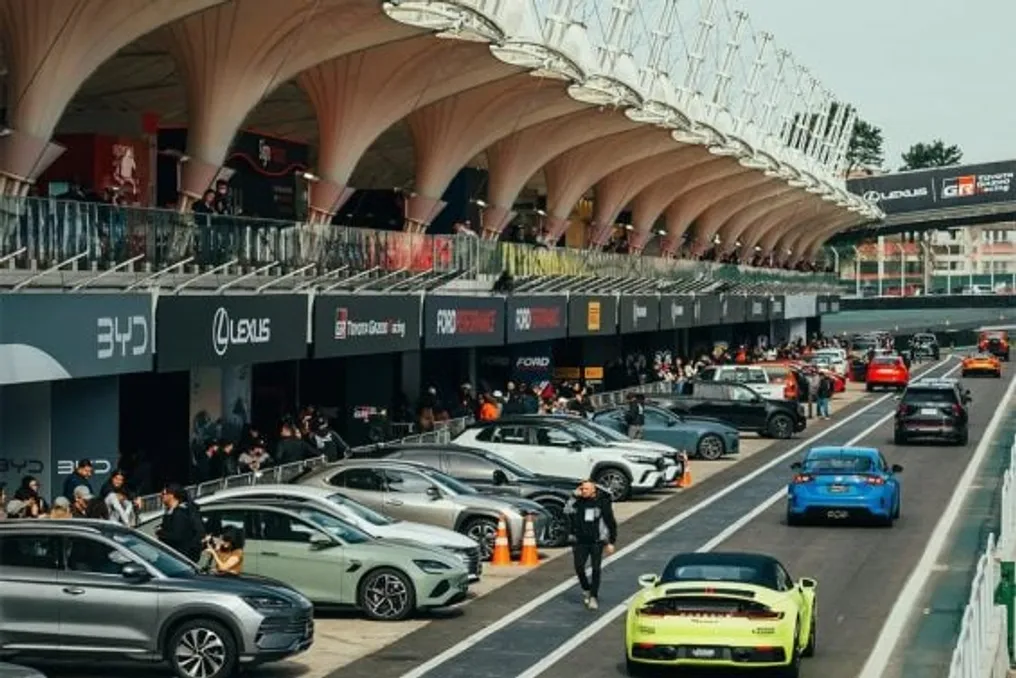
The Interlagos Festival consolidated its success with the dynamic format, being classified by the organization itself as the largest global event focused on experimentation in racetracks. The festival's structure was expanded, including a new 15,000 m² pavilion and a convention center, in addition to the traditional VIP areas.
The event featured the presence of 32 brands, 14 of which were Chinese. Some companies that did not participate included Audi, Caoa Chery, Chevrolet, Citroën, Nissan, and Mercedes-Benz. Volkswagen established a partnership with Mercado Livre in a dedicated booth, while Chery presented other vehicles from its group, such as iCaur, Jetour, and Omoda & Jaecoo.
The insurer Suhai was the festival sponsor. Over three days of realization, the event attracted 215 thousand visitors and enabled 15.2 thousand track tests, consisting of two or three laps accompanied by an instructor. A total of 36 launches and demonstrations were presented, covering new models, versions, pre-launches, and unprecedented products for the Brazilian public.
Global Brands' Innovations
BMW exhibited the iX3, a compact SUV equipped with two electric motors, generating 469 hp and 65.8 kgf·m combined, scheduled to arrive at dealerships on the 24th. Ford confirmed the availability of the F150 Raptor pickup truck, with 450 hp and 70 kgf·m, in the first quarter of 2027.
Among the innovations from China, Dongfeng stood out, operating as DFM and planning to launch ten models by 2028, with plans for local production. GAC presented the GS9, a large plug-in hybrid SUV, offering 500 hp and 62.5 kgf·m for R$ 399,990.
IM Motors, MG's luxury brand, displayed the IM6, a large electric coupe SUV, powerful with 767 hp and 81.7 kgf·m, reaching 0 to 100 km/h in 3.5 seconds. The Jaecco 8, another large seven-seater SUV, plug-in hybrid, with 605 hp and 66 kgf·m, estimated at around R$ 300,000, was also shown. Baic had the Arcfox T1 electric vehicle available for pre-sale next month, with an estimated price of R$ 150,000, and the T5 is expected in 2027. The Omoda E5, another Chinese electric model, will have an entry-level version costing about R$ 150 thousand.
BYD Geely, with national production of the EX5 EM-i at the Renault factory in Paraná, displayed the customized EX2 Street and Track versions. The 2027 Kwid was presented with a redesigned grille and bumper, along with promotional offers. Abarth, belonging to the Stellantis Group, showed the Pulse Scorpioníssima, still in market study phase. Finally, BYD displayed the Mako, an intermediate pickup prototype focused on urban use and flexible plug-in hybrid powertrain, destined for production in Camaçari (BA), competing in price with Toro, Rampage, Maverick, and future Niagara and Tukan.
Brazilian Consumer Perception of Artificial Intelligence
The interest of the Brazilian consumer in incorporating artificial intelligence (AI) into vehicle choice is already a reality, although there is caution regarding total control of the automobile. A survey conducted by Webmotors Autoinsights, involving 1,600 platform users, revealed that 51% of respondents expressed interest in cars with AI features (with 22% being very interested and 29% interested).
However, acceptance drops drastically when it comes to 100% autonomous driving, without any human intervention, with only 12% stating full trust in this capability. The data indicates that AI is primarily seen as a driving assistant, not as a complete replacement for the driver. While 60% would accept the technology's assistance in navigation and internal adjustments, 37% would approve its use in active safety systems, such as automatic emergency braking and collision alerts, relegating full automatic driving to a secondary role.
In terms of most desired functionalities, the order of priority was: collision/safety alerts (45%), preventive mechanical diagnosis (44%), smart routes (34%), and fully autonomous driving (only 10%). Despite this, the concept of AI is well assimilated by the public: 54% understand or already use AI tools, 30% know about the topic, and only 8% declare ignorance.
Despite high theoretical acceptance, cost remains a significant obstacle, as 57% of respondents stated they would not pay extra for AI in the car. Of those willing to invest, 20% would accept an increase of up to 5% over the original vehicle price. Eduardo Jurcevic, CEO of Webmotors, concluded that AI has ceased to be a future technology to become an expectation of a standard item, as consumers value it alongside safety, practicality, and mechanical predictability, seeing it as part of automotive evolution, not as a separately paid accessory.