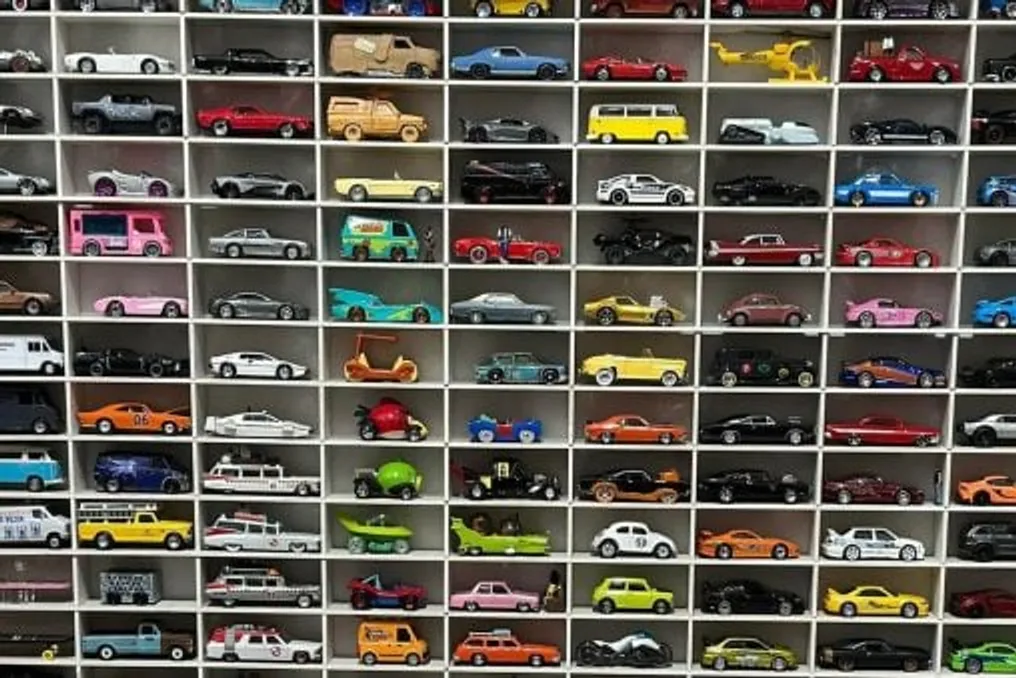
Starting to collect miniature cars can be motivated by childhood memories, a casual find, or simply the desire to replicate in reduced scale a striking car from a certain phase of life. However, due to the vast quantity of models, brands, special series, and releases available, this activity risks becoming an unlimited collection, including financially.
Felipe Novoa, a collector and owner of the Sala de Minis store located in Mirassol (SP), advises that collecting should remain a pastime. He emphasizes: 'Remember that this is a hobby. You have your obligations, like paying bills, rent, and making purchases. Don't think you will complete the collection because it is infinite.'
Although the advice seems simple, it is crucial in a market where supply has increased significantly and acquisition has become much more accessible. Whereas previously one needed to look for miniatures in physical stores, nowadays, online sales platforms, collector communities, and social networks facilitate finding models from various manufacturers with just a few clicks, which increases the chance of impulse buying.
The primary tip for beginners is to define a specific focus. The collection can be directed towards cars of a particular brand, national models, sports vehicles, racing cars, Formula 1, automobiles from a specific decade, or those that appear in cinematic and television productions.
Felipe Novoa himself went through several stages before consolidating his niche; currently, his main focus is on cinema-related cars, especially models from the 1980s and 1990s, citing the DeLorean from Back to the Future as an example.
Establishing a theme serves to restrict options. Instead of trying to acquire everything presented, the collector begins to analyze whether the miniature in question aligns with the purpose of the collection. This theme can be further refined, such as in a Formula 1 collection, which can focus on drivers, teams, historical periods, or specific cars. The same principle applies to national models, allowing the choice of vehicles manufactured in Brazil, from a defined decade, or even cars with a family connection.
Inspiration for the theme can also come from emotional memory. Miniature cars belonging to parents, grandparents, or friends may hold greater sentimental value than rare or expensive models. This emotional bond helps justify why miniature collecting transcends the mere search for market value, as a model can symbolize a father's first car, a childhood wish, or a vehicle frequently seen in a film.
Before acquiring new items, it is suggested to sift through the cars stored for years, as old toy boxes may contain forgotten models. According to Felipe, it is worth investigating these pieces to see if any spark interest for collectors.
Another common mistake among novices is the belief that a collection must be complete. In the miniature segment, the concept of a finished collection is practically nonexistent. As he explains, 'Manufacturers constantly release new models, while different scales, versions, colors, and special editions multiply the possibilities. Even within a single theme, the number of pieces can grow rapidly.'
The collector also needs to learn how to deal with releases that do not fit into their collection. Finding an attractive miniature does not automatically mean it should be bought. A practical tactic is to set a monthly budget, which should be established after covering essential expenses, not before them, ensuring that purchasing an item does not compromise other needs.
Miniatures related to films, characters, drivers, or famous cars can quickly generate demand. This happens when a manufacturer announces a specific model or when a film, series, or competition gains renewed attention. This demand can influence prices, especially when a specific model enters the market in limited edition. In some situations, initially cheap pieces begin to be traded for much higher values among collectors.
Therefore, caution is needed when paying a high price just because a model is trending. The goal should be to own a desired piece in the collection, and not necessarily to buy it with the intention of future resale. Furthermore, it is essential to avoid turning the search for a miniature into a constant pursuit. Although searching in stores, events, and groups is part of the fun, it should not dictate the pace of the collection.
Collector communities help reduce costs. Groups on social media and messaging apps allow people with similar interests to find each other, negotiate models, and exchange them. A miniature that interests one collector may be exactly the item missing from another's collection. Trading also allows correcting impulse buys and realigning the collection with the chosen theme.
Unboxing events are another frequent practice. At these gatherings, sealed boxes of miniatures are opened publicly, allowing for the discovery of more coveted models. The experience also serves as a meeting point for enthusiasts of the same hobby.
Another initial aspect to define is the scale. Models in the 1:64 proportion, like traditional smaller cars, take up little space and allow for accumulating a large volume of vehicles. Larger scales, such as 1:43, 1:32, 1:24, or 1:18, offer a higher level of detail but require more space and generally represent a considerably higher investment per unit. There is no mandatory scale to start with; the decision depends on available space, budget, and the profile of the desired collection.
It is equally important to plan the storage location. A collection that grows without organization can occupy closets, shelves, and even entire rooms. Thus, physical space must be considered before any purchase.
Collecting can serve as leisure and a way to connect with automotive culture, encompassing the search for models, creating scenes, customization, and interacting with other collectors. However, the hobby loses its positive character when it starts generating financial or family problems.
In summary, the rule is to impose limits before the collection establishes them on its own. Defining a theme, choosing a scale, setting a budget, controlling space, and accepting that some items will be left out are ways to keep the activity under control. As Felipe Novoa summarizes, the ideal is to collect with 'focus, prudence, and responsibility,' because there will always be a next model, but it doesn't always need to be on your shelf.