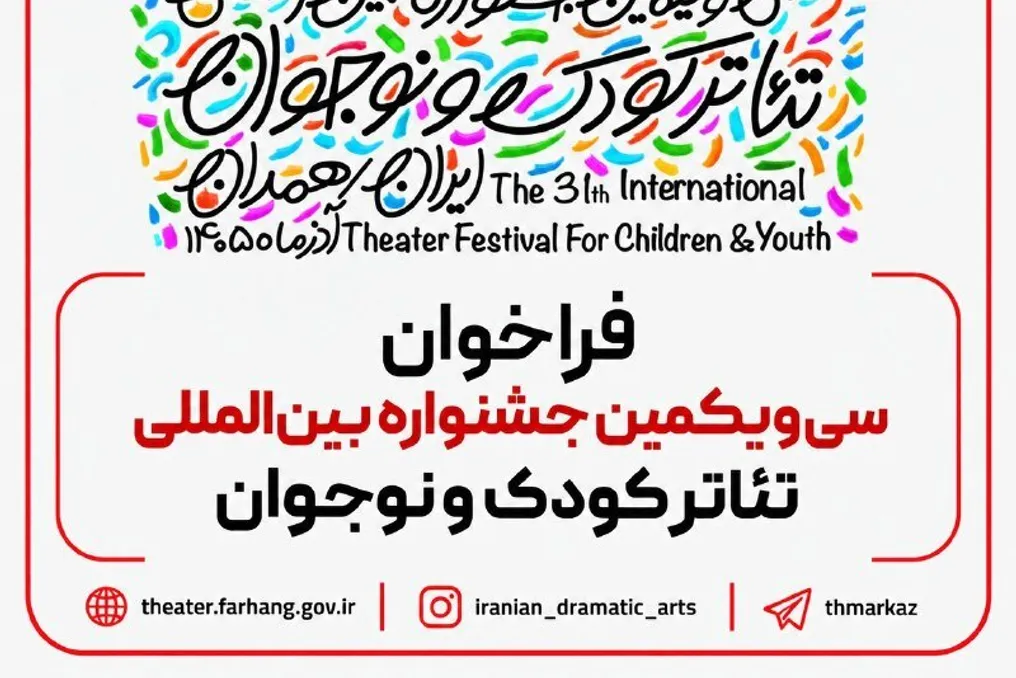
An invitation has been published for submissions to the 31st International Festival of Theatre Art for Children and Youth of Iran. The festival is scheduled to take place from November 29 to December 4 in the city of Hamedan and will be overseen by Iranian theatre figure Marzieh Borumand.
The event operates under the slogan 'The well-being of today's children is the well-being of tomorrow's Iran' and will feature eight different categories. These include competitions for theaters for toddlers, children, and youth, as well as sections for street and alternative performances, dramaturgy, international productions, international theatre, academic seminars, and experience exchange sessions.
The festival accepts both previously staged and premiere-ready productions. The competition for toddler theatre places special emphasis on the active participation of young audiences in the performance process, the use of understandable imagery and language, and an appropriate running time. Up to seven productions will be selected, with preference given to those suitable for presentation in kindergartens, play centers, educational institutions, and similar venues.
Competitions for children and youth will also accept up to seven productions each. The section dedicated to street and alternative forms will cover theatrical works presented outside traditional theatre halls, accepting up to seven productions. The dramaturgy competition focuses exclusively on the theme of 'water and its significance for sustainable development, the resilience of Iran's land, and the necessity of water resource conservation.' Participants must provide a one-page synopsis along with their plays; previously staged or published works are not eligible for entry.
Furthermore, a non-competitive guest section will be organized, featuring productions selected by the festival director. Specialized festivals of children's and youth theatre may nominate their best works for consideration in this section. The international theatre section is intended for productions created by non-Iranian theatre groups.
Submissions to all sections must be made online via the festival website icy.theater.ir, attaching the required documents. Submissions will only be accepted during the specified registration period. Video recordings of performances can be uploaded via Google Drive links. These videos must be of sufficiently high quality for the selection committee to clearly assess the production and its artistic details; the festival secretariat does not impose specific requirements on filming methods.
For registration in all sections, written permission from the playwright, translator, or publisher is mandatory. Any production lacking the required permission at any point will be disqualified. The festival secretariat recognizes only the production's director as its artistic owner and leader of the participating group. Only complete video recordings of productions are accepted for the competitive sections. Each applicant may submit a maximum of two productions, but they can only participate with one work and in one section at the final festival.
Works that have participated in previous editions of the festival will not be accepted unless they have undergone substantial and obvious changes in staging structure, scenography, set design, or other artistic elements, and an updated version is presented. Registration begins on September 6 and ends on October 17. The deadline for submitting plays for the dramaturgy competition is November 1, and the results of advancing productions to the next stage are planned to be announced on November 1.
The International Festival of Theatre Art for Children and Youth of Iran is one of the country's major cultural events dedicated to theatre for younger audiences. Held annually, the festival brings together Iranian and international theatre groups, providing a platform for productions created for toddlers, children, and youth. In addition to competitive categories, it includes international and guest performances, street and alternative theatre, dramaturgy, as well as educational and research programs, aiming to promote creativity, cultural exchange, and new approaches to theatre for the younger generation.