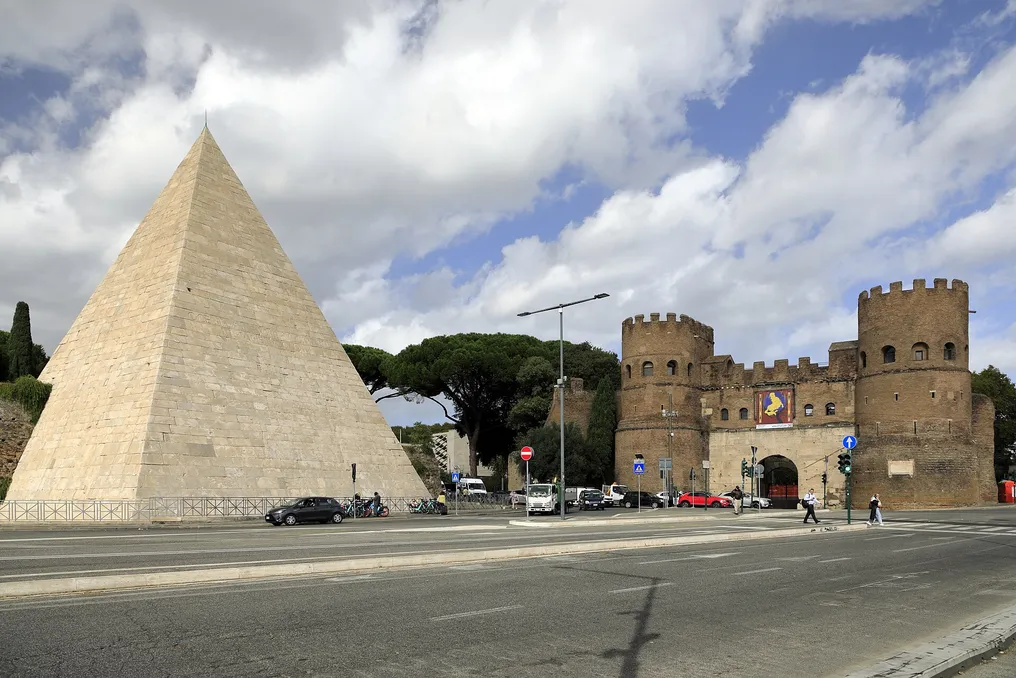
In Rome, just a few steps from the corner, stands a monument thousands of years old. Among such structures, the Pyramid of Chesterius stands out, resembling an Egyptian monument relocated to the heart of the Italian capital.
After a three-year closure for renovation work, the so-called 'Egyptian pyramid' of Rome reopened to the public on Friday (the 4th). The intervention allowed for the updating of the archaeological zone, improvement of safety and accessibility conditions, and the installation of a new lighting system.
The opening is initially temporary. Visits will be available until October 31st, on specific dates in September and October. Entry is free, but advance booking is required, depending on the availability of spots.
The pyramid's origin is linked to the influence of Egyptian culture on Rome after the conquest of Egypt in 30 BC. Elements of Egyptian architecture and religion spread among Roman society and reached the elite, who began incorporating pharaonic references into various buildings.
It was in this context that Gaius Cestius Epulon commissioned the construction of his tomb between 18 and 12 BC. Cestius was a Roman politician who held positions as praetor and tribune of the plebs, and was also part of one of the major priestly colleges of Ancient Rome.
The will stipulated very tight deadlines for the completion of the construction. The heirs had 330 days to finish the tomb, otherwise they risked losing their inheritance. Consequently, the pyramid had to be erected in less than a year. Moreover, this was not a small structure: the tomb is about 36 meters high and has a square base of approximately 30 meters on each side.
For a long time, the Pyramid of Chesterius was surrounded by many stories about its origin and purpose. One legend claimed that the monument contained the remains of Romulus, the founder of Rome. However, Latin inscriptions engraved on the pyramid's faces clearly indicate that Gaius Cestius Epulon was buried here.
The preservation of this structure was due to the decision of Emperor Aurelian. In the 3rd century, he incorporated the pyramid into the defensive system of the Aurelian Walls, built between 271 and 275 AD. Integrated into the fortifications near Porta San Paolo, the structure remained protected during an era when many monuments were dismantled or looted for the reuse of stones in new constructions. Decorative elements, such as frescoes with female figures, are still preserved inside the pyramid.
One of the main areas of work was lighting. The new system was designed to emphasize the volume of the structure and the preserved elements inside the burial chamber. The exterior area also underwent changes. The walking route received a new surface with improved accessibility, and the access steps were equipped with a new handrail. Furthermore, the complex's fences were modernized, and the entrance gates at Piazzale Ostiense were replaced.
To complement the updates, the gardens received improvements to the irrigation system, and information panels detailing the monument and its historical context were installed. These works are part of the Special Administration of Rome project, funded by the National Recovery and Resilience Plan (PNRR). The goal was to combine the preservation of the structure with ensuring the best conditions for visitors.
Evening guided tours are scheduled for September 4, 11, 18, and 25 at 7:00 PM, 8:00 PM, and 9:00 PM. Each session will last about 45 minutes and can accommodate up to 30 participants. Daytime visits are also planned for September 5, 12, and 19, as well as October 3, 10, 17, 24, and 31, always at 4:30 PM, 5:30 PM, and 6:30 PM. In these cases, the visit will be free, without a guide, and can accommodate up to 50 people per session. On European Heritage Days, September 26 and 27, a special program is scheduled from 10:00 AM to 4:00 PM, with hourly visits and a limit of 50 participants per slot. All visits are free, but pre-registration is mandatory.