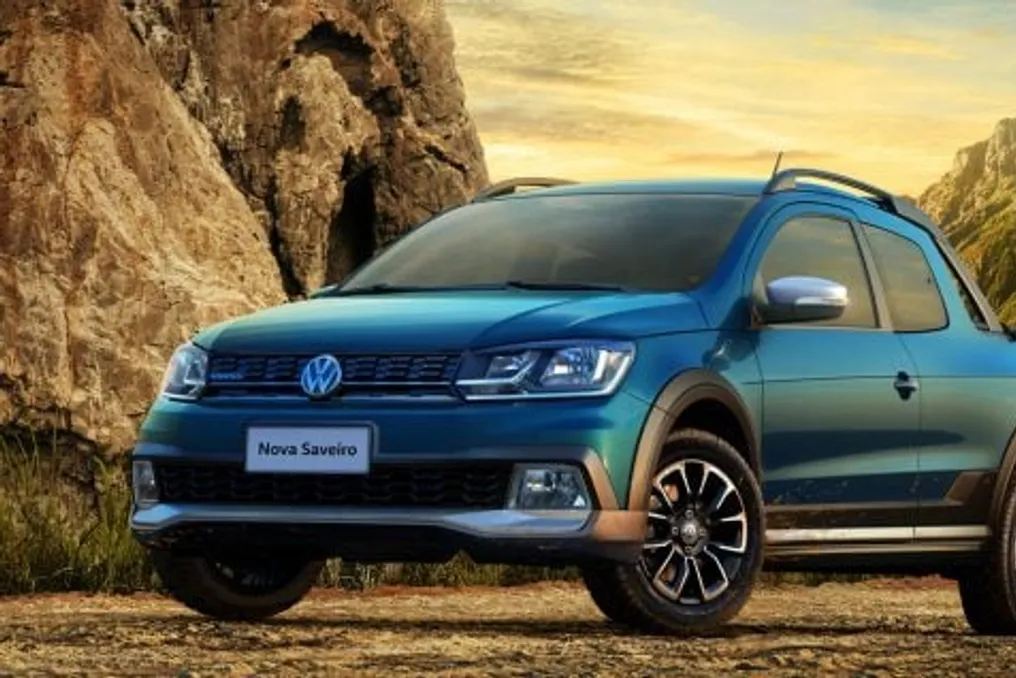
Volkswagen took some time to develop the adventurous Cross version for the Saveiro, but managed to create a compact model with an attractive style, designed to compete with the Fiat Strada Adventure, its main rival at the time.
Equipped with a 1.6 engine, off-road inspired details, and specific mechanical characteristics, the Volkswagen Saveiro Cross is currently a used choice for those looking for a more stylish pickup for urban use while maintaining functionality.
The history of the Volkswagen Saveiro began in 1982, being the first pickup derived from a passenger car from the German manufacturer. It was developed from the Gol and the BX Project to compete with the Fiat 147 Pick-up and the Ford Pampa, initially using a 1.6 air-cooled engine. In 1985, the vehicle started featuring liquid cooling.
The Gol family, to which the Saveiro belonged, was restyled two years later, and in 1988, Santana mirrors were added. There was a new update in 1991, followed by the inclusion of electronic injection in 1996. In 1997, the second generation, known as Bolinha, was launched.
The Saveiro continued to receive updates in 2000 and 2005, a period when TSI sports versions, flex engine, and special editions emerged. A precursor to the Saveiro Cross appeared in 2006 with the launch of the pickup's Crossover configuration.
The third generation was introduced in 2009, based on the new Gol and using the Fox's PQ24 platform, offering single and extended cabin options. The following year, Volkswagen made the Cross option available for the Saveiro.
The German pickup received a facelift in 2014. In the same year, Volks launched the double cabin option and introduced the 1.6 16V engine in the Saveiro line (including the Cross), along with stability control and four-wheel disc brakes.
In 2016, the Saveiro started presenting a distinct front end from the Gol after another design update. Although the pickup continues to be in production with over one million units sold in 44 years, it is expected to be replaced by the arrival of the Tukan.
The Volkswagen Saveiro Cross was launched in 2010, one year after the pickup's third generation (G5), which derived from the Gol launched in 2008. The adventure version debuted with an extended cabin, a new feature of this phase of the vehicle.
Initially, the Saveiro Cross came equipped with a 1.6 8V EA 111 engine and a five-speed manual transmission. In 2012, it received a white lighting dashboard. In 2014, it was updated along with the Volkswagen compact line.
The most significant change occurred in 2014, already in the 2015 line, when the Saveiro Cross began using the 1.6 16V engine from the EA 211 family. In addition to this more modern engine, it gained stability control and four-wheel disc brakes.
Shortly after, Volkswagen launched the double cabin body for the Saveiro, which was also available for the Cross version. In 2016, the pickup received its last facelift, as did the rest of the line.
The trajectory of the Saveiro Cross ended in 2023, when Volkswagen discontinued this configuration, being replaced by the Extreme, which remains the most expensive option in the line to date.
Visually, the Saveiro Cross stands out with adventurous style elements. Dark plastic moldings surround the front, rear, and wheel arches, and round auxiliary headlights accentuate the front look.
It uses 15-inch alloy wheels with all-terrain (ATR) tires for mixed use. Longitudinal bars on the roof integrate with the stylized tailgate, and the rear lid displays a sticker identifying the Saveiro Cross configuration.
The Saveiro Cross preserves the firm driving characteristic of Volkswagen models. The hydraulic power steering is direct and safe, and the body exhibits good rigidity.
The suspensions focus on comfort, especially at the rear, which uses a torsion beam with helical springs—a common solution in passenger cars, but one that affects load capacity. Despite the old platform (PQ24), the pickup performs well at high speeds and maintains stability even with an empty bed.
A negative aspect is the driving position: the seats are narrow, have insufficient lumbar support, and are short, which compromises comfort on long trips. The lever-style steering wheel height adjustment also makes it difficult to find the ideal posture.
Although there are criticisms regarding the use of a torsion beam and helical springs at the rear—given that the main rival, the Fiat Strada, uses a solid axle—the Saveiro Cross shows durability in daily use. On off-road terrain, the version benefits from a ground clearance exceeding 19 cm and an approach angle of 20.1 degrees, ensuring good performance for its purpose.