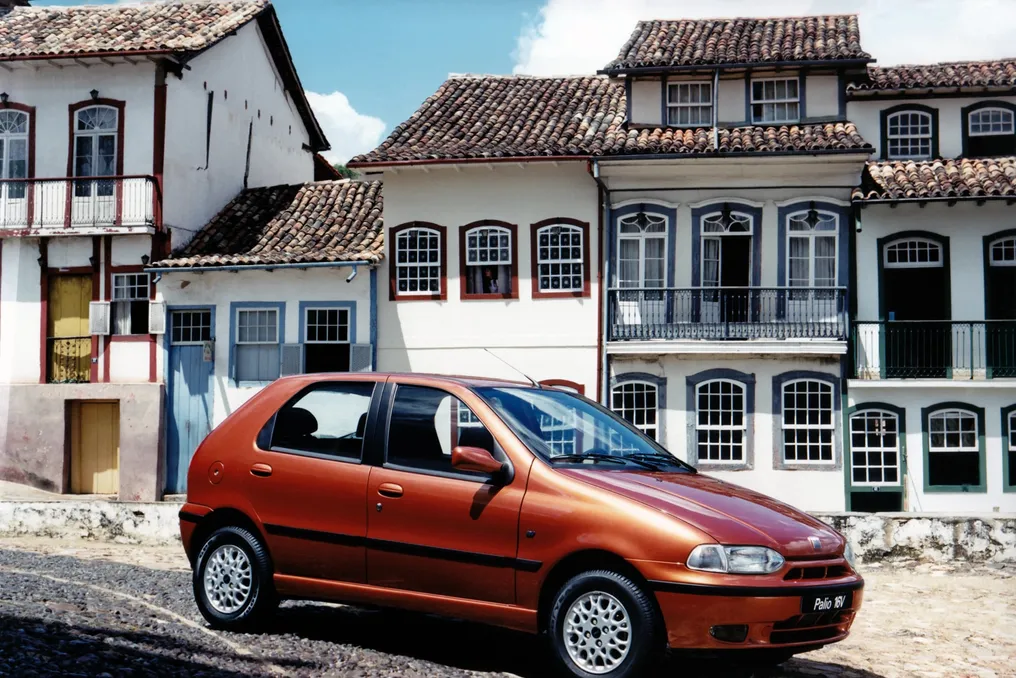
The launch of the Fiat Palio in Brazil is considered a significant milestone in the Brazilian automotive market, an event that occurred more than three decades ago. Fiat Automóveis introduced the Palio in April 1996, positioning it as a replacement for the Fiat Uno, which had been present in the country for over ten years.
Although the Palio was not as revolutionary as the Uno upon its original launch in 1984, it stood out as a compact car with modern and attractive lines. Its organic design, especially at the rear, caught the attention of keen observers.
A colleague who worked in the styling department at Volkswagen expressed admiration for the model's lines, noting the absence of sharp corners and the excellent resolution of the rear end. The headlight shape complemented the body curves, creating a harmonious and elegant look. The designer commented on the great effort by Fiat stylists to perfectly integrate the headlights into the rounded shapes of the rear steel panels, resulting in a unified appearance.
Beyond the rear, all the lines of the new Palio were harmonious, causing it to stand out positively compared to other national models of the time, such as the Gol, Fiesta, and Corsa.
The Fiat compact achieved immediate success. Already in 1997, the rest of the family was launched, including the Palio Weekend wagon, the Siena sedan, and the Strada pickup. All these vehicles derived from Project 178, conceived in Italy, whose first product was the hatchback launched in 1996 in two- and four-door versions.
At the time of its debut, the Palio offered various options for different consumer profiles. The ED version was the most basic, equipped with the 1.0 Fiasa engine. The EDX model provided a more refined finish while maintaining the same engine. The EL came with an intermediate finish and a 1.5 engine with multi-point injection. For enthusiasts, the 1.6 16V Sport version imitated the style of traditional sports cars from the Italian brand, offering a variety of options that surpassed the competition.
The Fiat Palio was in production from April 1996 until November 2017, totaling just over 21 years of manufacturing. A notable achievement in its trajectory was surpassing the Volkswagen Gol, which had led the Brazilian market for 27 consecutive years. This reversal occurred in 2014, when the Palio assumed the position of best-selling vehicle in Brazil.
The model went through two distinct generations: the first, produced between 1996 and 2011, and the second, from 2011 until the end of production in November 2017. The second generation incorporated a new platform, which increased interior space, along with a complete redesign of the body, making the Palio even more attractive to the Brazilian public. This evolution contributed to the consolidation of the model's leadership in the national market in 2014.
In its 21 years of success, the Palio underwent multiple updates in terms of design, mechanics, platform, and bodywork, totaling about 3.2 million units manufactured, not including other family members like the Siena, Weekend, and Strada. Summing up all these models, production exceeded the mark of 5 million vehicles. This success represents a source of pride for Fiat. Although the Palio was succeeded by the Argo in 2018, its successor failed to replicate the same impact as the graceful car presented in 1996, confirming the Fiat Palio as a major milestone in the Brazilian automotive industry.