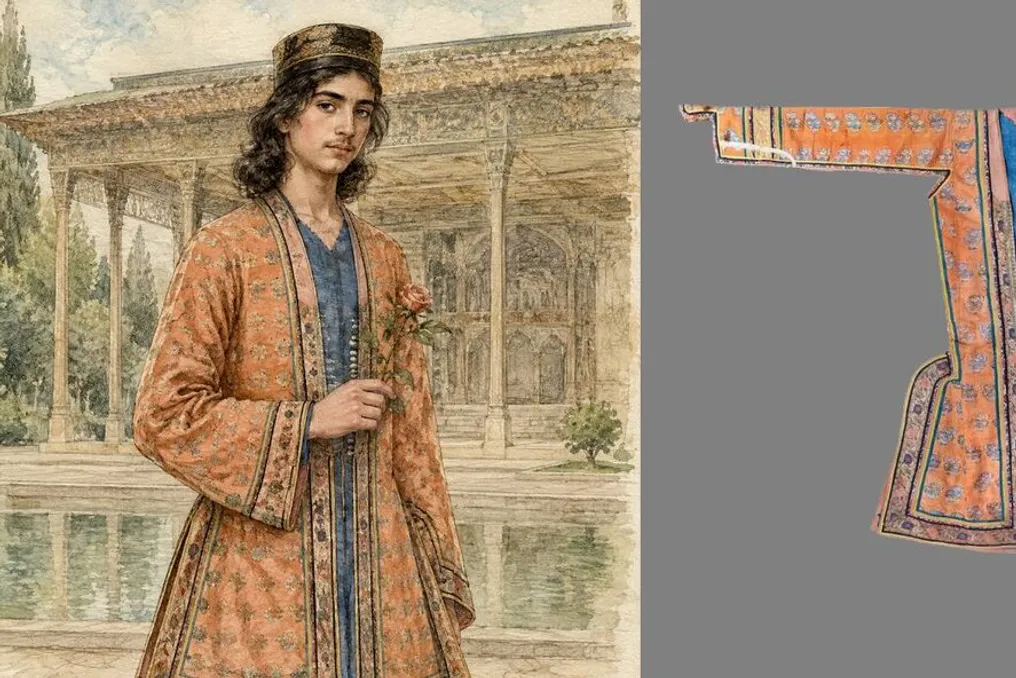
The National Museum of Iran preserves a red silk robe that, based on its material and formal characteristics, belongs to the textile tradition of the Safavid era.
This long-sleeved, ankle-length garment, made in the city of Yazd and dated to the 11th century AH, features side slits and cuffs. It measures ninety-seven centimeters in height. The construction, neat tailoring, choice of silk, use of metallic decorative elements, and inner lining of blue cotton were intentionally designed to create a vibrant and majestic silhouette on the wearer's figure.
The surface of the fabric brings to life a distinct visual rhythm. A basic network of hexagonal cells, set against a barely dissolving background, frames identical yet isolated floral compositions. This systematic repetition of botanical motifs—white, blue, green, and brown colors on a red field—does more than just decorate; it transforms the two-dimensional plane of the garment into a modulated three-dimensional surface, establishing geometric coherence and a measured, almost architectural balance. The color contrast particularly emphasizes the botanical forms, making them discernible from a distance, while upon closer inspection, they reveal a delicate, brushstroke-like detail.
The decorative embellishment further underscores the robe's ceremonial function. Gold bands, embroidered with foliage and flowers in red, green, purple, and white tones, frame both the side parts of the neckline and the side slits, as well as the cuffs. These metallic accents, contrasting with the silk background, lend the piece a glittering, courtly luxury. Seventeen silver buttons—sixteen conical along the left neckline and five smaller on one sleeve—serve simultaneously as fasteners and integral elements of the decorative scheme. Their presence reinforces the official, solemn character of the clothing and aligns with the protocol of Safavid court attire, where such details indicated rank and readiness for ceremony.
The continuous support of textile art by the Safavid court laid the necessary historical foundation for this piece. Royal patronage facilitated the fusion of painting, architecture, calligraphy, and weaving in royal workshops. In this environment, textile designers often worked across different media, and some artists even engaged with the loom themselves, creating luxurious silks and brocades that were initially conceived on paper. Weaving centers in Tabriz, Qazvin, Isfahan, Yazd, and Kashan consequently produced velvets, satins, multi-layered silks, and brocades unmatched in their color diversity and imaginative design. These fabrics were not limited to domestic consumption; they entered long-distance trade networks as valuable Iranian exports, reaching markets from the Ottoman Empire to the European continent.
Ultimately, this red silk robe synthesizes several different aspects of Safavid material culture: the technical skill of the weaver, the artistic vision of the spatial patterns of the artist, the tailor's attention to body shape, and the court's demands for visual markers of rank. It remains a concrete, tangible document from a period when Persian costume achieved a distinctive stylistic unity and established its place among the most sophisticated textile traditions of the early modern period.