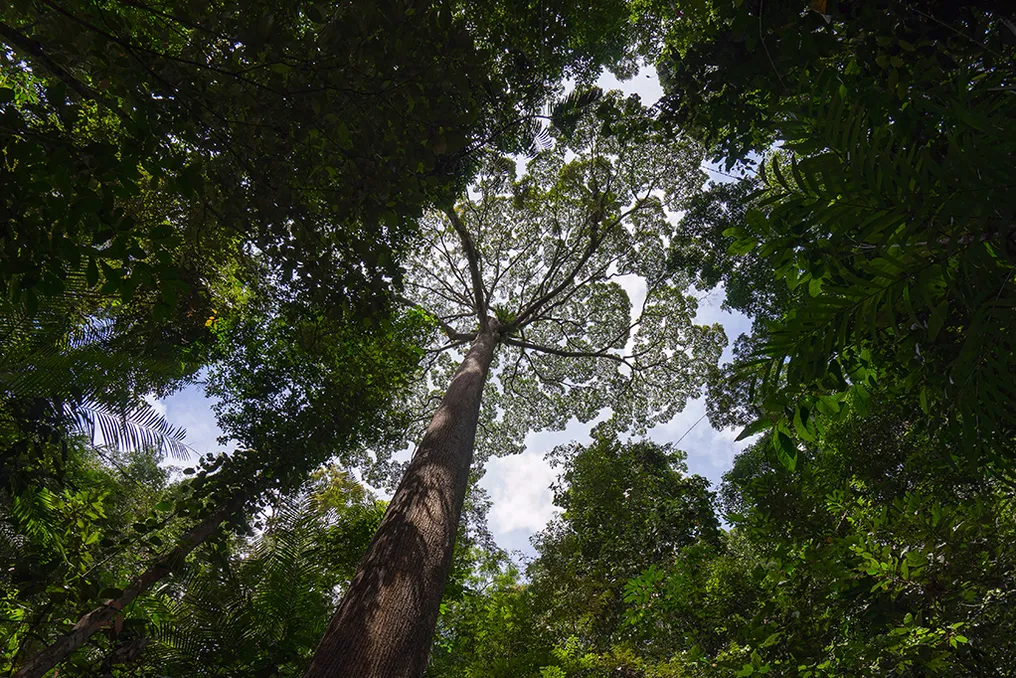
Research indicates that the planet's largest trees may possess crucial knowledge for facing periods of drought. A colossal tree, exceeding 70 meters in height in tropical forests, demonstrates apparent resistance to storms, droughts, and intense competition over centuries.
The main engineering obstacle faced by these giant trees is the need to conduct water over dozens of meters, from the soil to the leaves, especially when the drought intensifies. Initially, the question was raised whether these trees are inherently more susceptible to drought or if, on the contrary, they can contribute to forest resilience in the face of global warming.
Analyses conducted in the last decade do not point to a uniform response of tropical forests to droughts. While large trees suffer disproportionate mortality in some areas, in others, they exhibit a remarkable capacity for recovery.
In 2015, an analysis conducted by researchers showed that during drought events, larger trees were more likely to suffer growth atrophy or die compared to smaller trees. This conclusion seemed logical, given that larger trees need to transport water over longer vertical paths and are more exposed to atmospheric demands and sunlight in their high canopies.
Hydraulic theory supported this view, describing water transport as a continuous column under tension, similar to a straw. During severe droughts, this column can break, resulting in hydraulic failure and potential tree death. Researchers had demonstrated in 2012 that many species operate very close to the limits of their water transport systems during dry periods, suggesting a particular vulnerability of large trees.
The drought in the Amazon, which occurred during the warm phase of the intense 2015-16 El Niño event, confirmed this initial pattern. By measuring over half a million trees in collaboration with colleagues from across South America, it was observed that the forest's carbon sink practically ceased, and there was an increase in mortality, concentrated mainly in the largest trees.
However, an interesting finding was that the most impacted areas were not necessarily the wettest; the most severe consequences occurred in forests already adapted to relatively dry conditions, specifically on the margins of the Amazon. These forests host species accustomed to seasonal drought but still showed high sensitivity to water stress and extreme heat, proving that regular adaptation does not guarantee protection against exceptionally intense events.
Additionally, trees with lower wood density also showed greater vulnerability, a result consistent with hydraulic theory. A 2023 study validated that hydraulic characteristics can directly predict the risk of drought-induced mortality in Amazonian forests.
In contrast, the impacts of drought in African tropical forests during the same 2015-16 El Niño presented a different scenario. In these locations, growth reductions were more pronounced in smaller trees, while larger trees appeared relatively more protected against water stress.
These opposite responses demonstrate that there is no universal reaction to drought; the primary cause of death can vary between ecosystems, potentially being hydraulic failure in some cases and competition or carbon limitation in others.
The question shifted from whether large trees are more vulnerable to understanding under what circumstances this vulnerability arises. A recent study published in the journal Nature, analyzing a precipitation gradient in Puerto Rico, added complexity to the scenario, showing that drought resistance varied even within the same species, with trees in drier environments showing greater resistance to hydraulic failure.
Forest resilience therefore depends not only on the species present but also on the ability of these species to adjust to local drought conditions. Dipterocarps, known for their monumental size, high wood density, and large carbon storage, dominate many Southeast Asian forests and rise above the canopy like skyscrapers.
Working in Borneo forests, the author highlights the difficulty of studying these trees due to steep terrain and the presence of buttresses, classifying physiological measurements in such tall trees as an extraordinary feat.
Recent research suggests that these giant trees manage to overcome the hydraulic challenge of height through anatomical and physiological modifications, maintaining their hydraulic function despite their large size. This implies that size alone may not be the determining factor of vulnerability, but rather an indicator of exposure to more intense and adverse conditions in the canopy.
Although truly gigantic trees are rare and little studied in long-term forest inventories, the current scientific consensus is that there is no single rule to predict how forests will respond to droughts.