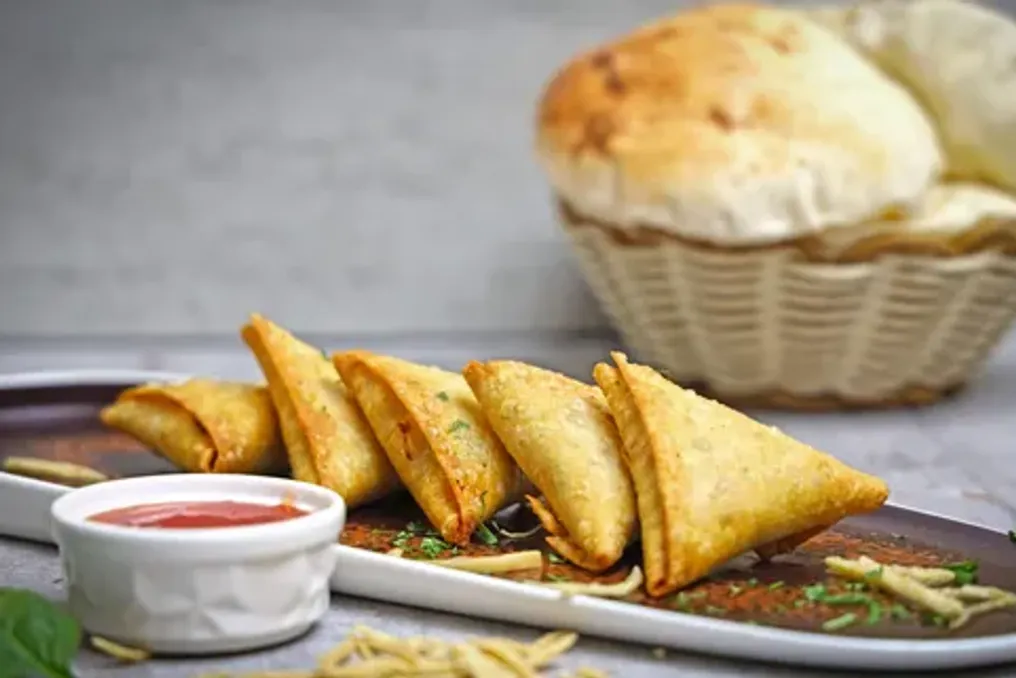
The journey of the samosa from India to South Africa is a story of migration, adaptation, and cultural heritage. Although a samosa can be small enough to eat in three bites, it carries a very extensive history.
For many families in South Africa, including the author's family, this history has a personal character, associated with the smell of frying samosas in the mother's kitchen, correctly seasoned filling, and serving on the table next to sweet milky tea.
However, on World Samosa Day, celebrated on September 5th during South Africa Heritage Month, the question arises about which specific samosa is being referred to. There is no single original version of this snack; it belongs to a much older family of stuffed pastries whose history spans Persia, Central Asia, the Middle East, and the Indian subcontinent.
The Oxford Companion to Food mentions related names such as sanbosag, sanbusak, and sanbusaj, and studies of Indian culinary history show how dishes like sambusa became part of a broader Central Asian influence on Indian cuisine. India adapted this pastry for itself, and South Africa did the same, making this history particularly interesting.
Anthropologist Dr. Dhihi Naidu from the University of Pretoria notes that the humble samosa has a history stretching across Persia, Central Asia, the Middle East, and the Indian subcontinent, but its path to South Africa has given rise to distinctly local versions.
Distinctive South African Samosa
Indian communities began arriving in Natal (now KwaZulu-Natal) as laborers starting in 1860, with nearly 152,000 people arriving via the labor system by 1911. They came from various regions of India, bringing with them different languages, religions, and culinary traditions, and later traders and other migrants, historically called 'passengers Indians', joined them.
Thus, South African Indian cuisine developed not as a copy of the cuisine of any part of India, but was formed here. Studies of the Indian diaspora in Natal demonstrate that cultural traditions were preserved but transformed in a new environment. Food is one of the most vivid examples of this.
The Durban samosa is recognizably linked to Indian samosas but has acquired its own individuality (it even has its own unique spelling—'samoosa' instead of 'samosa'). It is usually thin, crispy, and brightly spiced. Potatoes remain popular, but minced meat, chicken, and even canned fish have long been present in Durban kitchens. Fresh coriander, onion, and chili are often used in the filling. Simply put, Durban took an already traveling food and intensified its flavor.
Recipes rarely arrive in a new country unchanged. Ingredients change, neighbors influence each other, and families adapt to the food available and loved by them. Ultimately, adaptation turns into tradition. The change in the Durban samosa does not make it less authentic; its transformation is part of its authenticity.
More Than One Samosa Story in South Africa
Durban does not hold exclusive rights to the samosa. Cape Town has its own long history of migration, slavery, and cultural exchange involving communities from South and Southeast Asia, Africa, and Europe. Cape Malay cuisine developed within this history, creating unique combinations of spices, sweetness, and aroma. Therefore, Cape samosas can differ greatly from their Durban counterparts, often containing minced meat, onion, coriander, and aromatic spices, rather than a spicy filling. Placed side by side, they tell two different South African stories.
Neither should be considered superior, although anyone who has discussed food with a South African family knows that it doesn't prevent people from trying both versions. The broader samosa family is even larger. Across East Africa, sambusas and sambuus are found with various meat and vegetable fillings. In Central Asia, related samsa are usually baked. Even in India, fillings, dough types, and spice levels vary greatly. This crispy delight has never particularly respected borders.
From Festive Dish to Everyday Food
Perhaps the most South African part of the samosa's story is not what we put inside, but where we consume it now. Samosas have moved beyond weddings, religious ceremonies, and family gatherings, becoming part of daily life. They can be found at office meetings, school events, community gatherings, birthdays, bakeries, fast-food outlets, and taxi ranks. Somewhere along this path, food associated with certain communities has become familiar far beyond them. Thus, the samosa can carry memory, knowledge, skills, and even livelihoods, all wrapped in dough.
Heritage Should Not Be Frozen in Time
Perhaps this is the more important lesson of World Samosa Day. Heritage does not necessarily have to remain unchanged to remain significant. Living culinary traditions survive because people continue to cook them, adapt them, and sometimes add ingredients that previous generations might have viewed with suspicion.
Samosa with Cheese and Corn, Right?
The South African samosa demonstrates how new traditions can grow from old ones. Food whose roots trace back to Asia has passed through various societies before taking root here. Generations of South African chefs then changed it again, creating recognizable versions from Durban, Cape Town, and other local variations. Perhaps this is what makes the samosa such a suitable snack for Heritage Month. It carries traces of its origin while being completely comfortable in its current form. And it has become very comfortable in South Africa—place a plate of hot samosas at almost any gathering, and people rarely ask about its migratory history. Usually, they ask who is taking the last piece, because when it comes to samosas, politeness has a surprisingly short shelf life.