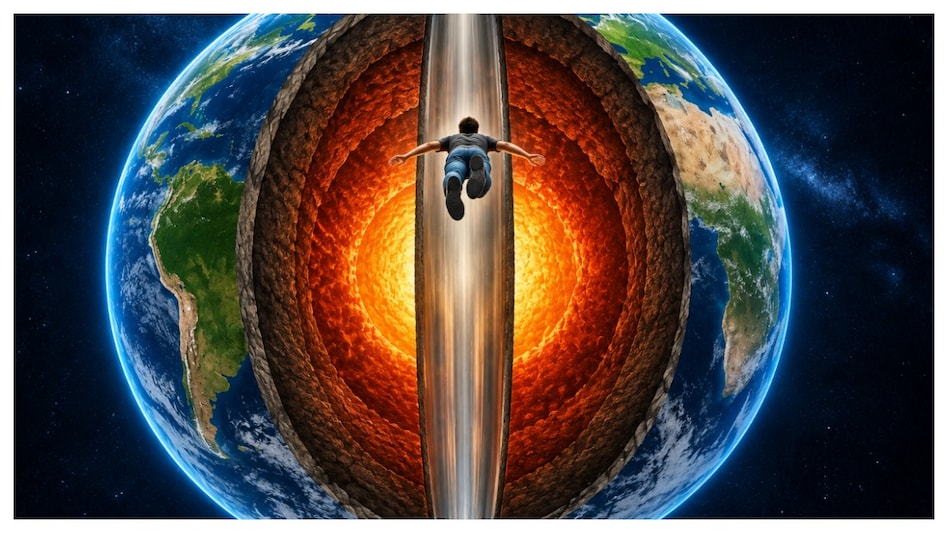
A hypothetical scenario is considered involving passage through a perfectly straight tunnel system running from one side to the other of the Earth. The question arises as to how long such a journey would take and whether the opposite side could be reached.
This question is a well-known thought experiment in physics. The exact time depends on which model of Earth's density and gravity is used for the calculations.
According to the classical physical model, it is assumed that the density of matter inside the Earth is uniform. If an absolutely straight tunnel passing through the center of the Earth were constructed, a person jumping into it would begin to fall under the influence of gravity. Initially, the speed would increase rapidly, growing as it approached the planet's center. The maximum speed is reached at the very center of the Earth.
After passing the center, gravity would begin to pull the person in the opposite direction. The speed would gradually decrease, reaching zero by the time the second surface is approached. Within this ideal model, the journey from one end to the other takes about 42 minutes. At this time, the speed near the Earth's center can reach approximately 7.9 kilometers per second.
However, reality is more complex because the Earth is not a perfect sphere with homogeneous material; it has different layers with varying densities. Density increases when descending from the crust and mantle to the core, where it becomes very high. If the actual distribution of Earth's internal density is taken into account in the calculations, the result changes. In 2015, McGill University student Alexander Klotz developed a more realistic model that accounts for the real density distribution. According to these calculations, the theoretical journey through the Earth could take about 38 minutes, showing that the answer is not limited to just 42 minutes.
Another interesting question arises: if the tunnel connects not two extreme poles, but just two cities, passing underground, would the travel time decrease? Nevertheless, jumping into the real Earth is practically impossible. Although all these calculations seem simple, they hide critically important conditions. All these calculations are based on ideal conditions, and creating such a tunnel in the real Earth using modern technology is practically impossible.
The most serious problems are temperature and pressure. As one descends into the Earth, the temperature rises sharply. The outer core is in a liquid state, while the inner core remains solid despite the extreme temperatures and pressure. Furthermore, at depths of thousands of kilometers, the pressure from the overlying rocks and matter becomes extremely high, making it extremely difficult to maintain the stability of a tunnel built from ordinary materials.
If it is assumed that there is air in the tunnel, air resistance must be considered. Ideal calculations (42 or 38 minutes) usually assume the absence of air and friction. However, the presence of air will create drag force on the falling person. As the speed increases, air resistance also increases, slowing down the movement and possibly preventing the achievement of the theoretical maximum speed. Some calculations including air resistance show that this journey could be very long; in some extreme assumptions, the theoretical time may reach 1.8 years. Nevertheless, this cannot be considered a definite travel time for a person in the real Earth, as it is based on mathematical models with various assumptions.
The diameter of the Earth is about 12,742 kilometers. Let's compare this with the deepest drilling performed by humans. The Soviet Kola Superdeep Borehole was one of the deepest scientific projects, reaching a depth of about 12.3 kilometers. Thus, compared to the Earth's total diameter, humans have only penetrated a very small distance inside the planet. With increasing depth, problems such as temperature and pressure become increasingly serious.
In conclusion, mathematics states that this is possible in an ideal world. If one imagines a tunnel with no air, no friction, the tunnel does not collapse, and the person is completely protected from extreme temperatures and pressure, then the fall from one end to the other could take about 40 minutes. In older models with uniform density, this time is about 42 minutes, whereas some models accounting for the real density distribution of the Earth lead to a time of 38 minutes.