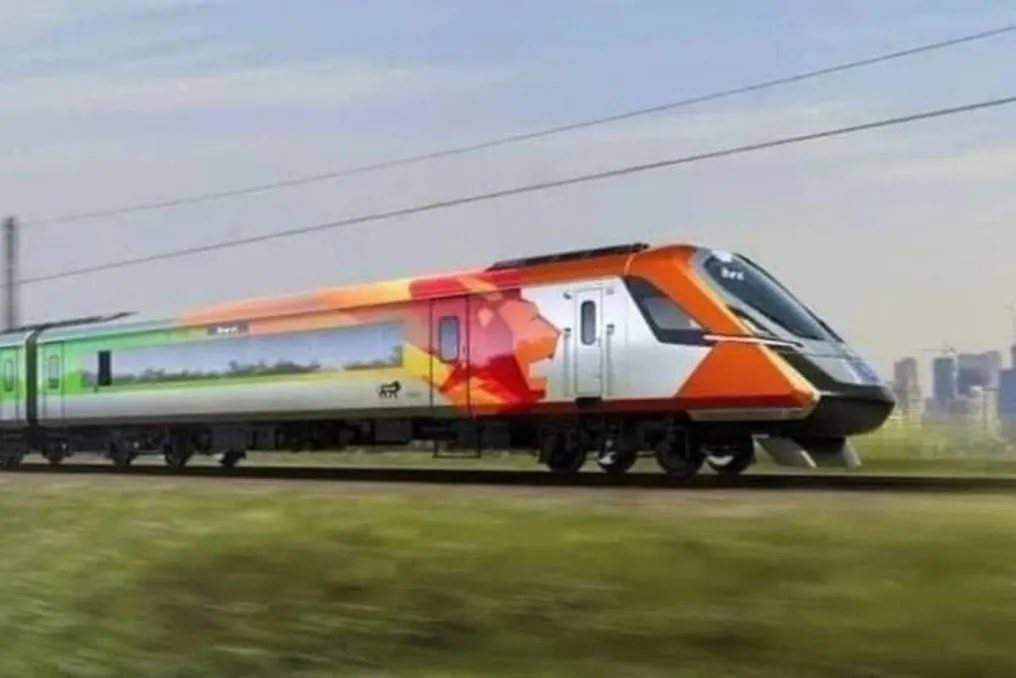
The Bandra Bharat train is being actively integrated into India's railway network and operates on most routes across the country. Many passengers have likely traveled on the Bandra Bharat express or heard about its luxurious amenities and design, but they may be unaware of a specific feature of its braking system.
The Bandra Bharat braking system functions similarly to an automobile's, which distinguishes it from standard systems used in trains. This system employs electro-pneumatic disc brakes installed near the wheels rather than directly on them.
The operation of the braking system is transmitted via electricity, ensuring a high response speed and immediate effect when the brake is applied. This system is comparable to how disc and drum brakes work in cars, making the Bandra Bharat train safer compared to other trains.
The Bandra Bharat train features a special system that allows the train to stop easily in case of an emergency. It integrates an Emergency Braking Distance (EBD) system, similar to those used in automobiles. This system is capable of safely stopping a high-speed train in an emergency. Testing of this system was completed in August, and it guarantees a smooth stop without any damage; however, it has not yet been implemented in passenger trains.
When the train is moving at high speed and braking is activated, the kinetic energy, which is usually lost in conventional brakes, can be converted in the Bandra Bharat. During braking, the electric motor can operate as a generator. The train's wheels rotate this motor, resulting in the generation of electricity. This energy can be fed back into the railway's electrical system or used as needed by the system.
Nevertheless, this does not mean that the full amount of energy is recovered with every braking event. Some energy is lost due to wear and tear of the motor, electronics, and other components. Estimates suggest that this technology can generate up to 30 percent of the electricity.