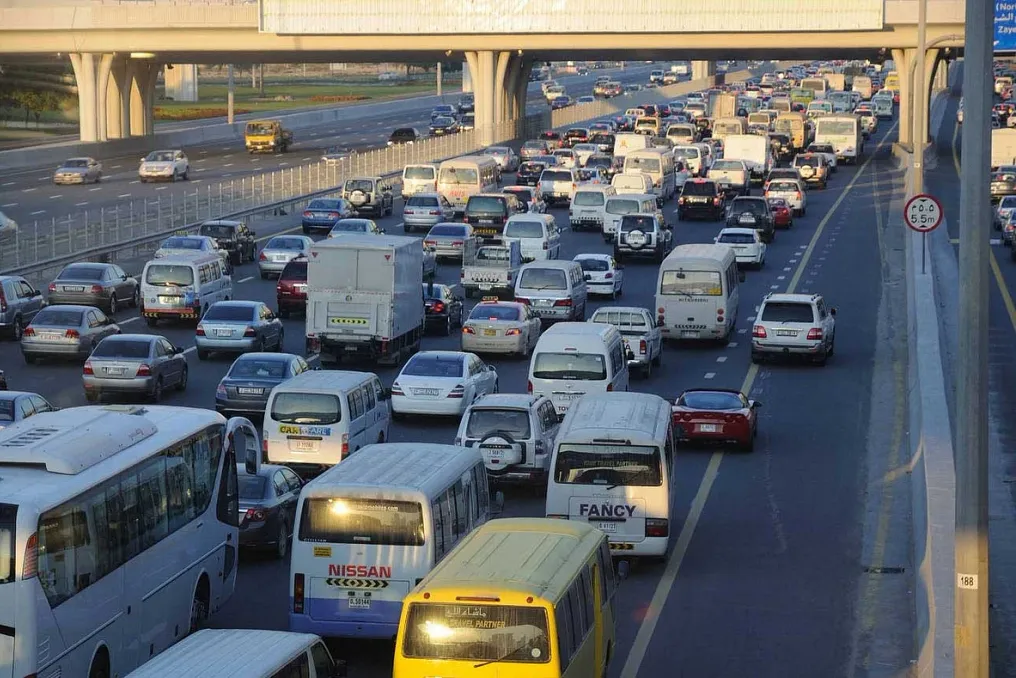
With the start of the new academic year in the United Arab Emirates (UAE), the school route has revived, leading to an increase in traffic flow and queues.
Parents and educational institutions are feeling familiar pressure due to more intense movement around campuses, especially during morning drop-offs when school traffic intersects with the daily congestion of office districts.
Some families note that traffic jams significantly lengthen relatively short trips. School transport operators report that the first week was marked by denser traffic than usual as families and staff adapt to new routines.
A parent from Dubai, Arijit Nandi, mentioned that the evening trip home for his son takes much longer than the distance dictates. He noted that although they live only two kilometers from the school, his son requires about forty minutes to get home by school bus.
The increase in travel time is partly due to school buses carrying multiple children, but the morning school traffic creates an additional problem—congestion near the school itself. Nandi added that his wife, who drives his son to school, noticed 'long queues' near the school zone, especially at turns before the school in the Emirates Hills area.
He emphasized: 'Now that schools have opened, you can really see the difference—the roads around school zones are lively again, especially in drop-off and pick-up areas, with familiar queues and jams returning.'
A similar situation is observed in other parts of Dubai; parents in areas like Arabian Ranches are having to adjust their schedules due to increased school traffic. Majd Hakim, whose daughter studies nearby, noted that the changes became apparent immediately after classes resumed.
She stated: 'Now that schools have opened, you immediately feel the difference on the roads around Arabian Ranches, where we live.'
Traffic problems become particularly acute during drop-off and pick-up times, when vehicles queue and move slowly in school zones. Hakim added that 'this is a familiar part of the school schedule every September; the roads get busier, and you need to allow extra time for the trip to school.'
Traffic issues are not limited to Dubai; schools in other emirates are also noting the impact of returning to normal study and work patterns. Mujib, responsible for transport at Woodlem Park School in Al Jurf, Ajman, reported that the first week brought more intense traffic, although conditions began to improve.
He specified: 'The first week was marked by more intense traffic, with some rush during class hours and peak working hours.' However, he also noted that 'the situation was manageable, and the flow of traffic gradually became smoother as families and staff got used to the new routine.'
Mujib also pointed out that morning drop-off proved more difficult because it coincides with the general morning rush hour, whereas afternoon pick-up was relatively easy to manage.
The scale of daily school commutes explains why school zones can become particularly congested during peak periods. Data from the Roads and Transport Authority (RTA) shows that private cars remain one of the main ways students travel to school. A survey conducted among over 20,000 parents during the 2025–2026 academic year revealed that about 47 percent of students travel by private vehicle, and 44 percent use school buses.
The remaining students walk, use public transport, or utilize individual and shared mobility options. The survey also found that 91 percent of parents use designated drop-off and pick-up zones in school areas.
Because thousands of vehicles converge in school zones in a relatively short period each morning and evening, even minor delays can quickly lead to increased queues. In response, the Dubai Roads and Transport Authority (RTA) used the summer holidays to modernize roads in six locations within school zones across the emirate, benefiting over 10 schools in Wadi Al Safa 4, Al Barsha, Umm Al Sheif, Dubai Motor City, and Al Sufouh.
These projects aimed to reduce congestion and enhance safety for students, parents, and school staff before the start of the new academic year. Among the implemented projects are a new road connecting Al Kudra Road and Hessa Street through Dubai Motor City and Dubai Studio City, which improves access to GEMS Metropole Schools – Motor City. RTA also doubled parking capacity at Horizon International School in Umm Al Sheif by adding new spaces, and improved the entrances and exits of the service road near the Al Barsha South school complex. At The International School of Choueifat – Dubai in Al Sufouh, classroom-level traffic improvements were implemented, along with work to enhance road infrastructure and safety around GEMS Winchester School – Dubai in Wadi Al Safa 4.
Drivers were advised to reduce speed when entering school zones, be prepared to stop at pedestrian crossings, and watch for children who might suddenly appear from parked cars.
Meanwhile, the Sharjah Roads and Transport Authority completed road development and maintenance work in the Al Jazzat and Al Hazana areas while schools across the UAE began the new academic year. These works included creating and maintaining asphalt layers on both sides of the roads, as well as repainting and updating road markings. These improvements are part of ongoing efforts to strengthen Sharjah's road network, improve traffic flow, and enhance safety for drivers and other road users.
In Ajman, schools expect initial disruptions to decrease as families get accustomed to new schedules, routes, and routines. Mujib noted that cooperation between parents and staff will be crucial for maintaining a smooth school commute. He concluded: 'With the cooperation of parents and staff, we expect the commute to become even more streamlined in the coming weeks.'