In various cities across Mexico, drinking water has not disappeared from public life but has been reorganized through a substitution economy. Water is delivered by tanker trucks, in plastic bottles, in twenty-liter canisters, via water tanks, household filters and purifiers, as well as through informal distributions and storage routines, turning access to water into a calculated daily practice.
What appears to be a system failure has generated a spatial and economic culture where responsibility falls on families, and often on individuals who carry, buy, clean, doubt, and manage the water before consumption.
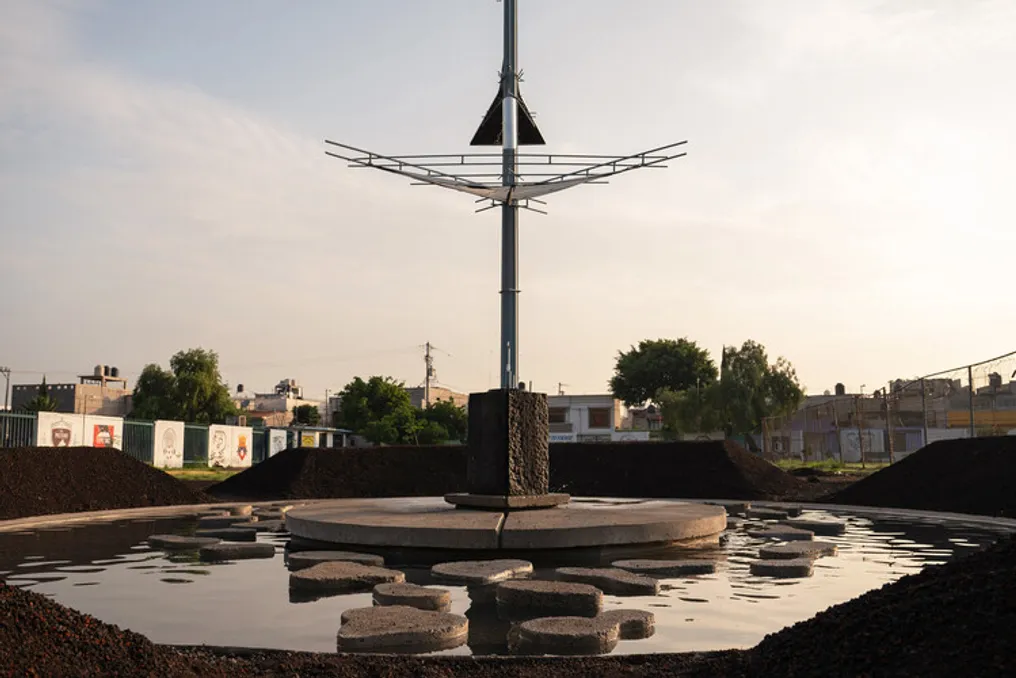
The 'Rizoma de Lluvia' project stems from this state of displacement. Developed in Chimalhuacán, a metropolis east of Mexico City, the project is a fountain for collecting rainwater that gathers, stores, filters, and returns the water for public use. Its architectural approach is not limited only to collection or efficiency, although both concepts are necessary for its functioning.
The project posits the idea that public relations with water are possible in areas where scarcity has become the norm due to private survival mechanisms, and where drinking water is viewed as a civil right rather than a commodity to be bought, transported, and carefully conserved.
Installed at the community-managed Deportivo Las Flores sports complex, this fountain integrates into the existing social infrastructure, which includes football leagues, neighborhood support, maintenance, and local trust. Rain falls onto a permeable surface, passes through gravel and sand, enters an underground reservoir, undergoes filtration, is then lifted by a pump, and returned through a public tap.
Rather than 'aestheticizing' the mechanism or turning scarcity into an image of sustainability, the project materializes a process that usually remains hidden. As part of 'Rizoma del Agua,' a research platform at the TÁNAT office, the project views the rhizome as a way to understand connections, adaptation, and partial interconnectedness.
Its value lies not in replacing the state water supply system or presenting rainwater harvesting as an isolated solution, but in making visible the process by which water becomes potable. In Chimalhuacán, the project collects only a small portion of the rain, but uses this portion to raise the question of how water could once again become part of the common space, care, and collective life.