The Flex technology, developed in Brazil, allows most current vehicles to use gasoline, ethanol, or a combination of both. This system was commercially launched in the country in 2003.
Initially, the creation of this technology served as a response to consumer distrust regarding alcohol, motivated by supply crises and price fluctuations of the product during the 1990s.
By offering the driver the freedom to choose the most economical fuel at the pump, the system quickly gained popular acceptance. More than two decades after its launch, the Flex engine is seen by the automotive industry as an option to reduce pollutant emissions, alongside electric cars.
Previously, the choice was restricted: the driver had to acquire a car designed exclusively for gasoline or another for hydrated ethanol. Due to the loss of credibility in alcohol-powered vehicles in the 90s, some drivers began mixing fuels themselves in the tank, a practice known as 'rabo de galo' mixture, which frequently resulted in mechanical problems in workshops.
It was in this scenario of difficulties that engineering identified an opportunity: to develop an engine capable of operating with any proportion of alcohol and gasoline without suffering damage.
Professor Renato Romio, responsible for the engines and vehicles department at the Mauá Institute of Technology, mentioned that there was a previous program, Proálcool, which was declining. He stated that the emergence of Flex cars allowed this program to be rescued, ensuring the maintenance of ethanol at gas stations.
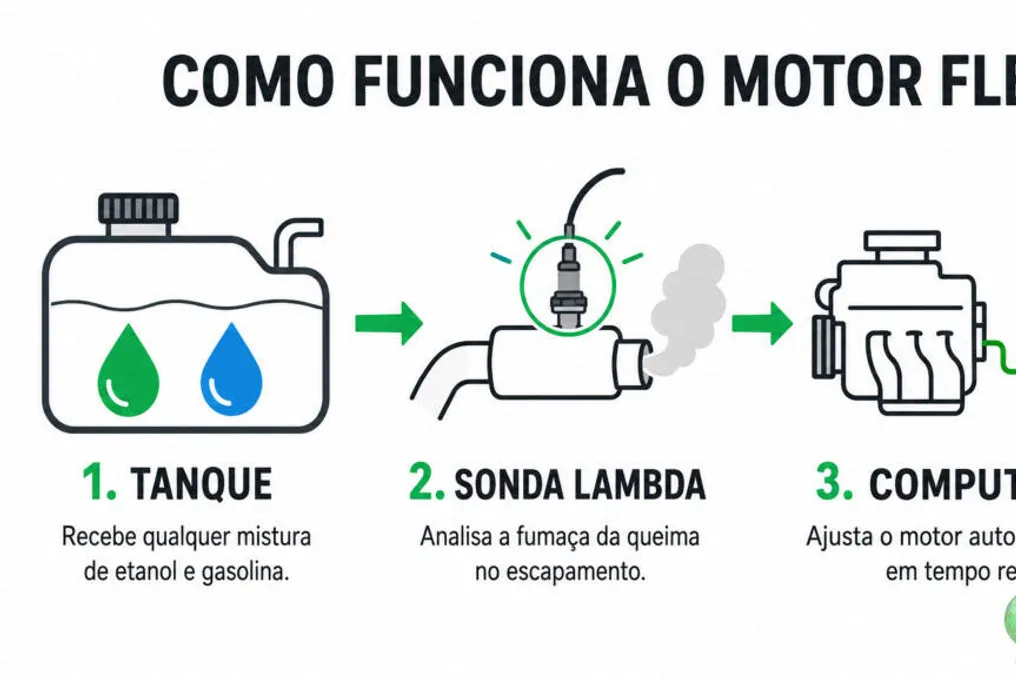
Although the idea of a dual-fuel car already existed in the United States, where they used a sophisticated and costly tank sensor to monitor the mixture, Brazilian engineers opted for a more accessible approach. They dispensed with the tank sensor and used the lambda probe, a part already present in vehicles and significantly cheaper.
Positioned in the exhaust system, the lambda probe acts as an electronic detector. Instead of analyzing the tank contents, it examines the smoke generated by the combustion of the fuel exiting the exhaust. An embedded software, such as systems developed by Magneti Marelli or Bosch, interprets this data in real time. By detecting the composition of the ethanol and gasoline burn, the system makes automatic adjustments to the engine's operation.
With the technical solution established, manufacturers began a competition to introduce the innovation to the market. Volkswagen led the launch, presenting the Gol 1.6 Total Flex in March 2003. Subsequently, Fiat and Chevrolet followed with the Palio 1.3 and the Corsa 1.8, respectively, using the same technology, marking the beginning of the Flex car era in Brazil.
A crucial advantage of the Flex vehicle is the possibility of keeping pure ethanol available at gas stations. According to engineer Renato Romio, the Brazilian differential lies not only in the Flex technology but also in the availability of hydrated ethanol at stations, something other countries do not have.
The implementation of the Flex engine required engineers to solve practical issues to increase the longevity and ease of use of the cars. The first obstacle was material resistance, as ethanol causes corrosion in common metals. Therefore, manufacturers began to use more robust components in the construction of the engines.
Another problem was the cold start system, necessary because ethanol requires more heat to burn than gasoline. Flex cars came equipped with a small gasoline reservoir under the hood to inject some of this fuel on cold days, aiding ignition. With engineering advancements, systems were created that heat the fuel before combustion or inject it under high pressure directly into the engine, eliminating the need for this aid.
Currently, Flex technology is integrated into the energy transition movement alongside electric vehicles, starting with Flex hybrid cars, which combine an electric motor and an internal combustion engine. In these models, the battery assists during periods of lower energy demand, while the ethanol engine takes over when higher power or autonomy is needed, resulting in efficient and low-pollution vehicles.
The next stage involves converting ethanol into electricity. Brazilian researchers developed the microreformer, a component that extracts ethanol from the tank and converts it into hydrogen gas inside the vehicle itself. This hydrogen then undergoes a chemical reaction that generates electrical energy to charge the battery and move the automobile, allowing the driver to refuel with ethanol and drive an electric vehicle.
The professor at Mauá Institute considers the battery electric vehicle to be the future, but recognizes the importance of ethanol as a viable source for prolonged use until battery vehicles achieve large-scale application.