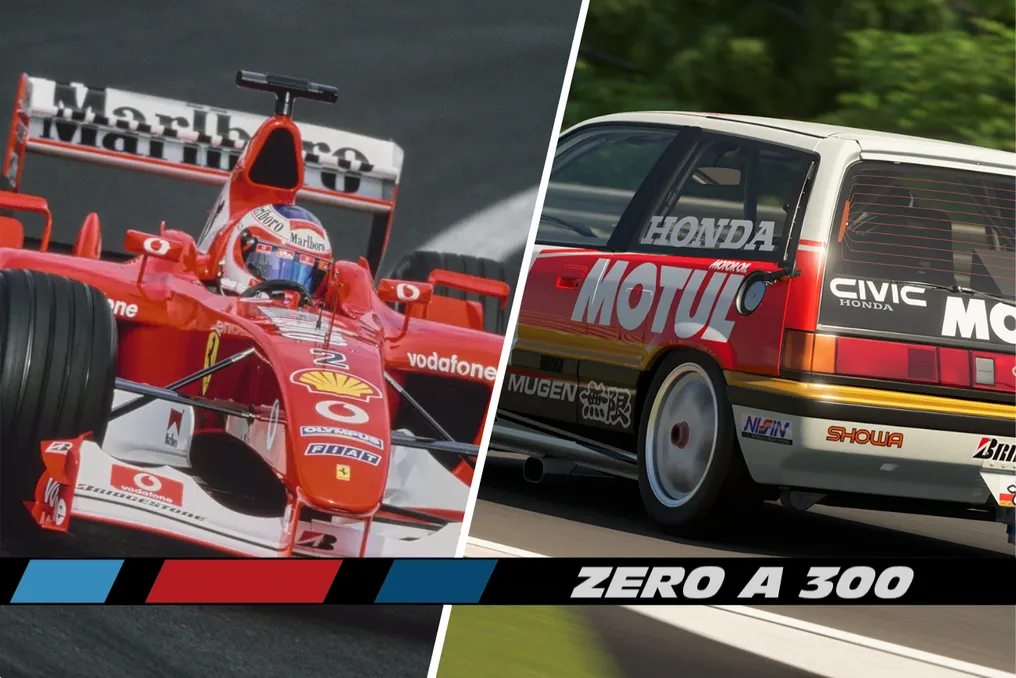
Ferrari paid tribute to Michael Schumacher at the Italian Grand Prix by bringing back the Ferrari F2002 to the track. This historic car will be driven by Rubens Barrichello and Sebastian Vettel as part of the celebrations marking the 30th anniversary of Schumacher's arrival at the team in 1996.
The F2002 will return to the circuit on Saturday (5), driven by Barrichello, who won the Italian GP in 2002, leading a Ferrari duo with Schumacher in second place. On Sunday (6), before the start, Sebastian Vettel will make another demonstration lap in the F2002. Vettel, who raced for Ferrari between 2015 and 2020, always considered Schumacher a great inspiration and later became his friend.
The F2002, launched in the 2002 season, demonstrated great dominance, winning 14 out of the 15 races held that year. Schumacher won the title already at the French GP in July, equaling Juan Manuel Fangio's five championships, while Ferrari secured the Constructors' World Championship early in Hungary. At the end of the season, the team accumulated 15 victories in 17 races.
This vehicle also represents one of the last great Ferraris of the V10 engine era, using the 3.0 naturally aspirated Type 051. It was developed during the period when Rory Byrne, Ross Brawn, and Jean Todt formed the technical and administrative core responsible for transforming the team into the dominant force in Formula 1 at the beginning of the decade.
The tribute extends to Hamilton's and Leclerc's SF-26 cars, which will receive a special paint job inspired by the red of the 1996 Ferrari. The drivers' racing suits will also feature Schumacher's logo and the seven stars, referencing the German driver's seven world titles.
The Return of the Jensen Interceptor
The original Jensen Interceptor was a European sports car with an American engine popularized in the 1970s. Its chassis engineering was British, but the engine was always a Chrysler V8, available in 360, 383, or 440 cubic inch versions, characterizing it as a true muscle car manufactured in the United Kingdom.
It is currently back, but not as a restomod. The new model, named Interceptor GTX, is an entirely new sports car, without retro intent, equipped with a Texas-produced V8 featuring a supercharger capable of generating nearly 1,000 horsepower. Jensen International had been gradually providing information, and now the complete package has been revealed.
The design of the Interceptor GTX is appealing, presenting the expected proportions of a coupe with the V8 positioned behind the front axle: elongated hood and short rear in a fastback style. Although the reference to the original silhouette is subtle, details such as the rear side windows, the C-pillar, and the wrap-around rear glass are elegant allusions to the classic.
This specific version is designed as a track car and features various aerodynamic components, including a large front splitter, a robust rear diffuser, a prominent rear wing, and side skirts. The interior reinforces its track purpose with carbon fiber elements, competition seats, leather straps replacing door handles, and a full roll cage. The dashboard architecture also evokes the original Jensen Interceptor.
Mechanically, the Jensen Interceptor GTX uses a 6.2-liter Chevrolet V8 engine, prepared and assembled by Late Model Engines, a Texas company. The 2.65-liter supercharger helps the engine reach 973 hp, although Jensen guarantees it can handle over 1,100 hp. The transmission is a six-speed sequential gearbox, controllable both via the console and levers behind the steering wheel. Acceleration and top speed data have not yet been released.
Structurally, the GTX opts for aluminum, both in the monocoque and the hand-molded bodywork, instead of carbon fiber. This choice, although technically less sophisticated, aims to reduce costs and align with the vehicle's classic proposal. The suspension features overlaid triangular arms on all four wheels and Nitron shock absorbers with three distinct adjustments, and the steering is hydraulic, aiming for a more engaging drive.
Historically, the Jensen Interceptor was more of a grand tourer than a pure sports car. The GTX represents a more economical way to introduce a new model into the catalog and generate revenue, without the need for heavy investment in homologation testing. Next steps include street models, which are in advanced development, with the promise that at least 80% of the GTX's aesthetic elements will be present in the legalized version. This street version may feature a torque converter automatic or a six-speed manual transmission. Jensen plans to launch the Interceptor GTR, the version closest to the GTX for public road use, and eventually a four-door variant, targeting competitors like Aston Martin.
Gran Turismo 7 Update Brings New Cars and the Return of Autumn Ring
The Autumn Ring circuit has always been one of the most notable original layouts in Gran Turismo, known for its highly technical curves, diverse terrain variations, and a layout that demands calculated overtakes. Launched in the first Gran Turismo almost thirty years ago, it has been present in all subsequent titles up to Gran Turismo 6, appreciated by old-school enthusiasts.
After its absence in Gran Turismo Sport, the Autumn Ring will return to Gran Turismo 7 through the latest free update, named Spec IV. However, this update is extensive and will be released in two phases: the first in October and the second in December. It is important to note that the Autumn Ring will only be available in the second part.
The first phase of the update will also bring a new real circuit: the Sportsland SUGO, located in Japan, which has hosted rounds of Super GT and Super Formula. This track measures 3.7 km and is recognized for its altitude changes and sections that require great driver skill.
Players will be rewarded for their wait with the arrival of the Autumn Ring in December. In addition to the original layout, which favors lower-powered cars with good dynamics, Polyphony Digital will develop an expanded version suitable for more powerful and faster vehicles.
The update will also include 12 new automobiles, distributed in two groups of six. Although the official list has not yet been released, promotional material shows a variety of models, such as the BMW M5 E60, the Mugen Motul competition Honda Civic, the Citroën 2CV Charleston, the Honda Stepwgn Spada minivan, the Mazda RX-Vision GT3, and the Xiaomi Vision Gran Turismo.
Other functionalities will be added to the game. An interesting feature is the Car Concierge service, which will facilitate the acquisition of desired vehicles, allowing orders for used and Legendary models. A Family Mode will also be implemented, offering simplified driving challenges for beginners. Additionally, there will be a Random Race Mode, with randomly selected track and opponents, a new store called Retro dedicated to cars unavailable for new purchase, and an increase in both the Collector Level limit and the difficulty selector.
Sony announced that more details about the update will be shared later, including during a 'Gran Turismo World Series' event in Singapore, scheduled for October 3rd.
Volkswagen Restructuring Plan and the Future of SEAT
The Volkswagen Group is seriously planning to discontinue one of its oldest brands, SEAT, its Spanish division, as part of a restructuring plan focused on cost reduction and return to profit. Although there is no official confirmation, internal documents and comments from executives linked to the group suggest that the brand will be phased out by the end of this decade.
Reports from the German press indicate that the group has already removed SEAT from its long-term strategic planning, forecasting the gradual discontinuation of its portfolio over the next three years, culminating in its total extinction in 2029. The German portal WirtschaftsWoche obtained a document detailing that the closure of SEAT will occur in an organized and efficient manner, ensuring support for current customers and fulfillment of all outstanding obligations.
However, the Cupra brand, which emerged as SEAT's sports division, will be preserved. Unlike SEAT, Cupra has proven to be profitable: while sales of the first fell by 17% in 2025, the second registered a growth of 33% in the same year.
When contacted, Volkswagen declined to officially comment on the information. However, the company acknowledged that, like the automotive sector in general, the VW Group and SEAT are undergoing a profound transformation, but stated that no decision has been made at this time and that any strategic decisions regarding SEAT will be communicated in due course.
Ford Resuscitates Its Secret V10 Mustang
In the early 2000s, Ford engineers decided that an eight-cylinder engine was insufficient for the Mustang. They adapted the architecture of the 4.6 Modular V8, adding two cylinders to build a 5.8-liter naturally aspirated V10. This vehicle never reached widespread commercialization in dealerships.