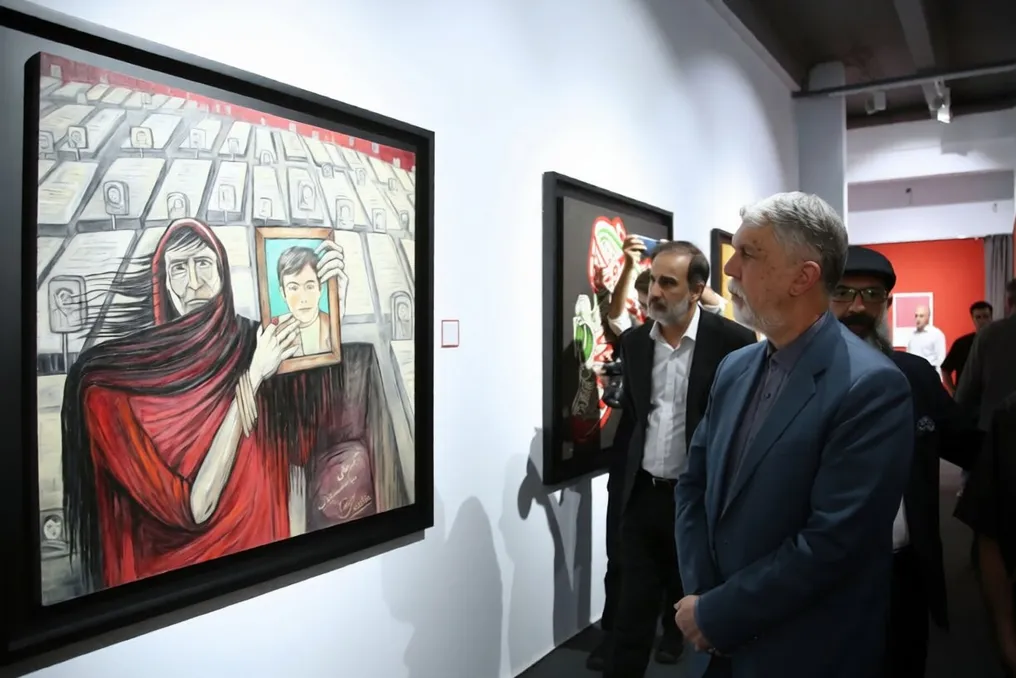
The Minister of Culture and Islamic Guidance, Seyyed Abbas Salehi, visited the group exhibition 'Minab School' on Thursday, which was held at the Art Bureau in Tehran.
Some artists were present during the visit, who informed visitors about the process of creating and executing the works, according to the IRNA agency. After viewing the exhibition, Salehi gave an interview to reporters, emphasizing the significance of holding such exhibitions.
He stated that the 'Minab School' tragedy is, on one hand, a global and historical catastrophe, and on the other, an unprecedented and fateful event for the Iranian people. The Minister added that documentary evidence clearly shows that this incident was not accidental but was completely planned.
Salehi recalled the first days after the incident when parents desperately searched for their children, and mentioned that the parents of Makan Nasiri never found the body of their child. He noted that since Minab is a small town, the death of over a hundred students plunged the entire town into mourning. According to him, when he visited Minab in May, sorrow affected not just one family but the entire settlement.
The Minister stressed that the Minab tragedy represents a global catastrophe that will remain forever in human memory, similar to other great human disasters such as Hiroshima and Nagasaki. Regarding the exhibition, he noted that he visited it to praise the artists who created this exhibition, who strive to turn this huge event into a lasting work and a living message both nationally and globally.
Salehi also emphasized that viewers will definitely see valuable films dedicated to the War imposed during Ramadan at upcoming festivals—the Short Film Festival, the Cinema Verite Festival (Documentary Film Festival), and the Fadr Festival. He explained that due to its duration (40 days), various aspects, and length, the War imposed during Ramadan provided unique opportunities for artistic narration.
The Minister pointed out that the 'Minab School' tragedy presented in this exhibition is an example of such opportunities. He indicated that in the 19 works he saw, each artist viewed the Minab incident from their own angle and presented it through the language of art—the language of deep, contemplative, and reflective thought. He added that there are many events during the 40 days of the Third imposed war and in the period after it that can become subjects of artistic narration, whether in the form of images and cinema or in other forms of art that are no less effective than film.
Seyyed Abbas Salehi also stated that one of the key features of art forms such as visual arts and painting is their ability for rapid exchange; they can instantly convey their message to new spaces, influence the audience, and engage their mind, memory, and soul. Therefore, all artistic capabilities of Iran will be directed towards presenting the resistance of the great nation of Iran.
Upon concluding his visit to the 'Minab School' exhibition, the Minister of Culture and Islamic Guidance wrote a note about the exhibition, stating: 'The little angels of Minab School are the heavenly guardians of the land of Iran and will protect this ancient territory from monsters and beasts.'
The exhibition was organized by the Nam Scientific and Cultural and Artistic Institute and includes works by several renowned contemporary Iranian artists. Among the participants are Behzad Shisegaran, Cyrus Mokkadam, Holam Ali Taheri, Mortaza Asadi, Kazem Chalipa, Ali Nedai, Hassan Yaquti, Abdolhamid Ghadirian, Mostafa Gudarzi, Nasser Seifi, Jamshid Hakikatshenas, Seyyed Masoud Shojaei Tabatabaei, Kamyar Sadeghi, Seyyed Ali Mirfatta, Mahyar Charmchi, Mostafa Korbani, Hossein Einibakhsh, and Mohammad Ali Naderi.
On February 28, the Shajareh Tayeb Primary School in Minab, Hormozgan province, became the scene of a devastating massacre after the United States and Israel began their strikes on Iran. While dozens of girls and boys aged 7 to 12 were starting lessons, the school was hit by a missile strike that caused the building to collapse, burying children and teachers under the rubble. Iranian authorities confirmed the final death toll—168 people, and at least 95 were injured, making it one of the most horrific incidents in the early days of the conflict.