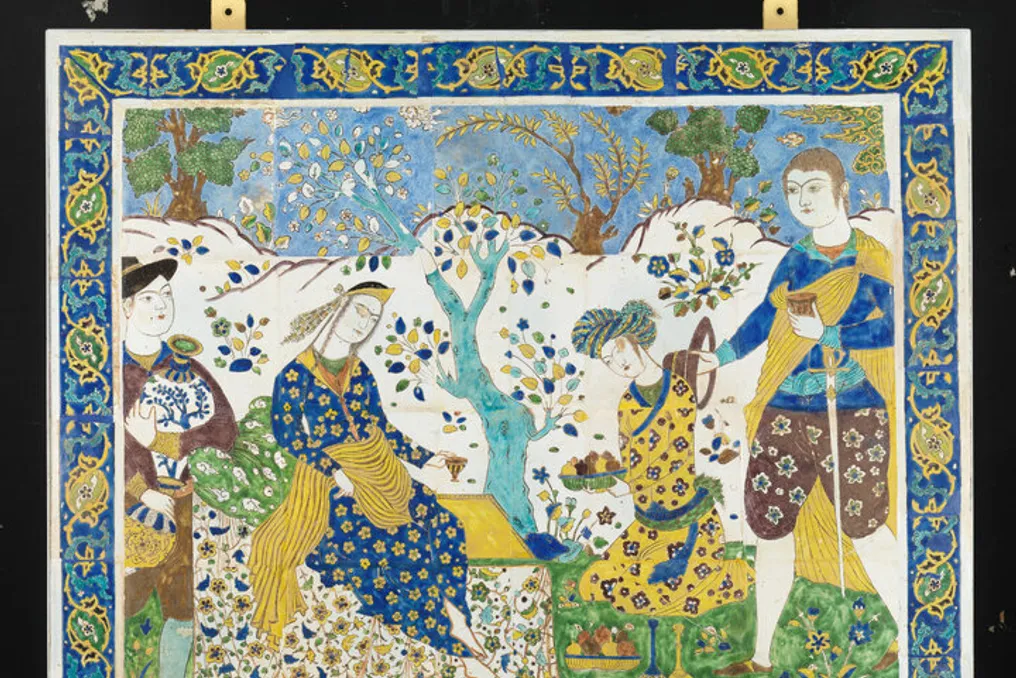
Tile mosaics during the Safavid period in Iran were not limited to geometric patterns, arabesques, and inscriptions used to decorate religious structures. In the 16th century, in Isfahan, the capital of the Safavid Empire, square tiles increasingly became a medium for creating pictorial compositions depicting people, gardens, and scenes of court life.
Examples of this unique form of tile mosaic are preserved today in major museums such as the Metropolitan Museum of Art in New York, the Louvre, and the Victoria and Albert Museum.
One notable example is a large tile panel held in the Metropolitan Museum of Art's collection. This panel, dated to the first quarter of the 17th century and presumably originating from Iran, possibly Isfahan, measures approximately 115.6 by 138.7 centimeters. It consists of square tiles, each about 22.5 centimeters in size, assembled into a single continuous scene depicting a woman and three men in a garden, according to ISNA on Friday.
The significance of such works lies not only in their subjects but also in the technique used to create them. The tiles were made using a method known as cuerda seca (dry cord), where lines of a glaze-resistant material separated areas of different colors. During firing, this separating material burned away, leaving dark, dry lines between the colored sections. This allowed several colored glazes to be applied side-by-side without mixing.
This technique was particularly useful during the Safavid period because it allowed artists to create richly colored compositions more efficiently and with fewer costs than some more complex tile mosaic techniques. Metropolitan Museum of Art research indicates that Isfahan and Nain were important centers for fine tile production during the Safavid era. While geometric and floral patterns continued to dominate mosques, religious schools, and other monuments, a different approach developed in secular architecture, where individual square tiles became elements of larger pictorial scenes.
This approach required artists to think beyond merely decorating individual tiles. A large composition had to be broken down into numerous small parts, with each tile functioning as part of an overall visual puzzle. Therefore, preliminary design, color coordination, proportions of human figures, and continuity of landscape elements between adjacent tiles were critical to the final result. The wall itself transformed into the final canvas—created not from paper or fabric, but from glazed ceramic tiles.
The themes of these compositions are closely related to the tradition of Safavid miniature painting. The Metropolitan Museum of Art notes that popular subjects for Safavid artists included garden scenes with groups of men and women. Depicting figures in gardens, along with details of clothing, social interaction, and leisure, brought aspects of courtly and daily life into architectural spaces.
This distinction between religious and secular tiling is important for understanding the development of Safavid pictorial ceramics. In mosques and other religious buildings, floral, geometric, and calligraphic decoration remained central. However, in royal residences, garden pavilions, and other secular settings, depictions of people and narrative scenes had greater scope for appearance. Thus, tile mosaics evolved from a predominantly decorative architectural element into a visual medium capable of conveying aspects of court culture, gardens, clothing, and social life.
Recent art historical studies have also provided clues regarding the original architectural setting of some surviving panels. Farshid Emami, a researcher of Islamic art and architecture, studied groups of Safavid pictorial tiles in a paper published by the Metropolitan Museum of Art. His research suggests that examples currently dispersed in the collections of the Metropolitan Museum of Art, the Louvre, and the Victoria and Albert Museum may have originally been associated with a now-lost Safavid building.
Safavid pictorial tiles represent an important intersection of several Iranian artistic traditions: ceramics, tilework, painting, miniature art, and architecture. Their production required both technical knowledge of ceramic materials and glazing, and artistic skill in designing figures and complex scenes. Up close, the works appear as a collection of individual ceramic pieces; from a distance, they merge into unified and carefully composed paintings.
The long-term significance of these works lies in the close relationship between image and architecture. During the Safavid period, tiles could serve not just as cladding but as a means of illustrating stories and scenes from the social and cultural world of the time. Although many examples are now in museums around the world, every surviving panel serves as a valuable chronicle of the artistic, architectural, and visual culture of Safavid Iran.