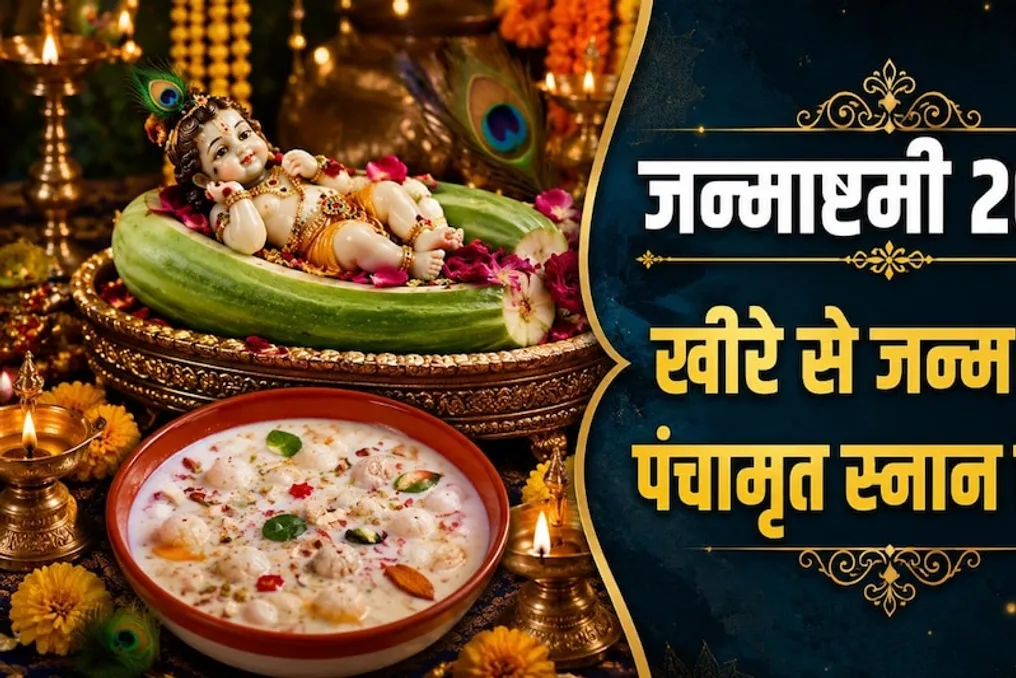
Currently, the great festival of Shri Krishna Janmashtami is being widely celebrated across the country. According to tradition, a special worship of the deity in the form of Laddu Gopal is performed during this festival. There is a belief that Lord Krishna was born in the middle of the night during the Rohini nakshatra. Therefore, on Janmashtami day, people arrange the birth of Lord Krishna at midnight during the period coinciding with the Rohini nakshatra, after which they perform the proper worship rituals.
A cucumber is used to perform the ritual of the birth of Kanhaiya. A step-by-step guide is provided for those observing the Janmashtami fast for the first time or who have not performed this rite before.
The auspicious period for celebrating Janmashtami falls on September 4th, when the Nishita Kaal will be active from 23:57 to 00:43. It is during this fortunate hour, after the deity is born from the cucumber, that the Panchamrit bath can be performed and all necessary worship can be conducted.
In Janmashtami rituals, the cucumber holds special significance. The process of cutting the cucumber stem is called Nal Chhedan and is considered a symbol of Lord Krishna's birth. Before starting the night ceremony, the cucumber should be cleaned with clean water. Then, using a coin, the cucumber stem must be cut, symbolizing the cutting of the infant's umbilical cord. After this, a small incision is made in the cucumber, and a small statue of Laddu Gopal is placed inside. Simultaneously with Kanhaiya's birth, devotees chant the greeting: 'Jai Kanhaiya Lal Ki.'
Step one: First, place Laddu Gopal in a cradle and gently massage him, then wash him with clean water.
Step two: Prepare a paste by mixing sage powder with water, and gently apply it to the child's image of the Lord. Next, take two clean vessels: place Laddu Gopal in one, and water for bathing in the other.
Step three: Add Gangajal and several Tulsi leaves to the water. Immerse the Laddu Gopal statue in this sacred water and wash it while chanting Lord Krishna's mantras.
Step four: The Panchamrit bath of Laddu Gopal should be performed following a specific sequence. First, he is washed with raw milk, and then yogurt is used.
Step five: Next, honey and pure ghee are used. The bathing process must be concluded with a wash of Gangajal.
Step six: After the bath is complete, dress Laddu Gopal in clean and beautiful clothes. Offer roses to the Lord and place a turban with a peacock feather on him.
Step seven: Finally, decorate Balu Gopal's hands with a flute. Thus, his childhood form will be ready. To conclude, perform the worship according to all rituals and offer Aarti to Lord Krishna.