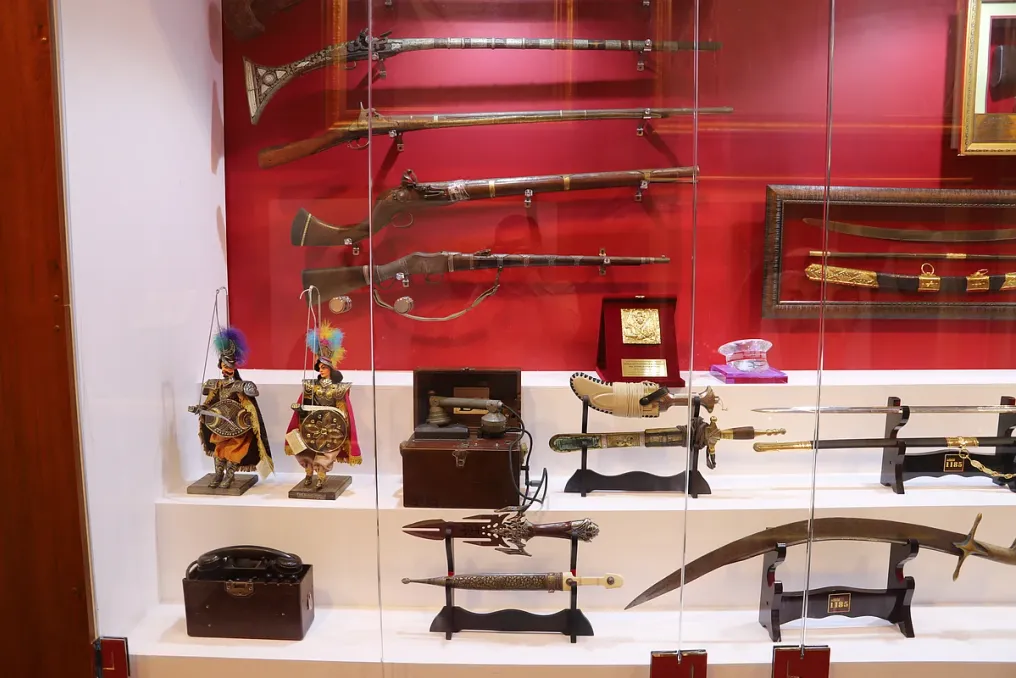
Various items, including a sword from the film 'The Lord of the Rings,' a military identification badge numbered 1185, an old UAE passport, and an 18th-century hunting rifle, may seem unrelated, yet all illustrate the history of one Emirati general.
At the Abu Dhabi International Hunting and Equestrian Exhibition (Adihex) 2026, the Museum 1185 showcases a selection of exhibits from the extensive private collection of General Obaid Al Ketbi in a small red corridor-style stand. This collection comprises over 15,000 items and includes souvenirs from more than 160 countries. Previously displayed at the Al Ketbi home in Abu Dhabi, the Adihex exhibition features a smaller set of objects reflecting his military, diplomatic, sporting, and humanitarian career.
Museum curator Abdulwahhab Bulabrouf stated that many exhibits are personal belongings or gifts received by Al Ketbi during his service, which began as a second lieutenant in the UAE Armed Forces, after which he held high military and police positions, as well as participating in diplomatic and governmental activities.
The number 1185 is central to the collection's identity. It was a military number assigned to Al Ketbi upon graduation from Zayed Military College in 1976. According to Bulabrouf, the military ID badge with this number also recorded his blood type and was intended for identifying soldiers in the field; he still wears it as a pendant.
The museum's name is a tribute to this number and, according to the museum, to the investment and support of the people by the UAE. The collection description characterizes it as a chronology of success for both an individual and the nation that supported him.
Not all items in the collection have a grand military or diplomatic history. For instance, an Australian security officer's hat recalls an unforeseen moment during Al Ketbi's tenure as UAE Ambassador to Australia. When his official motorcade stopped due to a kangaroo crossing the road, the security officer responsible for the convoy stepped out and presented Al Ketbi with his hat as an apology for the delay. The hat remains in the collection as a souvenir from that mission.
Al Ketbi served as the UAE Ambassador to Australia from 2015 to 2018, during which time he also contributed to the development of sports diplomacy between the two nations.
A wall of photographs, paintings, and documents in the stand allows visitors to go back much further, to the UAE's humanitarian operation during the Kosovo War in 1999. The materials document the UAE's participation in supporting Kosovar refugees, including a camp established near Kukës in Albania. Al Ketbi participated in the UAE's humanitarian mission, which he previously described as a three-month assignment. The exhibition includes photos of the camp, visits by high-ranking UAE officials, and records of the operation.
One of the most touching stories is that of the first child born in the camp, named Fatima in honor of Sheikha Fatima. The materials also trace the longer history of this location, which became associated with the development of Zayed International Airport in Kukës.
For the museum, these photographs serve not only as a record of the humanitarian operation but also as a testament to Al Ketbi's personal role in one of the UAE's international missions.
Among the most striking items is an old Panasonic mobile or car phone placed in a bulky briefcase. This equipment serves as a reminder of a time when mobile communication differed drastically from modern smartphones. Al Ketbi's collection also contains an even earlier communication device—a World War II field telephone used for military communications and signaling. Comparing these two items encapsulates decades of technological change in one display case.
Next to it are a Japanese dagger and an Emirati sword associated with the Emirate's guard, now the Presidential Guard. The latter is adorned with the UAE falcon emblem. Also displayed is a UAE passport from before 1986—another seemingly ordinary item that has become part of the country's history.
Then comes an object that cannot be overlooked: a giant Guinness World Records medal related to Al Fursan. The UAE medal holds the Guinness World Record for the largest sports medal in the world. It weighs over 68.5 kg and measures 1.6 by 1.6 meters, with a four-meter ribbon. It is made of stainless steel and topped with gold.
Al Ketbi founded Al Fursan in 2008, initially with 13 members. The team later grew to 48 athletes and participated in sporting events in the UAE and abroad.
One of the most unexpected exhibits in the stand is a sword from the 'Lord of the Rings' film trilogy. According to Museum 1185, this sword is one of the 15 original swords created for the films. The collection notes that three of these 15 belong to Queen Elizabeth II, the Emperor of Japan, and former US President Barack Obama. Al Ketbi owns the fifteenth and final sword. He acquired it during a visit to New Zealand, where it was exhibited in a gallery. The other 14 swords had already been sold, and this sword was not originally intended for sale. However, after lengthy negotiations with the owners, Al Ketbi managed to acquire it. This was reported by Khaleej Times during a tour of Al Ketbi's home museum in 2021, when he described finding the sword in New Zealand and persuading the owners to sell it.
This is what makes the Adihex exhibition different from a typical military or personal collection. The items are not just valuable or unusual; they mark different chapters of one life. The 1185 badge symbolizes the start of a military career in 1976. The old passport relates to an earlier period of the UAE. The field telephone recalls another era of military communications, while the mobile phone in the briefcase shows how technology has changed throughout his life. The Australian hat captures a humorous moment from diplomacy. The photos from Kosovo preserve the humanitarian mission. The giant Al Fursan medal embodies sport and endurance, and the Lord of the Rings sword is a reminder of unexpected treasures found over decades of travel. Only a small part of this collection fits into the narrow red stand at Adihex, but each item was chosen to tell a story, as Al Ketbi often said, which is the museum's goal—to tell stories through the things he kept.