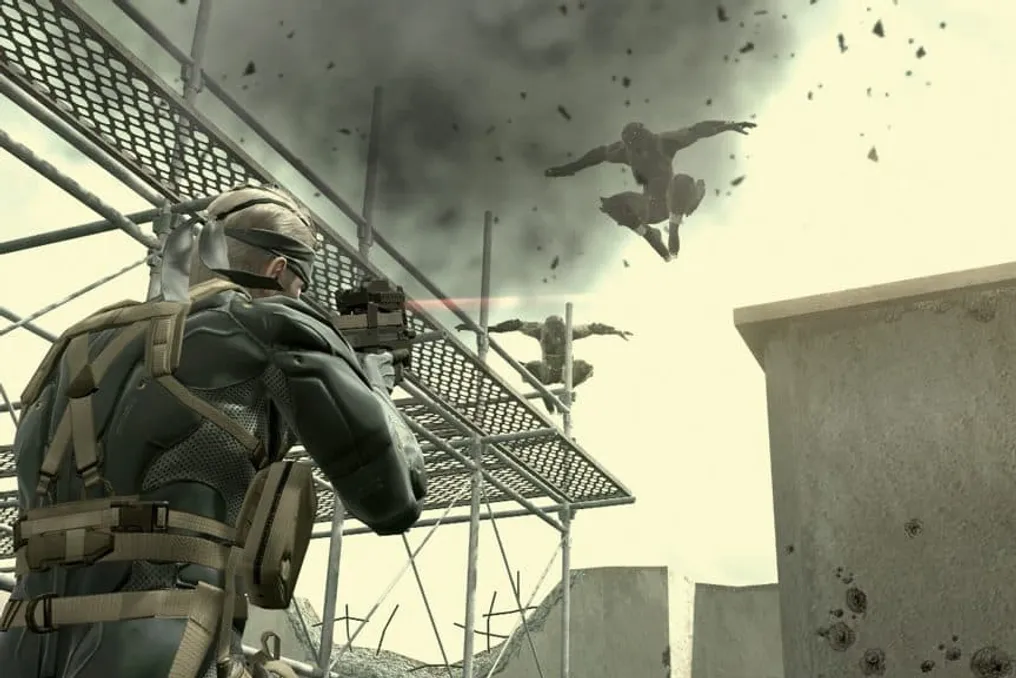
The Master Collection Metal Gear Solid Vol. 2 makes the titles Metal Gear Solid 4: Guns of the Patriots and Metal Gear Solid: Peace Walker available for current generations, which breaks the original exclusivity of Sony. Currently, the games can be found for Nintendo Switch, PlayStation 5, Nintendo Switch 2, PlayStation 4, Xbox Series X|S, and PC (only on Microsoft Windows).
Metal Gear Solid 4: Guns of the Patriots
This game continues the events of the second title in the series (with the third set decades before the first) and offers a conclusion for Solid Snake. It is a stealth game with a strong emphasis on narrative, presenting both positive and negative aspects.
The gameplay is considered quite functional, featuring practical and simple controls. The camouflage system interestingly simplifies the excess menus present in the third game, while weapon customization remains direct, maintaining its complexity. Gameplay diversity ranges from using mortars to clear paths, direct firefights, to motorcycle chases.
Some boss encounters have distinct characteristics, such as the split-screen where Snake fights robots with a giant weapon and Raiden faces Vamp with knives, in addition to battles between giant robots and exchanges of punches with the final boss. All these elements positively reinforce the stealth aspect, avoiding monotony and repetition.
Regarding graphics, which were notable in their time, they remain pleasing by current standards. Although they do not reach the level of contemporary AAA games, they function adequately and do not detract from the gaming experience.
The cinematic scenes (cutscenes) represent a problematic point: they are excessive and very long. In the introduction alone, which lasts approximately thirty minutes, there is only about two minutes of gameplay. Furthermore, each chapter begins and ends with twenty to thirty-minute cutscenes. Whenever a new character is introduced, a new 'lesson' occurs (such as with the arms dealer, which lasts 12 minutes to introduce the character). This makes the experience tedious, filled with details irrelevant to the plot, whose segments could be replaced by pure gameplay.
In terms of gameplay, despite being varied and interesting, the accessibility of the arms dealer can hinder stealth. Due to the ease and speed with which weapons and ammunition can be acquired (instantly, even during actions and fights), it is possible to trade stealth and patience for frantic firefights, which may displease fans of the stealth genre.
Finally, the narrative also has flaws. The excess of unnecessary details affects the pace, and exaggerated dramatic or comedic scenes diminish the seriousness of the plot. The critique of the military industry, imperialism, and the profitability of wars is lost amidst the artificiality and, mainly, the excessive explanations about the 'technical' aspects of the various technologies used and the multiple twists of the plot.
Metal Gear Solid: Peace Walker
Originally released for PSP, this game brought a unique approach to the franchise, focusing on multiplayer mode. This element implies significant changes compared to what is known of Metal Gear Solid, some positive and others not.
The story of Metal Gear Solid: Peace Walker is exceptionally good, rich, and engaging, serving as a direct link to Metal Gear V. It is narrated in motion comic format due to PSP limitations, but this is not bothersome; on the contrary, its grayscale art, highlighting certain colors (especially red), adds charm to the plot.
The structure of short levels, conceived with multiplayer in mind, represents a drastic but very welcome change for a series spin-off. Its division into stages is intuitive and facilitates navigation without impacting the game's pace. However, upon death, the game returns to the beginning of the stage, imposing an additional challenge within this structure.
The base building system is a robust aspect, adding an interesting layer of complexity. It is possible to recruit new characters, assign them to research, material collection, or intelligence gathering. Thus, it is also possible to develop and improve new weapons and equipment, configuring an addictive mechanic.
The game is practically unplayable using keyboard and mouse. Even with support, the controls exhibit malfunctions: the camera freezes, there is command lag, or they simply do not respond. Without a controller, Peace Walker cannot be played on PC—at least until this analysis. Not even the first introductory stage can be completed.
Quick Time Events (QTEs), notorious at the time of the initial release, are another negative point. They occur during cutscenes when the player is focused on following the story, completely interrupting the narrative rhythm. Despite this, they are occasional and do not ruin the experience.
Side missions serve solely to obtain more resources, being extremely repetitive, as are the boss fights. These latter boil down to using a bazooka against a war tank, helicopter, or advanced machinery, which act as large damage absorbers, intensifying the repetition. Repetition is even greater with grinding, which becomes essential towards the end of the game, making it impossible to proceed without completing the side missions.
The Master Collection Metal Gear Solid Vol. 2 offers a vast range of extra content. Among the items are the soundtrack of the two games, a database of the entire story up to the fourth game, a complete illustrated guide, and the entire script, in addition to Metal Gear: Ghost Babel, released for Game Boy Color.
Metal Gear: Ghost Babel
Released in 2000, Metal Gear: Ghost Babel brought the series to the Nintendo portable format. Its gameplay style is viewed from above, reminiscent of the early games in the series, such as those on the MSX and NES (Nintendo). Unlike these classics, its mechanics are slightly more elaborate, partially recalling the first Metal Gear Solid.
Despite its simplicity, it is not a short game by the standards of 2000s handhelds. It has about six to eight hours of duration, distributed between gameplay and cutscenes, which are displayed through the communicator, using basically character photos and text of their dialogue (the technology of the time did not support spoken dialogues on a portable).
In summary, the Master Collection Metal Gear Solid Vol. 2 is a modest compilation, containing only three games, but it offers great value. It brings two high-quality titles in many aspects, previously restricted to PS3 and PSP (in addition to a bonus game for series fans). It is an essential acquisition for Metal Gear series admirers, and may also please those who appreciate stealth and/or espionage, criticism, and political themes. However, it is recommended to be prepared for long cutscenes in Metal Gear 4 and to have a controller if you wish to play Peace Walker on PC.