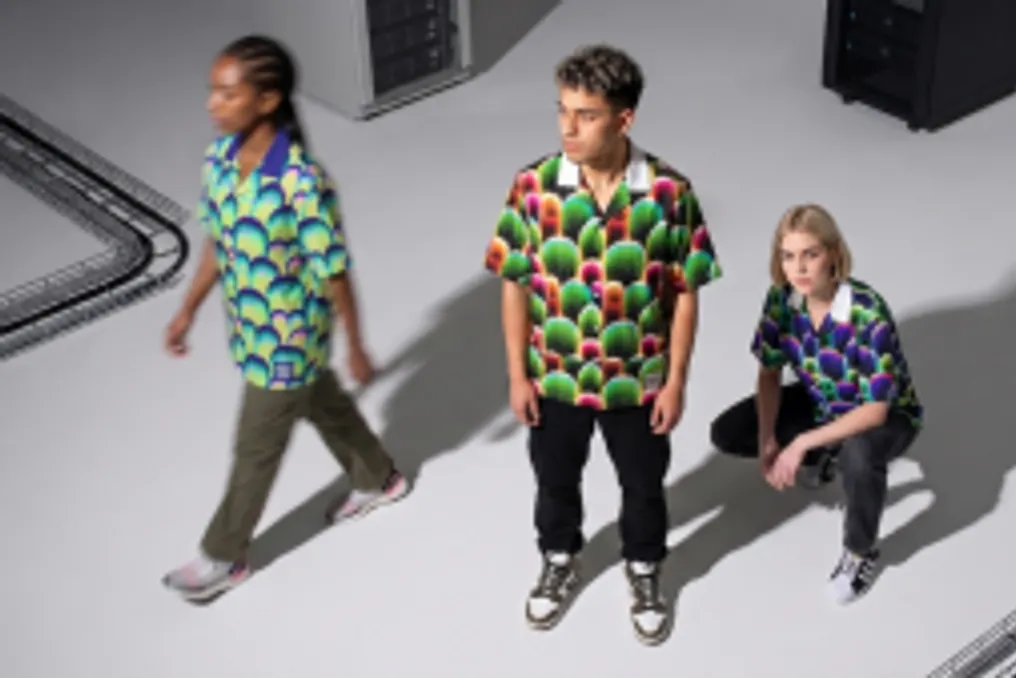
Due to the growing prevalence of artificial intelligence detection systems, German designer Simon Weckert has developed a shirt designed to disrupt human recognition by digital surveillance systems.
At a quick glance, the bright shirt appears as a geometric shape in green, pink, and orange tones, but beneath this striking aesthetic lies a mathematically optimized pattern created to disorient AI systems.
AI detection systems identify objects by analyzing statistical relationships between elements such as textures, edges, and colors; Weckert interrupts this process with his pattern design.
Testing has shown that this shirt is capable of interfering with the open-source YOLO object detection system, reducing its ability to identify the person wearing it.
This piece of clothing creates a dialogue between the real world and the digital experience, as it is perceived differently depending on the observer: for people, it is an expression of fashion choice, while for digital algorithms, it is visual noise.
The 'Digital Camouflage' design concept is a provocation, not a universal solution, turning clothing into a tool for challenging machine vision and privacy issues.