Paleontologists and physicists have discovered evidence regarding the possible cause of death of the largest registered tyrannosaur. The fossil, known as Scotty, preserved for 66 million years, had a rib fracture that likely occurred after a collision with another dinosaur.
This damage revealed an even rarer find: a network of mineralized blood vessels preserved in the bone. The structure was identified using imaging techniques that allowed the study of the fossil without damaging it.
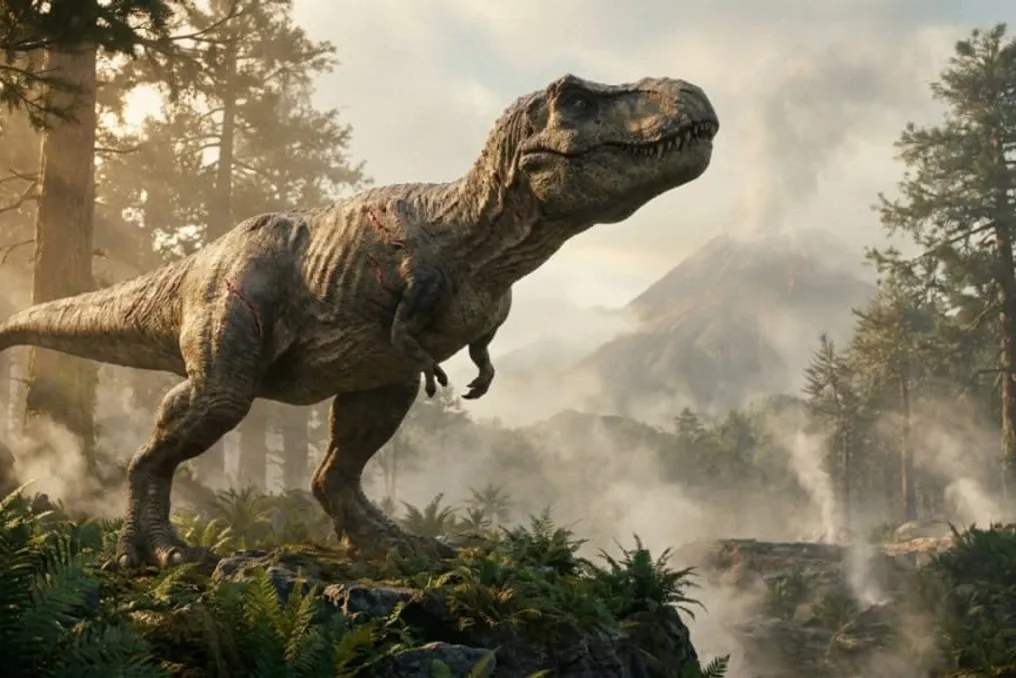
Scotty, which reached about 4 meters high at the hip, over 13 meters long, and weighed approximately 8.8 tons, is the largest known T. rex. As with many other specimens of this species, it was impossible to reliably determine whether the animal was male or female.
However, size is not the most striking feature of this specimen. On the fractured rib, researchers found an extensive network of mineralized blood vessels. The preservation of soft tissues over tens of millions of years is extremely rare in paleontology.
The preservation also helps reconstruct events that might have happened to the animal. After the rib broke, the damaged area was covered with iron-rich blood. The organism reacted by forming small blood vessels to accelerate the healing process.
As Mauricio Barbí noted, a physicist from the University of Regina, it is like winning the lottery: Scotty's rib contains an extensive network of mineralized blood vessels that has never been observed in any fossil before.
The fracture indicates that Scotty may have sustained an injury during a fight with another dinosaur. Nevertheless, the healing response was insufficient. The animal died shortly thereafter in a salt marsh, where environmental conditions slowed down the decomposition process.
Researchers from the Oak Ridge National Laboratory in the United States used neutron imaging combined with other methods to study the rib. This method also helped confirm previously made discoveries using synchrotron radiation.
More details:
Marcella Berg, a physicist from the University of Regina, explained: 'Neutrons not only confirmed what we found using synchrotron radiation methods, which led to the discovery of blood vessels on Scotty's rib.' She added: 'They also proved to be an extremely valuable addition to our current research on soft tissue preservation in fossils.'
The Scotty case demonstrates how an injury recorded in the bone can preserve clues about the final moments of an animal that lived 66 million years ago. Thanks to non-destructive imaging methods, researchers can now study these structures without endangering the fossil itself.