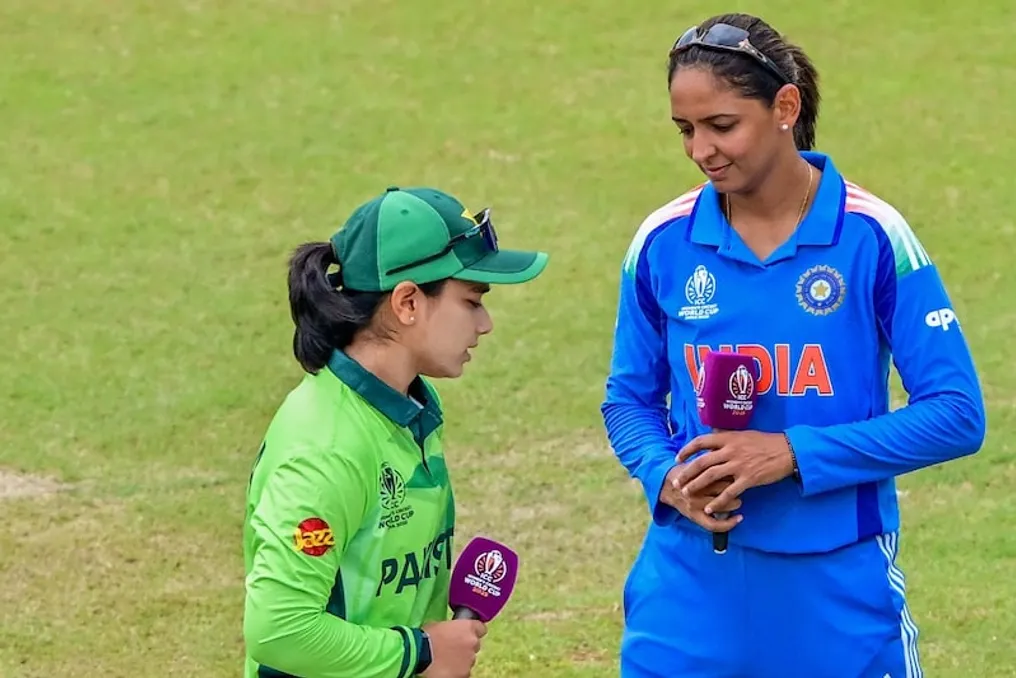
The Indian team is preparing for the match against the Pakistani team in the Women's Asia Cup, which will take place at the Dubai International Stadium on Saturday (September 5th) at 20:00. Although India's tickets for the semi-finals are already guaranteed, the game against Pakistan will remain extremely important for the Indian team.
In this confrontation, the Harmanpreet Kaur team is considered a strong favorite based on statistical data from overall T20 matches. Although tensions between India and Pakistan are always high off the field, there has been a decrease in the expected intense competition in recent multi-team tournaments. Under current conditions, India appears significantly stronger than Pakistan on paper.
Nevertheless, for India, this match is not just another league fixture. The team needs to improve its performance in several aspects in the shortest format (T20), as India eliminated early in previous World Cups. To challenge the dominance of strong teams like Australia, India will need to form a powerful lineup of aggressive batters and fast bowlers.
In the context of Asian cricket, India's dominance is obvious, and currently, there is no team that can compare to India. However, in the past Asia Cup, India became the runner-up, losing the final in Sri Lanka. Pakistan's situation is different: they won their opening match against Thailand and remain in the race for a semi-final spot, making the game against India very significant for them.
India's main strength currently lies in its opening pair: Smriti Mandhana and Shafali Verma, both of whom are in excellent form. Mandhana, in particular, noted a memorable century in the match against Hong Kong, clearly showing all tournament teams the level of form of the Indian opening batters.
Despite the playing conditions at the Dubai grounds not being easy, the batters needed time to understand the environment. Usually, after the game, players acclimatize to the pace and bounce of the pitch in about 10 overs, and then continue their innings accordingly. Mandhana and Shafali used the same approach against Hong Kong, first studying the field and then building a solid foundation for the Indian innings.
One of the problems for India is also the number three position. Pratiksha Rawal constantly faces difficulties in the T20 format. Although she achieved significant success in ODIs, her performance so far does not meet the requirements of the short format, increasing the pressure on her. Furthermore, Richa Ghosh and captain Harmanpreet Kaur have not yet managed to convert opportunities into big scores. Both batters started but could not stay on the field for long. The team management hopes that these players will spend more time in the middle overs and turn their starts into big innings.
The addition of Nandini Sharma to the Indian fast bowling has been a positive sign for the team. She is performing according to her capabilities and working with experienced fast bowler Kranti Gaur. To challenge teams like Australia, India needs to prepare more options in fast bowling. Thus, Nandini's good play can be considered important for future tournaments.
The biggest challenge for the Pakistani team against India is its batting. In recent years, their batting unit has often disappointed. Against such a strong team as India, this weakness could prove very costly. Even in the previous match against Thailand, Pakistan's start was not the best when they lost three wickets in the powerplay over. Nevertheless, they managed to successfully defend the score of 119 runs.
However, defending such a small total against India will be much harder. Currently, the Pakistani team heavily relies on its openers Munib Ali and captain and all-rounder Fatima Sana. If Pakistan wants to challenge India, the other batters must also take responsibility, as it will be difficult to play against such a strong team relying only on Munib and Fatima.
A total of 17 matches have been played between India and Pakistan in women's cricket: India has won 14, and Pakistan has won 3.
>